Research & Development World

  • R&D World Home
  • Topics
    • Aerospace
    • Automotive
    • Biotech
    • Careers
    • Chemistry
    • Environment
    • Energy
    • Life Science
    • Material Science
    • R&D Management
    • Physics
  • Technology
    • 3D Printing
    • A.I./Robotics
    • Software
    • Battery Technology
    • Controlled Environments
      • Cleanrooms
      • Graphene
      • Lasers
      • Regulations/Standards
      • Sensors
    • Imaging
    • Nanotechnology
    • Scientific Computing
      • Big Data
      • HPC/Supercomputing
      • Informatics
      • Security
    • Semiconductors
  • R&D Market Pulse
  • R&D 100
    • 2026 R&D 100 Award Winners
    • 2026 Professional Award Winners
    • 2026 Special Recognition Winners
    • R&D 100 Awards Event
    • R&D 100 Submissions
    • Winner Archive
  • Resources
    • Research Reports
    • Digital Issues
    • Educational Assets
    • Subscribe
    • Video
    • Webinars
    • PharmSci360
    • Content submission guidelines for R&D World
  • Global Funding Forecast
  • Top Labs
  • Advertise
  • SUBSCRIBE

OpenAI says GPT-6 Astra designed a talking Codex “pet.” Manufacturing took several rounds

By Brian Buntz | November 3, 2026

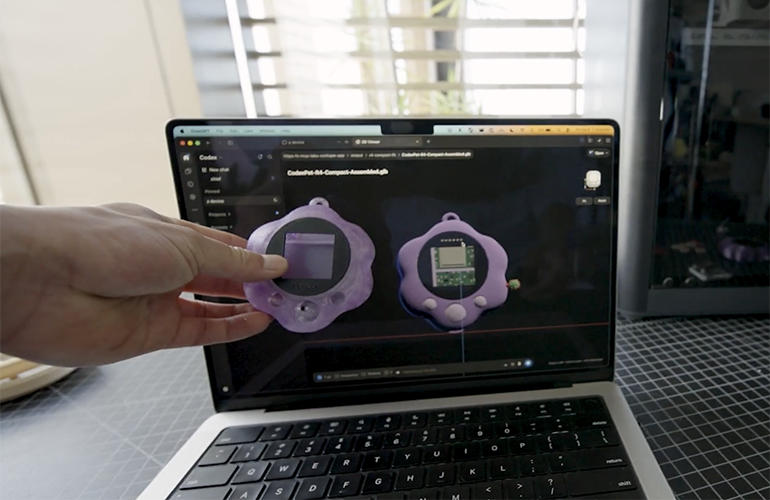
[From the OpenAI video]

A push-to-talk button and a small display give Justin Lin a way to check on his coding agents without opening his laptop. The OpenAI researcher calls the prototype a “Codex pet.” Its enclosure, circuit board and firmware came from GPT-6 Astra, OpenAI said Nov. 3, in an experiment that took a first-time board builder from plans to assembled hardware.

Two team members worked with Astra  modelon the side project for less than a week, and a contract manufacturer built a small batch of prototypes in under a month. OpenAI says the team generated the designs without direct human edits with some rounds of review and iteration to prepare them for manufacturing. “Obviously, took a few rounds with the factory, but this is what came back,” Lin said in a video about the project.

A desk companion for coding agents

Lin said he built the device to show Astra’s computer-use skills alongside “some of the new physical engineering capabilities.” The inspiration came in part from the growing trend of using voice to speak to agents while having some UI friction of its own. “I really, really don’t like having to like open my laptop and like whisper my sweet nothings into Codex,” he said. He wanted “a Codex pet” that lives on a small display, with a push-to-talk button.

Lin said it was his first time taking a board from bare to assembled, which he called “super daunting.” “I told Chat what I wanted, gave it some plans, and it designed the board,” he said.

The experiment sits within a broader hardware push that includes a design collaboration with former Apple design chief Jony Ive and his firm LoveFrom. For this prototype, OpenAI credits Astra with the design work and cites keyboard maker Work Louder, games and toys as visual references.

From design files to assembled hardware

According to OpenAI, Astra defined the functional requirements, designed the case and the internal structures that hold the components, selected the electrical components, and placed and connected them on a printed circuit board sized to fit the enclosure. It also designed the user interface and generated the firmware and software integrations that connect the device to Codex. OpenAI labels the images “TamaGPT device experiments” and describes the result as a “test device.”

A separate September test by circuit-board manufacturer NextPCB illustrates how specialist software can contribute to that work. Hubert Hu, its head of technology, gave Astra a board with components already placed. Astra produced a routing result in about 12 minutes by passing the design to Freerouting, an open-source autorouter, then importing it back into KiCad, the electronics design software. Restricted to KiCad’s interface, it drew three short trace segments in an hour before Hu stopped the run. “Freerouting performed the core routing computation. Astra orchestrated the workflow,” NextPCB wrote.

Tell Us What You Think! Cancel reply

You must be logged in to post a comment.

Related Articles Read More >

RLWRLD names former IBM consulting executive COO to advance robotics commercialization
Line chart of the share of Anthropic's model R&D work that Claude leads, rated AL4 on Epoch AI's automation scale: under 1% in February 2026, 1% in March, 3% in April, 12% in May, 14% in June, 22% in July and 26% in August
After spending tens of billions on R&D, Anthropic sees reasons to slow its pursuit of self-improving AI
Heatmaps of first-layer weight strength for four game-playing networks; Breakout's paddle row, Pong's paddle column and Pac-Man's maze show up in the weights
MIT team says GPT-6 Astra can improve other AI models by editing their weights. Critics say its biggest result relied on standard ML engineering.
Palantir wants to dominate AI. Anthropic spent 43 times as much on R&D in Q3.
rd newsletter
EXPAND YOUR KNOWLEDGE AND STAY CONNECTED
Get the latest info on technologies, trends, and strategies in Research & Development.

R&D World Digital Issues

Fall 2026 issue

Browse the most current issue of R&D World and back issues in an easy to use high quality format. Clip, share and download with the leading R&D magazine today.

R&D 100 Awards
Research & Development World
  • Subscribe to R&D World Magazine
  • Sign up for R&D World’s newsletter
  • Contact Us
  • About Us
  • Drug Discovery & Development
  • Pharmaceutical Processing
  • Global Funding Forecast

Copyright © 2026 Arrowfly LLC. All Rights Reserved. The material on this site may not be reproduced, distributed, transmitted, cached or otherwise used, except with the prior written permission of Arrowfly
Privacy Policy | Advertising | About Us

Search R&D World

  • R&D World Home
  • Topics
    • Aerospace
    • Automotive
    • Biotech
    • Careers
    • Chemistry
    • Environment
    • Energy
    • Life Science
    • Material Science
    • R&D Management
    • Physics
  • Technology
    • 3D Printing
    • A.I./Robotics
    • Software
    • Battery Technology
    • Controlled Environments
      • Cleanrooms
      • Graphene
      • Lasers
      • Regulations/Standards
      • Sensors
    • Imaging
    • Nanotechnology
    • Scientific Computing
      • Big Data
      • HPC/Supercomputing
      • Informatics
      • Security
    • Semiconductors
  • R&D Market Pulse
  • R&D 100
    • 2026 R&D 100 Award Winners
    • 2026 Professional Award Winners
    • 2026 Special Recognition Winners
    • R&D 100 Awards Event
    • R&D 100 Submissions
    • Winner Archive
  • Resources
    • Research Reports
    • Digital Issues
    • Educational Assets
    • Subscribe
    • Video
    • Webinars
    • PharmSci360
    • Content submission guidelines for R&D World
  • Global Funding Forecast
  • Top Labs
  • Advertise
  • SUBSCRIBE