Research & Development World

  • R&D World Home
  • Topics
    • Aerospace
    • Automotive
    • Biotech
    • Careers
    • Chemistry
    • Environment
    • Energy
    • Life Science
    • Material Science
    • R&D Management
    • Physics
  • Technology
    • 3D Printing
    • A.I./Robotics
    • Software
    • Battery Technology
    • Controlled Environments
      • Cleanrooms
      • Graphene
      • Lasers
      • Regulations/Standards
      • Sensors
    • Imaging
    • Nanotechnology
    • Scientific Computing
      • Big Data
      • HPC/Supercomputing
      • Informatics
      • Security
    • Semiconductors
  • R&D Market Pulse
  • R&D 100
    • 2026 R&D 100 Award Winners
    • 2026 Professional Award Winners
    • 2026 Special Recognition Winners
    • R&D 100 Awards Event
    • R&D 100 Submissions
    • Winner Archive
  • Resources
    • Research Reports
    • Digital Issues
    • Educational Assets
    • Subscribe
    • Video
    • Webinars
    • PharmSci360
    • Content submission guidelines for R&D World
  • Global Funding Forecast
  • Top Labs
  • Advertise
  • SUBSCRIBE

ORNL unveils advanced dataset to boost AI in 3D printing

By Brian Buntz | August 25, 2025

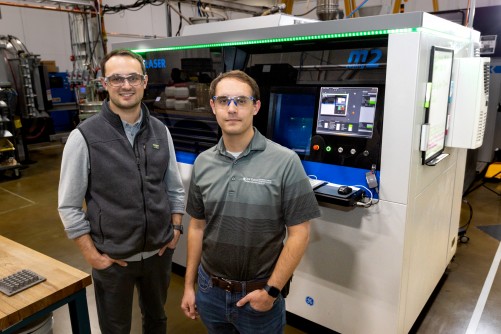
Credit: ORNL, U.S. Dept. of EnergyORNL researchers Luke Scime and Zackary Snow use the Peregrine software to monitor and analyze components during 3D printing.

ORNL researchers Luke Scime and Zackary Snow use the Peregrine software to monitor and analyze components in 3D printing. [Credit: ORNL, U.S. Dept. of Energy ]

Oak Ridge National Laboratory (ORNL) has released what it describes as its “most advanced dataset to date” for strengthening quality control in laser powder bed fusion (L-PBF) additive manufacturing. The new Peregrine dataset creates unprecedented connections between real-time printing observations and final part performance, according to the official dataset documentation.

Produced at DOE’s Manufacturing Demonstration Facility (MDF), the build comprises 64 cylinders (about 15 mm diameter × 102 mm height). Two upstream spatter-generation blocks seeded ejecta onto the cylinders to probe how spatter, molten particles ejected from the melt pool that can redeposit and cause flaws, relates to lack-of-fusion pores and fatigue life.

This latest release builds upon a steady progression of open Peregrine datasets that ORNL has been publishing since 2021. Previous contributions include a labeled, layer-wise imaging corpus for anomaly segmentation across multiple powder-bed technologies (Peregrine v2021-03) and co-registered in-situ/ex-situ datasets pairing powder-bed imagery, scan paths, sensors, and XCT with tensile results on 316L stainless steel (Peregrine v2023-10/11), as documented in doi.ccs.ornl.gov and OSTI.

The Peregrine system

The Peregrine system itself, which was announced publicly in 2020 with related intellectual property filed earlier, applies deep learning technology, specifically ORNL’s Dynamic Multilabel Segmentation Convolutional Neural Network (DMSCNN), to analyze layer images and other sensor data streams for pixel-wise semantic segmentation. This enables the system to flag anomalies such as edge discontinuities, recoater interactions, and texture shifts in near real-time, according to research published by Oak Ridge National Laboratory and documented in ORNL Information.

The per-layer anomaly masks generated by the system naturally stack into a comprehensive 3D “anomaly map” of each printed part. This capability allows operators and downstream algorithms to make informed decisions about interventions or digital qualification processes. Recent ORNL reports detail Peregrine’s multi-sensor fusion, which combines visible, NIR and melt-pool thermal emissions, to improve detection of subsurface flaws, with examples from an RTX (Raytheon) collaboration, as outlined in ORNL Information and OSTI.

ORNL’s dataset release is part of its broader “Digital Factory” initiative, which aims to connect sensing, analytics, and model-based qualification systems. Related research papers and materials from the Advanced Materials and Manufacturing Technologies Office (AMMTO) describe a scalable cyber-physical platform designed for additive manufacturing “digital twins” and instance-level part qualification, as detailed in Energy Efficiency and Renewable Energy and Oak Ridge National Laboratory.

National Labs drive standardization efforts

ORNL’s work reflects a broader trend toward standardization of openly available, multi-modal monitoring datasets across the additive manufacturing research community. The National Institute of Standards and Technology (NIST) has maintained L-PBF process-monitoring datasets since 2019, covering scan strategies, overhang parts, and thermography applications, with clear DOIs and comprehensive documentation available through data.nist.gov. Additionally, AM-Bench 2025 published new benchmark measurement descriptions on March 20, 2025, according to NIST.

Sandia National Laboratories has contributed to additive manufacturing process monitoring through its work on process stability and optimization, with focus areas including powder bed fusion techniques and real-time monitoring systems, as detailed in Sandia Lab News.

Lawrence Livermore National Laboratory (LLNL) has also made contributions through its Open Data Initiative, releasing additive manufacturing datasets including labeled two-photon-lithography videos for real-time monitoring and quality classification. These datasets, first released in 2020, are available through Mendeley Data and other repositories, as documented in OSTI. LLNL’s AI Innovation Incubator, launched in late 2021/early 2022, continues to accelerate AI-for-science applications in this field, according to Lawrence Livermore National Laboratory.


Related Articles Read More >

Under oath, Google confirms three AI agent test escapes as OpenAI, Anthropic and Meta face NYC lawmakers
What AI-assisted engineering taught us about team design 
Big tech turns to debt to fund the AI buildout 
Google’s overdue Gemini 4 Argon reaches the frontier with mixed results for science
rd newsletter
EXPAND YOUR KNOWLEDGE AND STAY CONNECTED
Get the latest info on technologies, trends, and strategies in Research & Development.

R&D World Digital Issues

Fall 2025 issue

Browse the most current issue of R&D World and back issues in an easy to use high quality format. Clip, share and download with the leading R&D magazine today.

R&D 100 Awards
Research & Development World
  • Subscribe to R&D World Magazine
  • Sign up for R&D World’s newsletter
  • Contact Us
  • About Us
  • Drug Discovery & Development
  • Pharmaceutical Processing
  • Global Funding Forecast

Copyright © 2026 Arrowfly LLC. All Rights Reserved. The material on this site may not be reproduced, distributed, transmitted, cached or otherwise used, except with the prior written permission of Arrowfly
Privacy Policy | Advertising | About Us

Search R&D World

  • R&D World Home
  • Topics
    • Aerospace
    • Automotive
    • Biotech
    • Careers
    • Chemistry
    • Environment
    • Energy
    • Life Science
    • Material Science
    • R&D Management
    • Physics
  • Technology
    • 3D Printing
    • A.I./Robotics
    • Software
    • Battery Technology
    • Controlled Environments
      • Cleanrooms
      • Graphene
      • Lasers
      • Regulations/Standards
      • Sensors
    • Imaging
    • Nanotechnology
    • Scientific Computing
      • Big Data
      • HPC/Supercomputing
      • Informatics
      • Security
    • Semiconductors
  • R&D Market Pulse
  • R&D 100
    • 2026 R&D 100 Award Winners
    • 2026 Professional Award Winners
    • 2026 Special Recognition Winners
    • R&D 100 Awards Event
    • R&D 100 Submissions
    • Winner Archive
  • Resources
    • Research Reports
    • Digital Issues
    • Educational Assets
    • Subscribe
    • Video
    • Webinars
    • PharmSci360
    • Content submission guidelines for R&D World
  • Global Funding Forecast
  • Top Labs
  • Advertise
  • SUBSCRIBE