Hyperscalers, the largest cloud computing companies, are borrowing at record levels to build data centers. AI-related debt issuance reached nearly $500 billion in 2026 by early August, according to Goldman Sachs.
That buildout is aimed at commercial customers and the companies’ own AI products, and it has done little so far to ease the compute shortage facing academic researchers. As interest in using compute-heavy AI techniques grows in academia and in research at large, access to cutting-edge compute remains constrained. For example, a 2024 survey of academic AI researchers found 85% reported zero cloud compute budget, and the typical researcher could use about 4 GPUs for a few days at a time. Two-thirds said that kept them from running some experiments they wanted to. The Digital Research Alliance of Canada, which runs national computing for Canadian universities, awarded only about 31% of the GPU time requested in 2025.
Big Tech raised a record $108 billion in debt in 2025, more than three times the average over the previous nine years, according to Nomura. Goldman Sachs estimated about 40% of this year’s AI-related debt supply has been issued directly by hyperscalers, including Amazon, Microsoft and Alphabet.
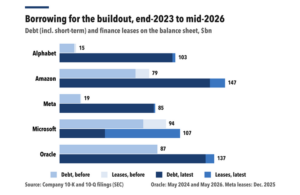
Alphabet’s debt is up to about $100 billion. The company says most of its capital spending goes to technical infrastructure, roughly 60% to servers and 40% to data centers and networking equipment. In February, CFO Anat Ashkenazi said the spending would provide compute for Google DeepMind, the AI arm of Alphabet, to meet cloud customer demand and fund “other bets.” More recently, in July, the company raised its 2026 capex outlook to $195 billion to $205 billion, from $180 billion to $190 billion.
Similarly, Amazon now expects about $220 billion in 2026 cash capex, $20 billion more than planned, which it attributed to rising memory prices. Like others, the company is expanding its data center infrastructure, buying Nvidia and AMD GPUs to power the centers.
While competitor Microsoft has less debt than other hyperscalers, it also has more finance leases, most of which are data centers. About two thirds of the company’s fourth quarter capex went to short-lived assets like CPUs and GPUs, the rest went to data center infrastructure. Microsoft is shifting future data center leases from finance leases to operating leases, the company said in its fourth quarter earnings call, which lowers expected reported 2026 capex to about $175 billion from about $190 billion without changing its investment plans.
Second only to Amazon, Oracle has racked up about $137 billion in debt and leases. S&P estimates that about half of Oracle’s $638 billion backlog comes from OpenAI. In September 2025, Oracle reportedly signed a five-year cloud deal with OpenAI worth about $300 billion that starts in 2027 and covers 4.5 gigawatts of computing capacity. OpenAI itself reportedly had no debt as of March 31, 2026, and less than $750 million in lease obligations. But that figure understates OpenAI’s exposure. The companies financing its expansion, including Oracle and SoftBank, are increasingly borrowing to do it. For instance, SoftBank secured a $40 billion bridge loan in March to fund OpenAI investments and general corporate purposes.



Tell Us What You Think!
You must be logged in to post a comment.