 The ChatGPT-maker OpenAI will license Synopsys’ chip design software to develop GPT-Synopsys, a specialized AI model the companies plan to sell through a service bundling computing, model access and software licenses. The partnership centers on pairing OpenAI’s frontier AI models with Synopsys’ Electronic Design Automation (EDA) software.
The multiyear agreement announced Sept. 30, alongside Synopsys’ Investor Day, describes the companies as preferred partners and includes joint commercialization and revenue sharing.
An investor presentation from Synopsys identifies a two-pronged revenue model. One dimension involves tool subscriptions related to frontier model training while the second covers tool subscriptions or consumption charges as well as revenue sharing from the use of those models.
At the Investor Day in New York, CEO Sassine Ghazi described AI as “creating multiple, reinforcing growth engines for Synopsys,” with frontier models driving demand for compute while making systems more complex. Those forces, he said, are “expanding our addressable market, increasing consumption of our technology, and creating new, recurring revenue streams.” CFO Shelagh Glaser said the company’s updated financial framework assumes it can scale efficiently while helping customers “re-engineer their engineering to accelerate AI-powered products.”
Synopsys is steadily ratcheting up its focus on AI. Earlier this week, it introduced AgentEngineer, which it calls “domain-specific long-horizon agents,” capable of autonomously running complex workflows across verification, implementation, simulation and manufacturing. The agents are built on its new Autopilot Platform, which handles orchestration, memory and governance. Availability is planned for the end of 2026. Ghazi said physical AI and agentic workflows are “driving deeper integration of our trusted tools.”
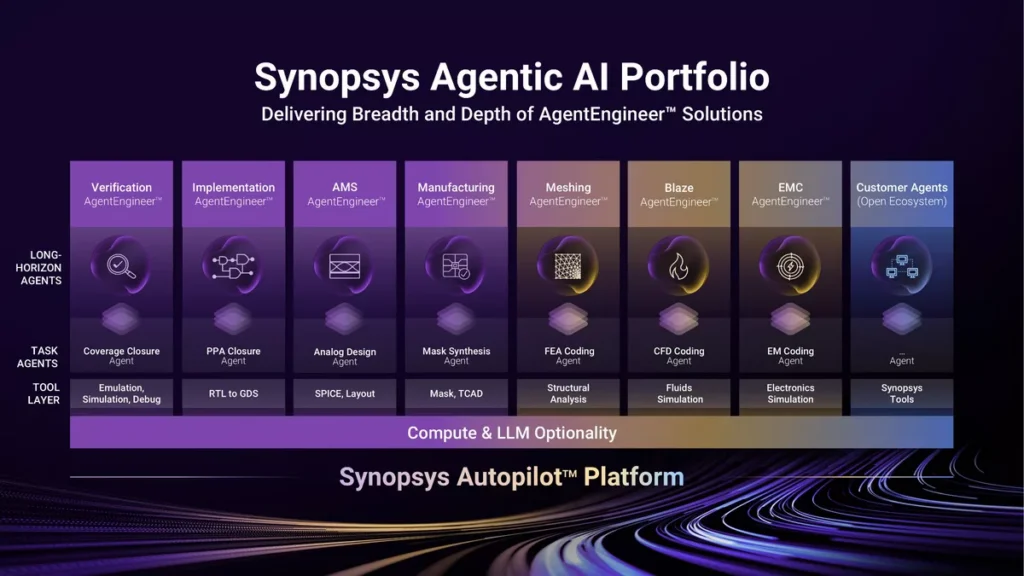
In July, Synopsys demonstrated a long-running chip verification agent built with Nvidia technology. Its coordinating agent took a chip’s specification, design and test repository, then assigned work to specialized agents and tools through test planning, debugging and coverage closure, the process of meeting verification targets.
Synopsys’ Multiphysics Fusion tools, made available in June, incorporate effects such as temperature and voltage drop into timing analysis because those effects can change whether signals arrive when required. Integrating these checks earlier helps engineers evaluate a change against physical conditions rather than discovering a problem late in development. In the press release, Samsung’s foundry design technology head, Hyung-Ock Kim, said accurate signoff at advanced nodes needs to account for IR drop, thermal and stress effects “directly within timing analysis.”
Synopsys has also extended alliances with other key partners recently. For instance, after more than 15 years of collaboration, Amazon and Synopsys announced a separate agreement the same day as the OpenAI deal. The multiyear deal, valued at more than $1 billion, makes Amazon the lead customer for Synopsys’ application-optimized silicon intellectual property, reusable design technology tailored to particular workloads. The deal fits Ghazi’s argument that “purpose-built silicon is reshaping the IP market.” It adds royalties to licensing, giving Synopsys a way to earn more as chip production grows. The announcement does not disclose a royalty rate or payment schedule.
Amazon also expands its use of Synopsys engineering software, while Synopsys adopts AWS computing, storage and Bedrock services for its own development. The companies plan to accelerate multiphysics software on Amazon’s Trainium and Graviton chips. These reciprocal commitments concern custom silicon and engineering infrastructure; the Amazon announcement does not identify the company as a GPT-Synopsys customer.
Synopsys is also a close partner with Nvidia, the company at the center of much of the current AI wave. Nvidia bought $2 billion of newly issued Synopsys shares in December 2025. Their nonexclusive agreement combines accelerated engineering software and agent development with joint sales efforts through Synopsys’ customer network. Nvidia supplies computing technology and capital; Synopsys supplies engineering applications and a route to their users.
GPT-Synopsys will run on OpenAI infrastructure, according to the companies, which say customer data will not train the model. Early customer engagements are underway. The announcement provides neither a general availability date nor numerical GPT-Synopsys results, and it leaves pricing and the revenue split undisclosed.


Tell Us What You Think!
You must be logged in to post a comment.