Superconducting MgB2 wire for high-efficiency electromagnets
Category: Mechanical/Materials
Developers: Hitachi, Ltd.
Co-Developers: KEK/CERN
Japan
Product Description:Hitachi has developed a superconducting 8-km-long magnesium diboride (MgB2) wire for high-efficiency superconducting electromagnets. This superconducting wire not only reduces the cooling power of the magnets for the klystron but also contributes to the energy saving of existing superconducting devices such as MRIs. It will also contribute to environmental load reduction as its application is expanded to the energy and transportation fields. The wire can be used with refrigerator-based cooling without liquid helium, a scarce resource. Using this wire, a superconducting magnet has been manufactured for use in klystrons and has achieved a magnetic field of 0.8 tesla at a temperature of 20K. Hence, the MgB2superconducting wire, which is supported by a structural ingenuity to reduce any heat invasion from the room temperature electrode to the cooling section, can be used for a superconducting magnet that keeps the superconducting state with just 3 kW or less of the power consumption by the refrigerator. This is in contrast to the conventional NbTi superconducting magnet, which would consume more than double.
Developers: Hitachi, Ltd.
Co-Developers: KEK/CERN
Japan
Product Description:Hitachi has developed a superconducting 8-km-long magnesium diboride (MgB2) wire for high-efficiency superconducting electromagnets. This superconducting wire not only reduces the cooling power of the magnets for the klystron but also contributes to the energy saving of existing superconducting devices such as MRIs. It will also contribute to environmental load reduction as its application is expanded to the energy and transportation fields. The wire can be used with refrigerator-based cooling without liquid helium, a scarce resource. Using this wire, a superconducting magnet has been manufactured for use in klystrons and has achieved a magnetic field of 0.8 tesla at a temperature of 20K. Hence, the MgB2superconducting wire, which is supported by a structural ingenuity to reduce any heat invasion from the room temperature electrode to the cooling section, can be used for a superconducting magnet that keeps the superconducting state with just 3 kW or less of the power consumption by the refrigerator. This is in contrast to the conventional NbTi superconducting magnet, which would consume more than double.
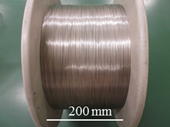
Superconducting MgB2 wire.