Next-Gen High-Performance Polyiso Foam Insulation
Category: Mechanical/Materials
Developers: Oak Ridge National Laboratory
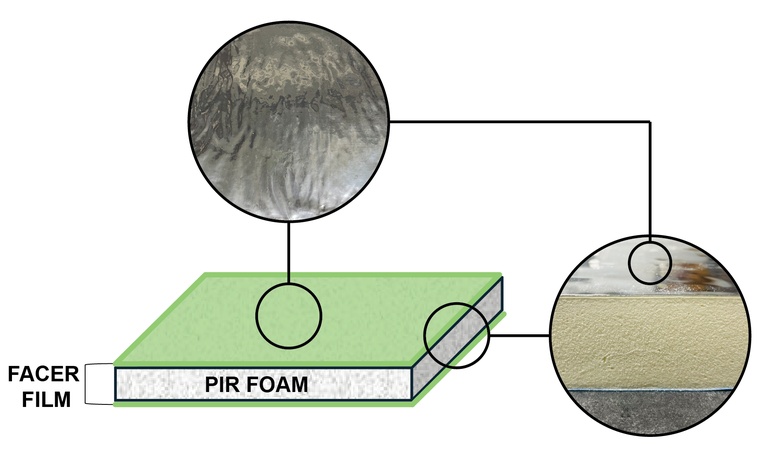
Product Description:An advanced polyisocyanurate (commonly known as polyiso or PIR) foam has an exceptional thermal resistivity (R-value) of 8.3 h·ft²·°F/BTU·in., making it 26% to 34% more resistant to heat transfer than conventional PIR insulation. Designed for efficiency, it lowers functional costs ($/ft²·R-value) by 10% and reduces assembly costs by 20%. An abstract describing the research attributes the gain to several key factors. These include the incorporation of low thermal conductivity blowing agents, tailoring the anisotropy (the vertical orientation) of the foam's cells, tuning the quantities of polymeric isocyanate, and incorporating a facer barrier. The study notes that these improvements use steps that can be easily integrated into current manufacturing processes for these foams.
Developers: Oak Ridge National Laboratory
Product Description:An advanced polyisocyanurate (commonly known as polyiso or PIR) foam has an exceptional thermal resistivity (R-value) of 8.3 h·ft²·°F/BTU·in., making it 26% to 34% more resistant to heat transfer than conventional PIR insulation. Designed for efficiency, it lowers functional costs ($/ft²·R-value) by 10% and reduces assembly costs by 20%. An abstract describing the research attributes the gain to several key factors. These include the incorporation of low thermal conductivity blowing agents, tailoring the anisotropy (the vertical orientation) of the foam's cells, tuning the quantities of polymeric isocyanate, and incorporating a facer barrier. The study notes that these improvements use steps that can be easily integrated into current manufacturing processes for these foams.