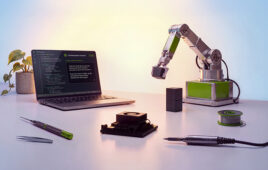
Little by little, fully autonomous cars are popping up across the world, offering consumers a truly driverless way to get from point A to B. Now, a similar transformation is emerging in laboratories worldwide. Self-driving, or autonomous, labs (SDLs) are lab facilities powered by AI, advanced computing and robotics, enabling the design and conduct of experiments autonomously with minimal to no human involvement. Nature called it one of the top technologies to watch in 2025.
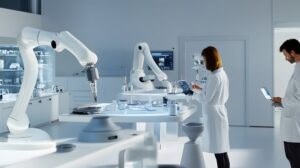
Adobe Stock
In autonomous labs, AI models design experiments from a plain language prompt, direct robotic equipment to run the experiment and collect data, and then analyze and learn from the data to propose better experimental procedures. The goal of self-driving labs is to create a closed-loop system where the AI learns from the results and improves its experimental design and predictions with every iteration.
SDLs can minimize human error and increase the reproducibility and reliability of experiments. Although building these labs and AI models will come with a steep upfront cost, they could save money in the long run by reducing waste and increasing efficiency.
Human error and paper data recording introduce barriers to the reproducibility of experiments. Autonomous labs reduce these barriers by allowing for more accurate measurements that are recorded immediately and accurately into electronic lab notebooks, as well as experimental procedures that can be reproduced at the push of a button.
Unlike human scientists, SDLs can operate 24/7, accelerating turnaround from months to days. What would take a human an entire work week to accomplish could be accomplished by an SDL working continuously in under two days. McKinsey reports that using automation in pharma could bring medicines to the market 500 days faster and reduce development costs by 25%.
Automation in labs: real examples
AI is already being used in labs to conduct autonomous experiments. Coscientist, an AI system developed by a team at Carnegie Mellon University, autonomously conducted chemistry experiments, including the reaction optimization of palladium-catalyzed cross-couplings, without human intervention. Coscientist uses large language models (LLMs) including OpenAI’s and Anthropic’s Claude models, to plan and execute experiments. The system executes the full experimental process from a plain language prompt.
In 2024, Carnegie Mellon opened the first autonomous lab at a university. The lab is part of a partnership between the university and Emerald Cloud Lab, an SDL company founded by two Carnegie Mellon alumni. The CMU Cloud Lab uses ECL software to conduct biology and chemistry experiments remotely. The lab can run more than 100 experiments simultaneously and continuously.
It’s not just lab work that is getting automated. Models like AI Scientist, from Sakana AI and “Carl” from Autoscience are among the first comprehensive systems for fully automated scientific discovery. The AI Scientist, for instance, can independently propose new machine learning research ideas, write code to test hypotheses, run experiments and report results in a research paper. The system produced multiple research papers at a cost of about $15 per paper, according to Sakana, though the papers contained some errors. Sakana says that it eventually aims to use its “proposed discovery process to produce self-improving AI research in a closed-loop system using open models.” Autoscience has shared a similar vision for creating a sort of research “factory.”
Material discovery is an active focus area of some self-driving lab research. For instance, in collaboration with the Acceleration Consortium (AC) at the University of Toronto, Merck KGaA developed the Bayesian Back End (BayBE), an AI experiment planner with a focus on chemistry and material science. BayBE, which is available open-source on GitHub, can recommend experiments and control automated equipment. Merck KGaA uses BayBE in their labs to accelerate their selection of viscosity-reducing experiments and to power a closed-loop platform that optimizes chemical reactions autonomously. The software also powers BayChem, a self-service experimental planner available to scientists at Merck KGaA.
Unilever, one of the world’s largest consumer goods companies, is using AI and robotics to complete time-consuming, repetitive jobs at high speeds, saving time and money and allowing human experts to focus on deeper, more involved tasks. The company cofounded the Materials Innovation Factory (MIF) at the University of Liverpool, which has the highest concentration of robots doing material chemistry in the world. Unilever has utilized robotics to develop several of its products, including Dove Intensive Repair Shampoo, Conditioner, and Mask, as well as Dirt is Good’s Wonder Wash.
To test the Dove Intensive hair care range, one robot prepared multiple consistent hair fiber samples in seconds, not only speeding up a tedious process, but also maintaining consistency and providing end-to-end data management. Another washed and conditioned hair, then detangled and blow-dried it, washing 120 hair samples every 24 hours. This allowed researchers to control external variables, ensuring the samples were treated in exactly the same way. In developing the Wonder Wash, robots at the MIF were able to shorten testing periods from weeks to days by operating 24/7. The robots can be programmed to mimic cycles from different types of washing machines.
Unilever is also in the process of training collaborative robots, nicknamed cobots, that are designed to work alongside human scientists. These robots will perform routine, repetitive tasks. One cobot can perform up to 200 microtitreplate scans per day. The cobots will allow scientists to focus on discovery rather than basic, time-consuming tasks.
Toward autonomous drug discovery
A group of researchers, including scientists from Insilico Medicine and the AC, used AlphaFold-based software and Insilico’s AI-powered drug discovery platform Pharma.AI, along with PandaOmics, a biocomputational engine, and Chemistry42, a generative chemistry platform, to identify a new treatment pathway for hepatocellular carcinoma (HCC). The project, with oversight from the University of Toronto’s Alán Aspuru-Guzik, Nobel laureate Michael Levitt and Insilico Medicine founder Alex Zhavoronkov, was completed in just 30 days, showing how even semi-autonomous labs can significantly shorten the timelines of drug discovery projects.
The team used PandaOmics to suggest promising targets for HCC, then used AlphaFold to predict a structure for the suggested target, CDK20. Then, Chemistry42 suggested binding sites for an inhibitor for CDK20. The system then used the predictions as guidance for compound generation, synthesis and testing.
Insilico launched Life Star in 2022, a fully automated laboratory that performs target discovery, compound screening, precision medicine development and translational research. The lab uses Insilico’s PandaOmics to predict targets for specific diseases, enabling the automated lab to conduct early-stage drug discovery experiments.
Intrepid, an SDL company spun out from the AC, has a pharmaceutical SDL, called Valiant, which works to optimize drug formulations. Valiant is a modular, autonomous lab that uses AI-powered data-driven experiment planning and robotic lab equipment to synthesize and test formulation candidates. The lab follows a closed-loop approach, retraining the ML on the resulting data from each experiment. The lab has already developed more effective options for oral drug delivery and long-acting injectable depots, according to an article from the AC. The Canadian company raised US$7 million in May.
Experiments on demand, from anywhere
Robotic cloud lab services, such as Strateos and Emerald Cloud Lab, provide remote-controlled automated labs that can be accessed remotely. These labs use AI-driven experimental design to enable autonomous experimentation on demand. Cloud-based lab services eliminate the need for organizations to construct their own autonomous labs, democratizing scientific discovery.
Researchers can submit a protocol to Strateos for review to use their automated lab remotely. After the protocol is approved, researchers can execute experiments using Strateos’ labs in California, accessing real-time camera feeds and data reports.
Autonomy, but with a learning curve
Self-driving labs largely remain an aspirational concept, and attempts to build them will require substantial human oversight. There will need to be safety restrictions that AI cannot override, such as limits on chemical quantities or temperatures. There will need to be guidelines for which decisions AI can make by itself, and which need human approval. Sensors and lab equipment will need to be routinely checked by human scientists to ensure accurate readings are fed to the AI.
AI will augment, not replace, scientists’ jobs
Some opine that integrating AI into the lab will enable scientists to focus on higher-level creative and complex objectives without wasting time on trivial tasks. Others worry that automation will make human researchers obsolete. Currently, AI struggles with some complex tasks, although it excels at coding and synthesizing information. It also cannot tell when it is wrong. As hallucinations are a major issue, at least for the present, AI needs human oversight. Additionally, most models have limited context windows and stateful memory. This means that they can only recall a certain amount of information before they struggle to retrieve older information, and they cannot remember previous sessions.
Despite its name, AI cannot think for itself. GenAI systems, for instance, are trained on vast amounts of data to fulfill users’ requests. But such AI systems struggle to create new ideas. They also cannot feel emotions, care or reason like a person would — although reasoning models attempt to replicate the process. AI depends on previous data, so it will struggle with new problems that are dissimilar to what the model has seen in its training data.
Although AI will replace some jobs, it will also create new roles, according to some pundits, while automating other tasks. Ultimately, most estimates conclude that more new jobs will be created than old jobs lost. The World Economic Forum’s Future of Jobs Report 2025 estimates that 92 million jobs will be displaced by AI by 2030. The report also estimates that AI will create 170 million jobs in that time, a net growth of 78 million jobs, or 7% of today’s total employment. Additionally, Goldman Sachs reported that AI could automate 300 million jobs globally.
According to global AI advisor Richard Foster-Fletcher, “Current AI is excellent at combining existing knowledge in new ways, but it hasn’t yet shown it can produce fundamentally new scientific concepts or transformative breakthroughs. Advanced AI is unlikely to replace scientists outright but will fundamentally reshape roles.”