Research & Development World

  • R&D World Home
  • Topics
    • Aerospace
    • Automotive
    • Biotech
    • Careers
    • Chemistry
    • Environment
    • Energy
    • Life Science
    • Material Science
    • R&D Management
    • Physics
  • Technology
    • 3D Printing
    • A.I./Robotics
    • Software
    • Battery Technology
    • Controlled Environments
      • Cleanrooms
      • Graphene
      • Lasers
      • Regulations/Standards
      • Sensors
    • Imaging
    • Nanotechnology
    • Scientific Computing
      • Big Data
      • HPC/Supercomputing
      • Informatics
      • Security
    • Semiconductors
  • R&D Market Pulse
  • R&D 100
    • 2025 R&D 100 Award Winners
    • 2025 Professional Award Winners
    • 2025 Special Recognition Winners
    • R&D 100 Awards Event
    • R&D 100 Submissions
    • Winner Archive
  • Resources
    • Research Reports
    • Digital Issues
    • Educational Assets
    • R&D Index
    • Subscribe
    • Video
    • Webinars
    • Content submission guidelines for R&D World
  • Global Funding Forecast
  • Top Labs
  • Advertise
  • SUBSCRIBE

Tailored Polymers From a Printer

By WILEY | July 6, 2018

An ever-growing number of coatings, including varnishes and printing inks, as well as tooth fillings, are cured with light. Yet, homogenous, tailored, polymer networks cannot be produced, and the materials tend to be brittle, which limits the use of photopolymers in applications like 3D printing, biomedicine, and microelectronics. In the journal Angewandte Chemie, researchers present a method by which methacrylate-based, homogenously crosslinked, tailored, tough polymers can be made – even at high resolution for 3D printing.

Light-curing is usually a radical chain polymerization. An initiator is split into radicals by light energy. These then attack the monomer, such as the C=C double bond in a vinyl group, which forms a new radical that becomes starting point of a growing polymer network by attacking more monomers and binding to them.

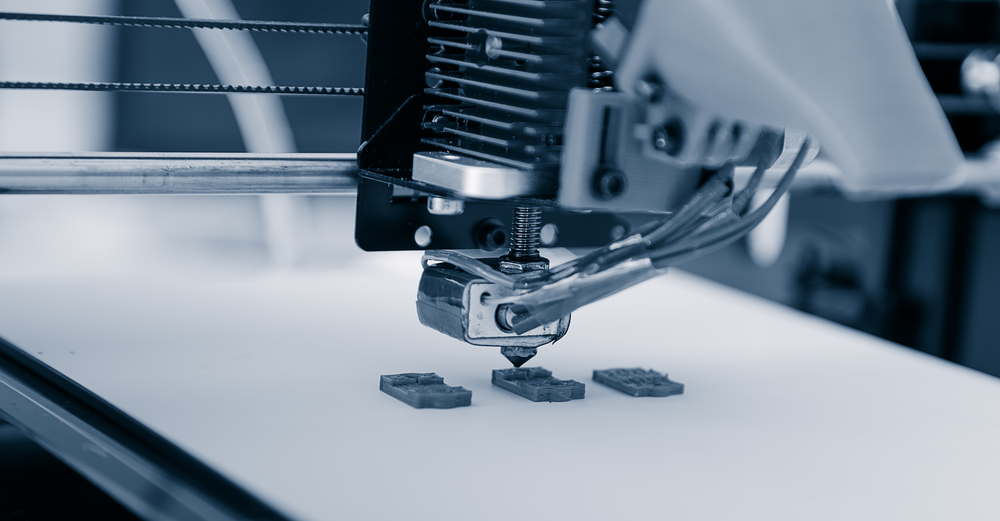
Newer methods to better control radical photopolymerization and the material properties of the products tend to slow the curing process, which is not ideal for 3D printing. A short irradiation phase is critical for high spatial resolution and economical production times.

A new approach for the tailored production of methacrylate-based photopolymers without inhibiting the curing process has been developed by a team led by Robert Liska at the Technical University of Vienna (Austria). Their success relies on the addition of an ester-activated vinyl sulfonate ester (EVS), which acts as a chain transfer agent. It is activated because it easily splits off one portion of itself.

If the growing polymer network attacks EVS instead of the next monomer, an intermediate forms and quickly splits apart to form a terminated polymer chain in the network and a highly reactive radical (tosyl radical), which starts a new chain reaction. The more EVS is added, the shorter the average chain length in the polymer network. Because shorter polymer chains remain mobile longer, the danger of shrinkage cracks during curing is significantly reduced. In contrast to conventional chain transfer agents, the polymerization is not inhibited, because there are no stable intermediates or reversible reaction steps involved. The splitting off of the tosyl radical is favored.

The researchers prepared a scaffold-like sample structure using a methacrylate copolymer. Individual layers with a thickness of 50 μm were spatially well resolved. The material is very homogenous, solid but elastic and impact resistant with high tensile strength. These properties can be adjusted by changing the amount of EVS added. Without EVS, the material was very brittle. This new approach prepares the way for tough, photopolymers for applications in biomedicine, such as shape-memory polymers for tissue growth and as fillings for teeth.

Related Articles Read More >

R&D 100 winner LLNL achieves 1,000x speed boost in 3D nanofabrication
Caltech team 3D-prints drug depots deep inside living tissue
What could make MXene a key to ultra-precise, additive-free 3D microprinting?
Industry 4.0 Modern Factory: Facility Operator Controls Workshop Production Line, Uses Computer with Screens Showing Complex UI of Machine Operation Processes, Controllers, Machinery Blueprints
Building the thinking factory: An additive exec on AI, automation, and the skills crisis
rd newsletter
EXPAND YOUR KNOWLEDGE AND STAY CONNECTED
Get the latest info on technologies, trends, and strategies in Research & Development.
RD 25 Power Index

R&D World Digital Issues

Fall 2025 issue

Browse the most current issue of R&D World and back issues in an easy to use high quality format. Clip, share and download with the leading R&D magazine today.

R&D 100 Awards
Research & Development World
  • Subscribe to R&D World Magazine
  • Sign up for R&D World’s newsletter
  • Contact Us
  • About Us
  • Drug Discovery & Development
  • Pharmaceutical Processing
  • Global Funding Forecast

Copyright © 2026 WTWH Media LLC. All Rights Reserved. The material on this site may not be reproduced, distributed, transmitted, cached or otherwise used, except with the prior written permission of WTWH Media
Privacy Policy | Advertising | About Us

Search R&D World

  • R&D World Home
  • Topics
    • Aerospace
    • Automotive
    • Biotech
    • Careers
    • Chemistry
    • Environment
    • Energy
    • Life Science
    • Material Science
    • R&D Management
    • Physics
  • Technology
    • 3D Printing
    • A.I./Robotics
    • Software
    • Battery Technology
    • Controlled Environments
      • Cleanrooms
      • Graphene
      • Lasers
      • Regulations/Standards
      • Sensors
    • Imaging
    • Nanotechnology
    • Scientific Computing
      • Big Data
      • HPC/Supercomputing
      • Informatics
      • Security
    • Semiconductors
  • R&D Market Pulse
  • R&D 100
    • 2025 R&D 100 Award Winners
    • 2025 Professional Award Winners
    • 2025 Special Recognition Winners
    • R&D 100 Awards Event
    • R&D 100 Submissions
    • Winner Archive
  • Resources
    • Research Reports
    • Digital Issues
    • Educational Assets
    • R&D Index
    • Subscribe
    • Video
    • Webinars
    • Content submission guidelines for R&D World
  • Global Funding Forecast
  • Top Labs
  • Advertise
  • SUBSCRIBE