Research & Development World

  • R&D World Home
  • Topics
    • Aerospace
    • Automotive
    • Biotech
    • Careers
    • Chemistry
    • Environment
    • Energy
    • Life Science
    • Material Science
    • R&D Management
    • Physics
  • Technology
    • 3D Printing
    • A.I./Robotics
    • Software
    • Battery Technology
    • Controlled Environments
      • Cleanrooms
      • Graphene
      • Lasers
      • Regulations/Standards
      • Sensors
    • Imaging
    • Nanotechnology
    • Scientific Computing
      • Big Data
      • HPC/Supercomputing
      • Informatics
      • Security
    • Semiconductors
  • R&D Market Pulse
  • R&D 100
    • 2025 R&D 100 Award Winners
    • 2025 Professional Award Winners
    • 2025 Special Recognition Winners
    • R&D 100 Awards Event
    • R&D 100 Submissions
    • Winner Archive
  • Resources
    • Research Reports
    • Digital Issues
    • Educational Assets
    • R&D Index
    • Subscribe
    • Video
    • Webinars
    • Content submission guidelines for R&D World
  • Global Funding Forecast
  • Top Labs
  • Advertise
  • SUBSCRIBE

Tiny Bubbles Provide Tremendous Propulsion in New Microparticles Research

By Ben-Gurion University of the Negev | June 22, 2017

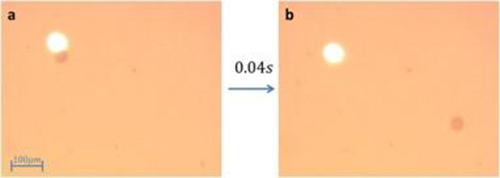
Ben-Gurion University of the Negev researchers demonstrate a light-generated bubble for microparticle propulsion. Panel (a) shows the 42μm diameter spherical particle and the 405 nm laser beam as the respective dark and bright patches. Panel (b) shows that 40 milliseconds later the microsphere has traversed a distance roughly 10 times its size. (Credit: Ben-Gurion U.)

An innovative technique using light and tiny bubbles to propel microparticles at forces many times greater than previously achieved has been developed by Ben-Gurion University of the Negev researchers.

The new technique could have significant implications in the development of micromotors and optical devices for use in solar cell optics. “What we ultimately hope to achieve is a highly accurate, passive technology for use in a concentrated solar device that would follow the sun without the need for a mechanical tracking mechanism,” says Dr. Avi Niv, study co-author.

According to the findings published recently in Nature Scientific Reports, the researchers converted the energy created from light into kinetic motion using nano-sized, laser-generated bubbles. As the bubble expands it acts as a propulsion mechanism for surrounding microparticles. Mechanical manipulation of micro- and nano-scaled objects is important in biology, surface science and microfluidics, and for micromachines in general.

View a video of the experiment. https://www.youtube.com/watch?v=fL9CUoSkYeU

Dr. Niv says, “In our study, a micron-sized object was propelled at unprecedented speeds of close to one meter-per-second, six times faster than what is common in present devices, while still maintaining motion direction control.” Dr. Niv and co-author Ido Frenkel, a Ph.D. student, are part of BGU’s Alexandre Yersin Department of Solar Energy and Environmental Physics at the Jacob Blaustein Institutes for Desert Research.

“After the bubble initiates movement and bursts, there is no trace of the vapor; the system returns to the original state and the same action can be initiated repeatedly, like a combustion engine.”
Related Articles Read More >

CEA-Leti achieves 400°C CMOS fabrication milestone for 3D chip stacking
The 2025 R&D 100 Finalists are here
New nanotechnology method increases microalgae biofuel yield by 300%
New nanopore sensor paves the way for fast, accurate, low-cost DNA sequencing
rd newsletter
EXPAND YOUR KNOWLEDGE AND STAY CONNECTED
Get the latest info on technologies, trends, and strategies in Research & Development.
RD 25 Power Index

R&D World Digital Issues

Fall 2025 issue

Browse the most current issue of R&D World and back issues in an easy to use high quality format. Clip, share and download with the leading R&D magazine today.

R&D 100 Awards
Research & Development World
  • Subscribe to R&D World Magazine
  • Sign up for R&D World’s newsletter
  • Contact Us
  • About Us
  • Drug Discovery & Development
  • Pharmaceutical Processing
  • Global Funding Forecast

Copyright © 2025 WTWH Media LLC. All Rights Reserved. The material on this site may not be reproduced, distributed, transmitted, cached or otherwise used, except with the prior written permission of WTWH Media
Privacy Policy | Advertising | About Us

Search R&D World

  • R&D World Home
  • Topics
    • Aerospace
    • Automotive
    • Biotech
    • Careers
    • Chemistry
    • Environment
    • Energy
    • Life Science
    • Material Science
    • R&D Management
    • Physics
  • Technology
    • 3D Printing
    • A.I./Robotics
    • Software
    • Battery Technology
    • Controlled Environments
      • Cleanrooms
      • Graphene
      • Lasers
      • Regulations/Standards
      • Sensors
    • Imaging
    • Nanotechnology
    • Scientific Computing
      • Big Data
      • HPC/Supercomputing
      • Informatics
      • Security
    • Semiconductors
  • R&D Market Pulse
  • R&D 100
    • 2025 R&D 100 Award Winners
    • 2025 Professional Award Winners
    • 2025 Special Recognition Winners
    • R&D 100 Awards Event
    • R&D 100 Submissions
    • Winner Archive
  • Resources
    • Research Reports
    • Digital Issues
    • Educational Assets
    • R&D Index
    • Subscribe
    • Video
    • Webinars
    • Content submission guidelines for R&D World
  • Global Funding Forecast
  • Top Labs
  • Advertise
  • SUBSCRIBE