At the University of Colorado Boulder campus, undergraduate students are using digital twin technology and robotics to advance the future of lunar studies. They published their study in the journal Advances in Space Research.
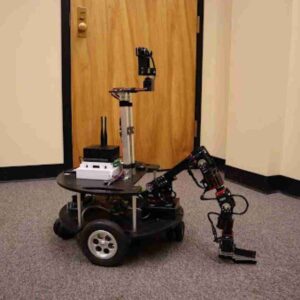
The Armstrong robot. Credit: Network for Exploration and Space Science
While “Armstrong”, the robot created by the undergrads, wouldn’t survive a trip to the moon’s surface, it can be used for training. The moon’s surface is vastly different from Earth’s, making it challenging for people to practice operating lunar robots before a mission.
The students at CU Boulder aim to solve that problem using digital twins, hyper-realistic virtual reality environments. This technology could allow people to practice driving lunar robots without risking damage to multi-million-dollar equipment.
The study was funded by NASA and the Colorado company Lunar Outpost as part of a larger research effort led by Jack Burns, an astrophysics professor at CU.
Creating Armstrong’s Lunar Twin
The researchers began the project by creating a digital twin of their office, Armstrong’s home. They accomplished this with Unity, a video game engine. When they created Armstrong’s virtual twin, they had to make sure it operated the same as the real robot.
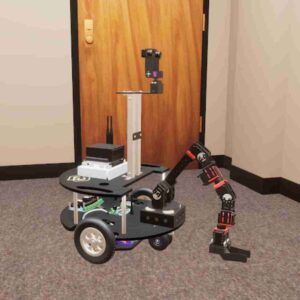
Armstrong’s digital twin. Credit: Network for Exploration and Space Science
“We had to get the digital twin as close to the real thing as possible,” said Xavier O’Keefe, who earned a bachelor’s degree in aerospace engineering sciences from CU Boulder this year and co-authored the study. “For example, we timed how fast the robot moved over one yard. Then we did the same test in the virtual environment and got the robot’s speed to be the same.”
The team recruited 24 participants to operate the robot while in a room down the hall. Wearing a VR headset, the participants controlled the robot to pick up and adjust a plastic block. 12 out of the 24 participants were able to practice the task first, using Armstrong’s digital twin, before they operated the real robot.
The participants who practiced with the digital twin completed the task about 28% faster than the others. They also reported feeling less stress during the task.
Looking ahead
With this study under their belt, the team is now working on recreating the lunar surface. They are working with Lunar Outpost to build a digital twin of a lunar rover in Unity. O’Keefe said the lunar dust presented a unique challenge.
“The rover will kick up dust with its wheels as it drives, and that could possibly block sensors or cameras,” O’Keefe said. “But it’s really hard to know exactly how dust moves on the moon because you can’t just go outside and measure it.”
An astronomical observatory on the moon
Burns is part of a team that received a grant from NASA to design FarView, a scientific observatory on the moon. FarView would be made up of a web of 100,000 antennas over about 77 square miles of the lunar surface. The work by this undergraduate team could contribute to the project.
“Unlike the Apollo program, where human astronauts did all the heavy lifting on the moon, NASA’s 21st-century Artemis Program will combine astronauts and robotic rovers working in tandem,” Burns said. “Our efforts at CU Boulder are intended to make lunar robots more efficient and recoverable from errors, so precious astronaut time on the lunar surface will be better utilized.”
According to NASA, the observatory will be manufactured on the moon, “utilizing Lunar Resources’ developed technologies that first extract metals (along with oxygen) from lunar regolith, then manufacture most of the required elements of the observatory.”