Research & Development World

  • R&D World Home
  • Topics
    • Aerospace
    • Automotive
    • Biotech
    • Careers
    • Chemistry
    • Environment
    • Energy
    • Life Science
    • Material Science
    • R&D Management
    • Physics
  • Technology
    • 3D Printing
    • A.I./Robotics
    • Software
    • Battery Technology
    • Controlled Environments
      • Cleanrooms
      • Graphene
      • Lasers
      • Regulations/Standards
      • Sensors
    • Imaging
    • Nanotechnology
    • Scientific Computing
      • Big Data
      • HPC/Supercomputing
      • Informatics
      • Security
    • Semiconductors
  • R&D Market Pulse
  • R&D 100
    • 2026 R&D 100 Award Winners
    • 2026 Professional Award Winners
    • 2026 Special Recognition Winners
    • R&D 100 Awards Event
    • R&D 100 Submissions
    • Winner Archive
  • Resources
    • Research Reports
    • Digital Issues
    • Educational Assets
    • Subscribe
    • Video
    • Webinars
    • PharmSci360
    • Content submission guidelines for R&D World
  • Global Funding Forecast
  • Top Labs
  • Advertisers
    • Advertise
    • PR Submissions
    • Eblast Submissions
  • SUBSCRIBE

Ionic liquid boosts efficiency of carbon dioxide reduction catalyst

By R&D Editors | June 6, 2014

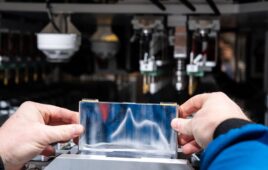
Yasuo Matsubara and David Grills. Photo: Brookhaven National LaboratoryWouldn’t it be nice to use solar- or wind-generated electricity to turn excess carbon dioxide—one of the gases trapping heat in Earth’s atmosphere—into fuels and other useful chemicals? The process would store up the intermittent solar or wind energy in a form that could be used when and where it was needed, including in transportation applications, all while getting rid of some greenhouse gas. The trick is to find the right catalysts to facilitate the conversion of carbon dioxide with high activity and minimal energy input. 

One useful product of such carbon dioxide reduction reactions is carbon monoxide (CO), a building block for making methanol and liquid hydrocarbons that could replace gasoline. So far, the catalysts tried for this reaction are often lacking in efficiency and/or specificity; either they take too much energy, are too slow, or make too wide a variety of products to be useful. Now a group of chemists at the U.S. Dept. of Energy (DOE)’s Brookhaven National Laboratory reports a new approach: performing the electrochemical reaction in an ionic liquid, which acts as both the solvent and electrolyte. 

The process—described in The Journal of Physical Chemistry Letters—was shown to boost both the energy efficiency and speed of the reaction for a well-known catalyst, with no loss of product selectivity, compared to the same reaction in a standard organic solvent solution.

Ionic liquids are salts made of positive and negative ions, similar to the sodium and chloride ions of table salt, but in liquid form at room temperature. Their blend of positive and negative charges makes them excellent conductors (electrolytes) and gives them unique properties, resulting in their recent emergence as superior alternatives to conventional organic solvents for many energy-related applications.

Ionic liquids have previously shown some promise at improving the energy efficiency of the direct electrochemical reduction of carbon dioxide at metal electrodes. The new work, led by Brookhaven Laboratory chemist David Grills and Yasuo Matsubara of the Japan Science and Technology Agency, is the first attempt to use ionic liquids to improve carbon dioxide reduction using a homogeneous electrocatalyst—where both the reactants and catalyst are dissolved in a liquid. Homogeneous carbon dioxide reduction catalysts are generally more selective in the products they produce.

“Our experiment resulted in an improvement in both the energy efficiency and kinetics of the carbon dioxide reduction process for the catalyst we studied, with no loss of product selectivity,” Grills said. 

The reason for the improvement, the scientists suspect, is a special interaction between one of the ionic liquid’s ions and an intermediate form of the catalyst that results in a lowering of the activation energy required for the reaction. 

The new approach will undoubtedly inspire a great deal of follow-up effort.

“We expect that these initial results will open up new possibilities for studying ionic-liquid-enhanced carbon dioxide reduction with a range of homogeneous catalysts and different types of ionic liquids,” said Matsubara.

The work may even point the way to catalytic systems that can directly convert carbon dioxide to other useful chemicals.

Source: Brookhaven National Laboratory

Related Articles Read More >

Inside the Lab: Can AI Solve the Critical Materials Challenge?
DOE’s fusion voucher program opens to consortia and pilot-plant reviews
A researcher handles a prismatic battery cell on PNNL’s manufacturing line.
DOE’s BattMan brings four national labs together to de-risk battery scale-up
INL’s $60 million nuclear AI project will spend the first year testing where AI agents can help and where they might hurt 
rd newsletter
EXPAND YOUR KNOWLEDGE AND STAY CONNECTED
Get the latest info on technologies, trends, and strategies in Research & Development.

R&D World Digital Issues

Fall 2026 issue

Browse the most current issue of R&D World and back issues in an easy to use high quality format. Clip, share and download with the leading R&D magazine today.

R&D 100 Awards
Research & Development World
  • Subscribe to R&D World Magazine
  • Sign up for R&D World’s newsletter
  • Contact Us
  • About Us
  • Drug Discovery & Development
  • Pharmaceutical Processing
  • Global Funding Forecast

Copyright © 2026 Arrowfly LLC. All Rights Reserved. The material on this site may not be reproduced, distributed, transmitted, cached or otherwise used, except with the prior written permission of Arrowfly
Privacy Policy | Advertising | About Us

Search R&D World

  • R&D World Home
  • Topics
    • Aerospace
    • Automotive
    • Biotech
    • Careers
    • Chemistry
    • Environment
    • Energy
    • Life Science
    • Material Science
    • R&D Management
    • Physics
  • Technology
    • 3D Printing
    • A.I./Robotics
    • Software
    • Battery Technology
    • Controlled Environments
      • Cleanrooms
      • Graphene
      • Lasers
      • Regulations/Standards
      • Sensors
    • Imaging
    • Nanotechnology
    • Scientific Computing
      • Big Data
      • HPC/Supercomputing
      • Informatics
      • Security
    • Semiconductors
  • R&D Market Pulse
  • R&D 100
    • 2026 R&D 100 Award Winners
    • 2026 Professional Award Winners
    • 2026 Special Recognition Winners
    • R&D 100 Awards Event
    • R&D 100 Submissions
    • Winner Archive
  • Resources
    • Research Reports
    • Digital Issues
    • Educational Assets
    • Subscribe
    • Video
    • Webinars
    • PharmSci360
    • Content submission guidelines for R&D World
  • Global Funding Forecast
  • Top Labs
  • Advertisers
    • Advertise
    • PR Submissions
    • Eblast Submissions
  • SUBSCRIBE