The technologies shaping the future—from electric vehicles and wind turbines to fusion energy, robotics, and national defense—depend on critical minerals and advanced materials. Yet discovering and deploying new materials can take years or even decades, while technological progress and demand accelerate. This challenge is compounded by supply chains vulnerable to geopolitical pressures, resource constraints, and limited domestic processing capacity, as well as the need for materials that withstand increasingly extreme operating environments. Accelerating materials discovery, scaling, and deployment to meet these demands has become one of the central challenges in modern materials research.
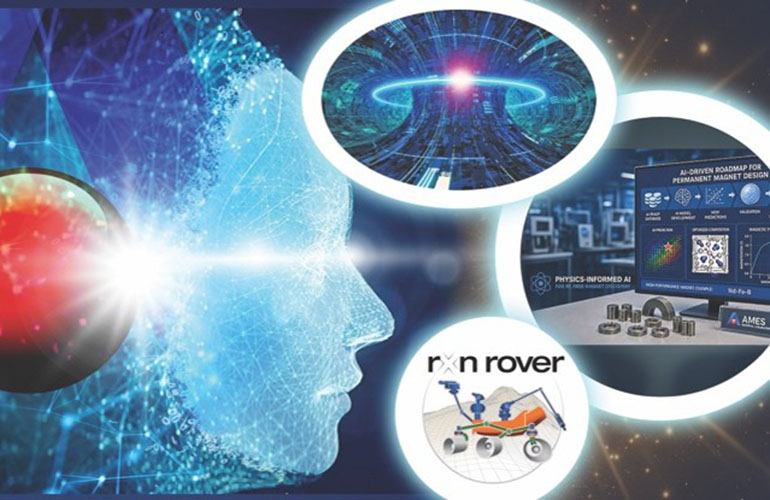
An illustration pairs a digital human profile with images of fusion energy and an AI-driven roadmap for permanent magnet design. [Image courtesy of Ames National Laboratory]
Ames National Laboratory has a long history of leadership in rare earths, critical materials, and materials innovation. Today, the laboratory is building on that legacy by combining artificial intelligence (AI), domain expertise, and experimental science to accelerate materials discovery and address these growing demands.
Rather than replacing scientists, AI helps researchers use their expertise more effectively. It can identify patterns across massive datasets, narrow vast search spaces, connect information from different scientific domains, and prioritize the most promising candidates for experiments. In doing so, AI allows researchers to focus their time and resources where discovery is most likely to happen.
One example is the development of permanent magnets that are essential for electric vehicles, wind turbines, robotics, and defense technologies. Because many high-performance magnets rely on rare earth elements with vulnerable supply chains, Ames researchers are developing AI driven roadmaps toward magnet sovereignty— the ability to reliably produce high-performance magnets domestically while balancing performance, cost, manufacturability, and supply-chain resilience. My colleagues and I integrate experimental data with quantum-mechanical simulations to train and fine-tune physics-informed AI models and domain-specific large language models (LLMs) capable of predicting key magnetic properties, including the Curie temperature, above which ferromagnetic ordering disappears. The team validated our predictions through the synthesis and experimental characterization of cerium-zirconium-iron alloys. Building on these advances, our roadmap integrates AI, first-principles simulations, and practical constraints on cost and material availability to prioritize promising compositions before laboratory synthesis. This physics-informed approach could accelerate the discovery of rare-earth-lean magnets and strengthen domestic magnet supply chains.
The same AI-driven approaches are accelerating materials discovery for fusion energy and critical mineral recovery.
Fusion energy is regarded as one of the most promising long-term solutions to global energy demand. However, realizing practical fusion power requires the development of structural materials capable of withstanding extreme temperatures, intense neutron irradiation, and harsh operating environments. To address this challenge, Ames researchers are developing an agentic AI platform, DuctGPT, that combines electronic-structure knowledge, machine learning, LLMs, and fusion-specific materials screening to rapidly identify structural alloys capable of withstanding extreme temperatures and neutron irradiation.
AI is also transforming how critical minerals are recovered. Ames researchers have developed an AI-enabled platform to recover valuable elements such as cobalt from low-concentration sources, including mine tailings and wastewater by integrating synthetic biology, machine learning, automation, and molecular modeling to design biological systems that selectively capture critical metals, offering a more scalable, lower-cost, and environmentally sustainable alternative to conventional recovery methods.
Ames Lab scientists are leading the path to show AI can also help strengthen the entire critical materials life cycle. Ames researchers are working with partners to explore methods for producing battery-grade graphite from post-consumer textiles (i.e., discarded clothing items). They also contributed to the Department of Energy’s Critical Materials and Minerals to Unlock Supply (CM2US) initiative under the Genesis Mission. These efforts recognize that securing critical minerals is not only a materials science problem. It is a systems problem where AI, advanced manufacturing, recycling, and supply chain intelligence must work together to build a more resilient domestic ecosystem.
Together, these efforts show that AI is moving beyond data analysis to become a practical engine for materials innovation, helping researchers discover better materials, recover critical resources, and strengthen the supply chains that future technologies depend on.
The future of energy systems, advanced manufacturing, and critical mineral supply chains will depend on the ability to discover, develop, and deploy new materials faster than ever before.
AI alone will not solve the critical materials challenge. But by helping scientists navigate complexity, uncover new opportunities, and move from ideas to solutions more quickly, it may become one of the most important tools for ensuring that the materials needed for tomorrow’s technologies are ready when the world needs them most.



Tell Us What You Think!
You must be logged in to post a comment.