Manganese fluoride (MnF₂) was one of the first materials in which scientists used neutrons to observe antiferromagnetic order, a pattern where neighboring atoms’ spins lock into an alternating up-down pattern, and neutron-scattering courses have used it as a textbook antiferromagnet. Now, it is one of two materials that new papers in the journal Science identify as altermagnets, a magnetic class proposed in 2022 that mixes traits of ferromagnets and antiferromagnets.
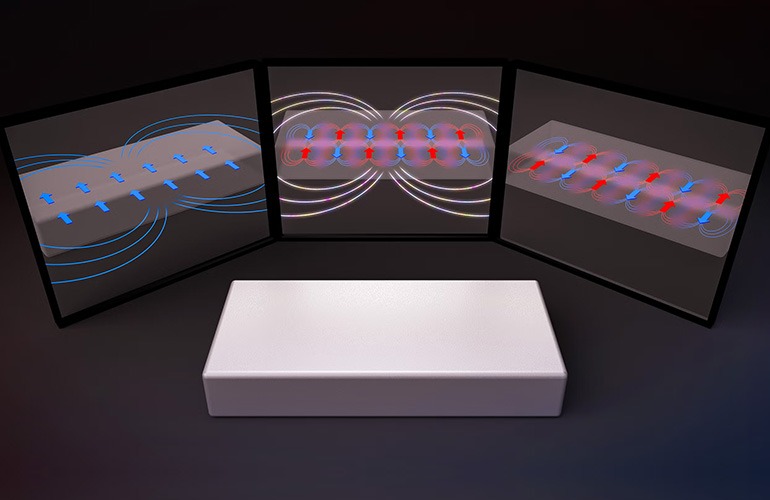
An illustration of three magnetic phases: ferromagnetism in the left mirror, antiferromagnetism in the right and altermagnetism in the center. [Image courtesy of SLAC National Accelerator Laboratory]
In “Chiral altermagnon in MnTe,” Daniel Jost and colleagues at SLAC National Accelerator Laboratory, funded by the Department of Energy, used circularly polarized X-rays at the European Synchrotron Radiation Facility in Grenoble, France, to determine handedness in manganese telluride (MnTe).
In “Altermagnetism revealed by polarized neutrons in MnF₂,” Quentin Faure and colleagues at the Laboratoire Léon Brillouin, a neutron-science lab near Paris run by France’s Alternative Energies and Atomic Energy Commission and National Centre for Scientific Research, used polarized neutrons at Oak Ridge National Laboratory’s Spallation Neutron Source in Tennessee to do the same in MnF₂.
In an altermagnet, spins alternate up-down so there is no net magnetization, like an antiferromagnet. But the opposite-spin sublattices are related by a rotation rather than a translation or inversion, which splits electron and magnon behavior by spin, as in a ferromagnet, but differently along different directions.
Until now, the case for altermagnetism rested mostly on photoemission showing spin-split bands, nanoscale imaging and a neutron study that found split magnon energies in MnTe. Those signals leave room for other explanations. The new papers use chirality, or handedness, as the test, a signature that is harder to mistake.
In an ordinary antiferromagnet, the two magnon modes have opposite handedness but stay at the same energy, so a probe sees no net chirality. In an altermagnet, the handedness shows up in some directions, vanishes along symmetry-enforced “nodal” directions and flips sign across them. Both papers found signatures of this pattern in MnTe and MnF₂.
Altermagnets have no stray field, and a Perspective commentary accompanying the papers notes controlling chirality could carry spin information without moving electrons.


Tell Us What You Think!
You must be logged in to post a comment.