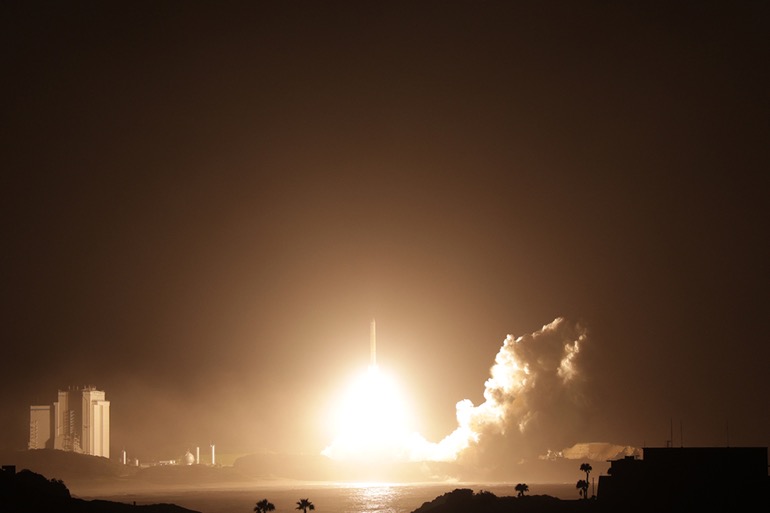
JAXA launched MMX on Oct. 20 (Japan time) from Tanegashima Space Center. Credit: JAXA
A germanium detector from Lawrence Livermore National Laboratory (LLNL) will help pick where the Japan Aerospace Exploration Agency’s Martian Moons eXploration (MMX) spacecraft lands to collect samples from Phobos, the larger of Mars’ two moons, for return to Earth in 2031.
MMX launched Oct. 19 (Oct. 20 in Japan) on an H3 rocket from the Tanegashima Space Center in southwestern Japan.
The craft carries the third LLNL germanium sensor to fly in space, after sensors on NASA’s MESSENGER mission to Mercury, launched in 2004, and NASA’s Psyche mission to a metal-rich asteroid in the main belt. The Psyche sensor is already in flight. A fourth sensor from the same family of LLNL germanium detectors is bound for Titan, Saturn’s largest moon, aboard NASA’s Dragonfly rotorcraft lander.
LLNL’s MMX sensor is a component of the Mars-moon Exploration with GAmma rays and NEutrons (MEGANE) instrument, the spectrometer NASA contributed to the mission, built in partnership with the Johns Hopkins Applied Physics Laboratory (APL). MEGANE, pronounced meh-GAH-nay, is also the Japanese word for “eyeglasses.” MEGANE is one of 13 instruments on MMX, which LLNL calls the world’s first sample return mission to the Martian sphere. MMX will also observe Deimos, Mars’ second, smaller moon.
“The primary goal of the mission is to understand the mysterious origins of Phobos and Deimos,” said Morgan Burks, an LLNL physicist who developed the sensor with Geon-Bo Kim and Nathan Hines, in a statement. “There are two competing theories: one is that they are captured asteroids and the other is that they were ejected from Mars.”
According to LLNL, remote sensing data show that Mars’ moons resemble the carbon-rich material found in asteroids in the outer asteroid belt. However, if the moons were captured from the belt, they would likely have elliptical orbits, not the near-circular, equatorial orbits Mars’ moons actually have. Their orbits suggest the moons may have formed from an impact on Mars, the same way Earth’s moon likely formed.
Reading a moon’s chemistry from orbit
Germanium gives planetary scientists the sharpest gamma-ray measurements of a surface’s chemistry, but it must stay at extremely cold temperatures. MEGANE’s germanium sensor operates at 90 kelvins (minus 183°C).
On an airless body like Phobos, galactic cosmic rays, high-energy particles from outside the solar system, constantly strike the surface. On impact, they knock neutrons loose from atoms in the soil. Those neutrons hit other atoms’ nuclei, which then release extra energy as gamma rays at an energy specific to that element. The LLNL sensor records the energy of each gamma ray to build a picture of the elements that make up a body.
Keeping germanium that cold in space takes a mechanical cooler. LLNL calls its Psyche instrument the fourth generation of its germanium spectrometers, after Cryo-3, the MESSENGER sensor and GeMini, a compact spectrometer the lab built for field use on Earth. In GeMini, engineers paired an ultraminiature mechanical cooling system with infrared shielding to cool the germanium to cryogenic temperatures without liquid nitrogen, which is difficult to use outside a lab. The Psyche and MMX instruments also carry cryocoolers.
“MEGANE faced tighter resource constraints on MMX than the team’s instrument aboard Psyche,” Burks said. “This impacted every decision from our choice of a low-mass, low-power cryocooler to radiator design.”
From Psyche to Titan
NASA’s Psyche mission, which launched in October 2023, will study the asteroid’s composition to better understand the cores of rocky planets like Earth.
The LLNL sensor ran during a Mars gravity assist on May 15, a slingshot maneuver that uses the planet’s gravity, after 2.6 years in deep space. The spacecraft flew past Mars at over 12,000 mph within 2,864 miles of the surface, according to LLNL. That altitude was too far to measure gamma rays from Mars, NASA said. Burks called the flyby “an invaluable dress rehearsal” that let the team test “all aspects of the instrument performance and data pipeline,” LLNL reported in July.
LLNL says the flyby data will help gauge the sensor’s sensitivity to iron, nickel, silicon and sulfur, elements the team expects to find on Psyche. The spacecraft reaches the asteroid in August 2029 and will orbit it for at least 26 months.
On Dragonfly, LLNL’s detector will use Titan’s cold temperature for passive cooling instead of a cryocooler as it measures the elemental composition of the surface. Because Titan’s thick atmosphere blocks cosmic rays, Dragonfly’s instrument will carry its own radioactive neutron source to trigger the gamma rays.
Dragonfly is set to launch on a SpaceX Falcon Heavy in July 2028 and reach Titan in 2034.
MMX is scheduled to enter Mars orbit in August 2027 and transfer to Phobos the following month. The sample return capsule is set to land in 2031.



Tell Us What You Think!
You must be logged in to post a comment.