Research & Development World

  • R&D World Home
  • Topics
    • Aerospace
    • Automotive
    • Biotech
    • Careers
    • Chemistry
    • Environment
    • Energy
    • Life Science
    • Material Science
    • R&D Management
    • Physics
  • Technology
    • 3D Printing
    • A.I./Robotics
    • Software
    • Battery Technology
    • Controlled Environments
      • Cleanrooms
      • Graphene
      • Lasers
      • Regulations/Standards
      • Sensors
    • Imaging
    • Nanotechnology
    • Scientific Computing
      • Big Data
      • HPC/Supercomputing
      • Informatics
      • Security
    • Semiconductors
  • R&D Market Pulse
  • R&D 100
    • 2026 R&D 100 Award Winners
    • 2026 Professional Award Winners
    • 2026 Special Recognition Winners
    • R&D 100 Awards Event
    • R&D 100 Submissions
    • Winner Archive
  • Resources
    • Research Reports
    • Digital Issues
    • Educational Assets
    • Subscribe
    • Video
    • Webinars
    • PharmSci360
    • Content submission guidelines for R&D World
  • Global Funding Forecast
  • Top Labs
  • Advertise
  • SUBSCRIBE

Eggshell-inspired shield cut projectile speed by 65% in simulation, but light-gas gun testing has not confirmed it 

By Julia Rock-Torcivia | September 17, 2026

A team of researchers at the Dalian University of Technology in China designed and 3D-printed a spacecraft shield consisting of arrays of hollow, water-filled aluminum eggshells between two plates, reporting that it slowed projectiles by as much as 65% in simulations. Whether the design will hold up against real projectiles remains to be seen.
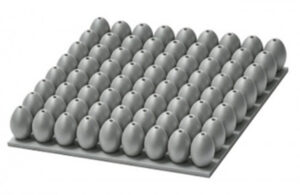
Aluminum eggshells filled with water sit between two aluminum plates. The top plate is excluded from this image. Credit: Wang et al.

The researchers’ work was published in the Journal of Applied Physics on September 14.

The team states that firing large projectiles at 7 km/s (about 4.4 miles per second) with light-gas guns, the standard hypervelocity test device, is challenging and expensive, two of the main reasons they turned to simulations instead. The paper states that most debris moves faster than 7 km/s and gun testing can’t capture the microscopic dynamics, making simulation an effective alternative.

Today, more than 33,000 tracked objects are circling Earth. As space junk continues to accumulate, spacecraft need lightweight shields that slow projectiles. The Whipple shield is the standard, a thin aluminum bumper designed to break apart projectiles, which dates back to a 1947 proposal and has flown on spacecraft for decades. The ISS uses a Whipple shield with Nextel and Kevlar intermediate layers.

Whipple shields depend on a gap between the shield and the rear wall. On the ISS, that gap is about 11 centimeters. On smaller spacecraft, this gap competes with the payload for space.

The eggshell-inspired design has no gap at all; the water-filled shells fill the entire approximately 12 millimeter space between the plates. The design disperses the energy of the projectile radially into the plane of the panel, and the water dampens and spreads the shock, according to the paper.

The researchers simulated an 11-millimeter projectile traveling at the shield at 7.5 km/s, about 17,000 miles per hour. A plain 6 mm sheet of aluminum slowed the projectile to 3.68 km/s. The simulation with the narrow ends of the ‘eggs’ facing the impact had the best results. In that run, the eggshell panel cut the speed to 2.63 km/s, a decrease of about 65%.

The simulations also showed that a larger share of the projectile’s kinetic energy was redirected sideways through the eggshell panel, as designed, rather than continuing forward toward a rear wall. Radial kinetic energy, the portion of the projectile’s energy converted into sideways motion in the panel, was about 3,000 joules on the plain plate and about 12,000 joules on the eggshell panel.

The simulations did not include a rear wall, so whether the design would protect a spacecraft wall is untested.

The only physical test the paper reports is two chicken eggs crushed in a press. Both broke around 363 newtons, or about 82 pounds.

The researchers checked the model against two published physical experiments, and it matched within a few percent. However, neither of those tests involved water, which is a key part of the new design.

This is the group’s second paper on this design. They published their first paper on the design in Physics of Fluids in March of last year.


 

Tell Us What You Think! Cancel reply

You must be logged in to post a comment.

Related Articles Read More >

The 100 most innovative companies of 2026: from NVIDIA and OpenAI to Eli Lilly and SpaceX
New observations contradict an earlier theory of how a binary star formed 
The Space Systems Division (05)-developed Parallelogram Synchronized Truss Assembly (PaSTA), seen Aug. 12, 2025, is a mechanism that will be integrated into the Life-Extension In-orbit Servicer (LEXI) and Astroscale Prototype Servicer for Refueling (APS-R) spacecrafts.
One SwRI R&D 100 winner turns buckled fiberglass into a spacecraft truss. The other models freight rail with 900 hours of BNSF field data
No propulsion, no problem: How CYGNSS’s solar panels will enable deorbit without propulsion 
rd newsletter
EXPAND YOUR KNOWLEDGE AND STAY CONNECTED
Get the latest info on technologies, trends, and strategies in Research & Development.

R&D World Digital Issues

Fall 2025 issue

Browse the most current issue of R&D World and back issues in an easy to use high quality format. Clip, share and download with the leading R&D magazine today.

R&D 100 Awards
Research & Development World
  • Subscribe to R&D World Magazine
  • Sign up for R&D World’s newsletter
  • Contact Us
  • About Us
  • Drug Discovery & Development
  • Pharmaceutical Processing
  • Global Funding Forecast

Copyright © 2026 Arrowfly LLC. All Rights Reserved. The material on this site may not be reproduced, distributed, transmitted, cached or otherwise used, except with the prior written permission of Arrowfly
Privacy Policy | Advertising | About Us

Search R&D World

  • R&D World Home
  • Topics
    • Aerospace
    • Automotive
    • Biotech
    • Careers
    • Chemistry
    • Environment
    • Energy
    • Life Science
    • Material Science
    • R&D Management
    • Physics
  • Technology
    • 3D Printing
    • A.I./Robotics
    • Software
    • Battery Technology
    • Controlled Environments
      • Cleanrooms
      • Graphene
      • Lasers
      • Regulations/Standards
      • Sensors
    • Imaging
    • Nanotechnology
    • Scientific Computing
      • Big Data
      • HPC/Supercomputing
      • Informatics
      • Security
    • Semiconductors
  • R&D Market Pulse
  • R&D 100
    • 2026 R&D 100 Award Winners
    • 2026 Professional Award Winners
    • 2026 Special Recognition Winners
    • R&D 100 Awards Event
    • R&D 100 Submissions
    • Winner Archive
  • Resources
    • Research Reports
    • Digital Issues
    • Educational Assets
    • Subscribe
    • Video
    • Webinars
    • PharmSci360
    • Content submission guidelines for R&D World
  • Global Funding Forecast
  • Top Labs
  • Advertise
  • SUBSCRIBE