A team of researchers spent almost eight years collecting observations of a binary star system to build a three-dimensional model which supports the theory that the two stars formed separately and came together later, rather than forming from the same disk, as the researchers’ 2019 paper suggested.
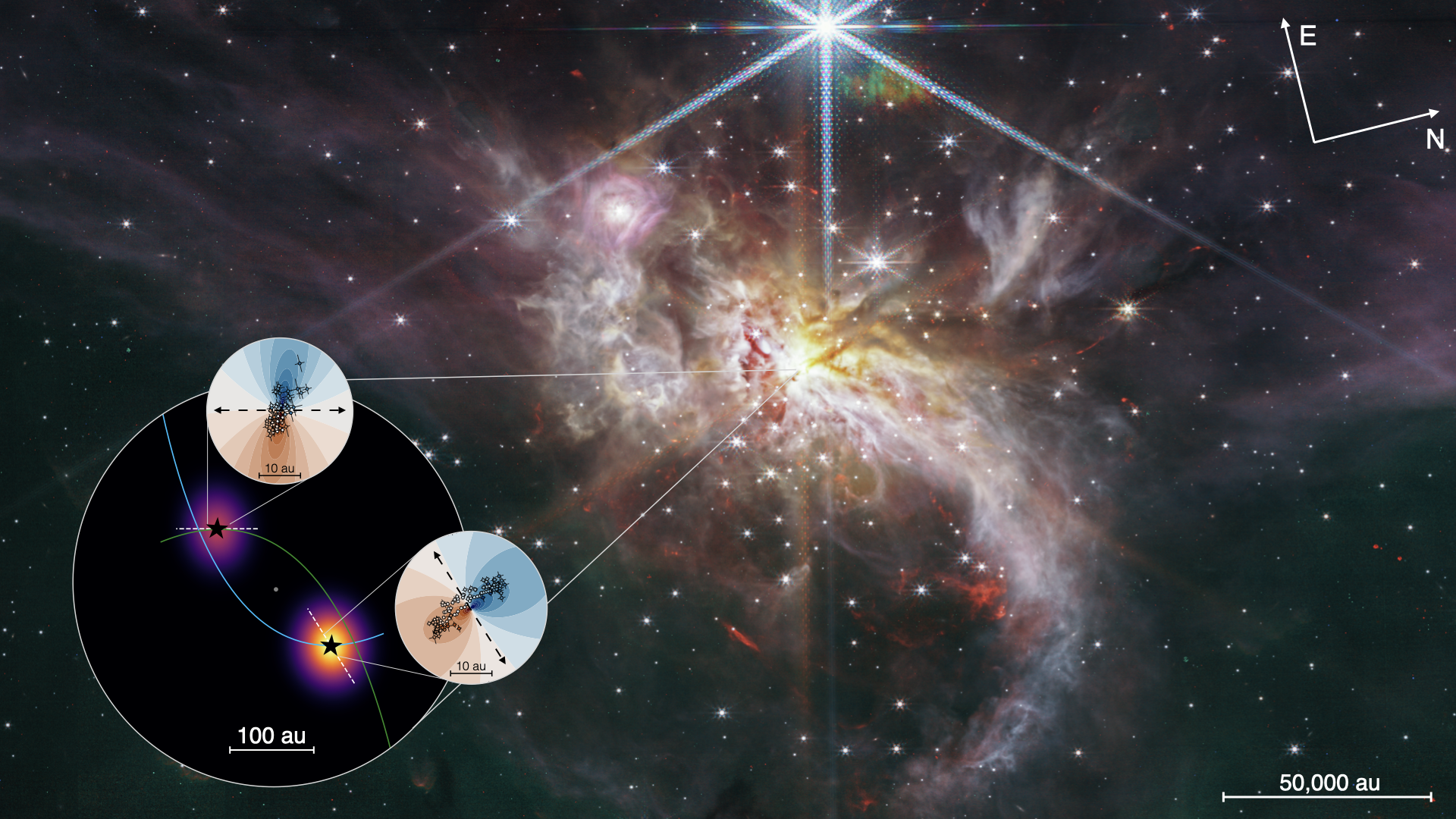
The inset circle shows an image of the binary star system with the orbital trajectories reconstructed from ALMA observations. The arrows indicate the direction of the stars’ jets. The red- and blue-shifted hydrogen recombination line emission show the rotation of the ionized circumstellar disks around the two forming stars. The background image is a mid-infrared image of the region from JWST. Credit: NASA, ESA, CSA, STScI, J. DePasquale (STScI), ALMA (ESO/NAOJ/NRAO), Y. Zhang
Astronomers think at least 90% of massive stars exist in binary or higher-order multiple systems, but they don’t have a firm understanding of how these systems form.
In 2019, Atacama Large Millimeter/submillimeter Array (ALMA) observations of IRAS 07299-1651, a star system about 5,500 light years away from Earth, provided direct dynamical constraints on the system. The results appeared consistent with the theory that the stars formed together from the fragmentation of a single disk. However, the researchers noted that the disks around the two stars appeared misaligned.
To further investigate, many of the same researchers spent almost eight years collecting data from ALMA, which they combined with observations from the National Science Foundation’s Very Large Array (VLA), James Webb Space Telescope (JWST) and the European Southern Observatory’s (ESO’s) Very Large Telescope (VLT). They published their findings in Nature Astronomy.
“It felt like solving a three-dimensional puzzle,” Yao Wang, the study’s first author, said in a press release. “Each new observation added another piece, and eventually the orbit, disks, and jets all came together into a single, coherent picture.”

An artist’s rendering of the formation of a close massive binary system with misaligned disks around two young stars. Credit: Y. Zhang
The team used the observations to reconstruct the system’s three-dimensional architecture, which allowed them to see how the stars orbit each other, the tilt of their disks and the angle of their jets. According to the paper, the researchers combined orbital fitting, multi-wavelength continuum modeling, hydrogen recombination line kinematics and jet observations to create the reconstruction.
They found that the stars’ orbit is highly eccentric, with the preferred orbital solutions close to a parabolic path. A circular orbit has an eccentricity of zero, while an eccentricity of one describes a parabola, a path on which two objects swing past each other and never come back together. The team’s fits land near the boundary between the two, leaving the stars on the line between staying together and drifting apart.
Additionally, their surrounding disks are tilted at sharp angles to each other and to the orbital path, making it unlikely that the stars emerged from the same disk.
“The combination of radio and infrared observations provides the most exquisite detail on the formation of this massive protobinary system,” Rubén Fedriani, a co-author of the study, said in a press release.
The researchers conclude that it is more likely that the stars formed separately before a chance encounter brought them together, a scenario they call a core-merger. The term refers to the two prestellar cores, dense clumps of gas and dust that collapse to form stars. The stars within these clouds never touched, which is why their disks survived. In representative orbital solutions, the stars passed closest to each other about 60 years before the observations.
Whether the two stars will stay together is still not certain. Interactions with the surrounding gas could nudge the pair toward a bound orbit or send them drifting apart. Future observations could help determine which way the system will go.