The International Space Station (ISS) National Laboratory launched its Orbital Edge Accelerator last year, funding six startups with its first cohort. This year, the lab split the program into two tracks, one focused on dual-use applications and one for in-space manufacturing and space biology.

ISS National Lab’s Orbital Edge accelerator program gives early stage startups access to low Earth orbit and other resources. Credit: ISS National Laboratory
The ISS National Laboratory selected a total of eight early-stage startups for this year’s group. As part of the program, they will get access to low Earth orbit for research and technology development and between $500,000 and $750,000 in funding in two installments, half at the beginning of the program and half upon successful completion.
Since the cohort was announced, “the selected startups have secured venture capital investment from well-known investment firms while also working through a comprehensive accelerator program that combines business development training, mentorship, investor engagement, and direct collaboration with the ISS National Lab and Orbital Edge partner network,” Patrick O’Neil, the public affairs and outreach lead for the ISS, said in an email to R&D World.
The program has grown since last year, when it funded six companies with $500,000 each.
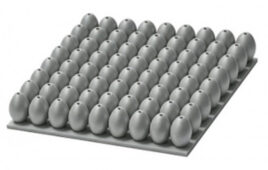
The track focused on space technologies and dual-use technologies, called the Sentinel Track, includes Aspect Aerospace’s single-board satellite, Mithril Space’s electrostatically actuated reflectors, Polaris Semiconductor’s linear regulators and Vaxon Space’s very low Earth orbit satellites.
The Disrupt Track, for in-space manufacturing and space bio, includes Astrileux’s extreme ultraviolet photomasks, Aura Life Science’s cyanobacteria photosynthetic biomanufacturing platform, Micro-gRx’s cell-free nanomedicines and Tensr’s autonomous factories that produce robots.
Space is a focus for the second Trump administration, which set a goal to return Americans to the moon by 2028. Other R&D priorities include AI, quantum, nuclear and fusion, semiconductors, advanced manufacturing and biotechnology.
A September 2025 Trump administration memo on R&D priorities set five federal research priorities, including critical and emerging technologies, American security, health and biotechnology, and space dominance. The memo directed agencies to prioritize semiconductor and microelectronics R&D and to support modular, scalable biological platforms for domestic biomanufacturing.
While this is not binding to the accelerator program, which runs on private funding, more than one project in this year’s cohort aligns with the priorities outlined, namely Astrileux’s EUV photomasks and Aura Life Science’s biomanufacturing program as well as Tensr’s AI and robotic manufacturing focus.
“The ISS National Lab closely monitors federal research priorities alongside emerging industry trends and areas attracting private-sector investment. As interest in leveraging the space environment for technology validation and commercial development continued to grow, we created the Orbital Edge Accelerator to help innovative companies explore how space can accelerate both technological advancement and business growth,” O’Neil said.
The startups will be able to access targeted mentorship and programming and are eligible for the Technology in Space Prize, funded by Boeing, which includes up to $100,000 for one or more cohort members. They can also apply to conduct research on the ISS, with the ISS National Lab sponsoring launch and astronaut time.
The accelerator is conducted in partnership with Cook Inlet Region, E2MC, Stellar Ventures, Context Ventures, Draper Associates and Draper University.
Each company will attend events in several states, culminating in a demo day in San Francisco in December where they will each present a planned spaceflight project. At the event, the ISS will award one project a potential flight to low Earth orbit.

Tell Us What You Think!
You must be logged in to post a comment.