Research & Development World

  • R&D World Home
  • Topics
    • Aerospace
    • Automotive
    • Biotech
    • Careers
    • Chemistry
    • Environment
    • Energy
    • Life Science
    • Material Science
    • R&D Management
    • Physics
  • Technology
    • 3D Printing
    • A.I./Robotics
    • Software
    • Battery Technology
    • Controlled Environments
      • Cleanrooms
      • Graphene
      • Lasers
      • Regulations/Standards
      • Sensors
    • Imaging
    • Nanotechnology
    • Scientific Computing
      • Big Data
      • HPC/Supercomputing
      • Informatics
      • Security
    • Semiconductors
  • R&D Market Pulse
  • R&D 100
    • 2026 R&D 100 Award Winners
    • 2026 Professional Award Winners
    • 2026 Special Recognition Winners
    • R&D 100 Awards Event
    • R&D 100 Submissions
    • Winner Archive
  • Resources
    • Research Reports
    • Digital Issues
    • Educational Assets
    • Subscribe
    • Video
    • Webinars
    • PharmSci360
    • Content submission guidelines for R&D World
  • Global Funding Forecast
  • Top Labs
  • Advertise
  • SUBSCRIBE

OpenAI says its AI models produced major proofs in mathematics, computer science and physics

By Brian Buntz | October 27, 2026

OpenAI logo glowing on a smartphone screen resting on a laptop keyboard

Credit: Adobe Stock

Nearly seven weeks after announcing an AI-generated proposed solution to the Navier–Stokes problem, and three weeks after releasing hundreds of mathematical manuscripts, OpenAI said on Oct. 26 that its internal AI models have produced three more results addressing longstanding scientific questions.

OpenAI says its computer-science result refutes the Exponential Time Hypothesis, a decades-old conjecture about how quickly computers can solve certain logic problems that underpins hundreds of studies of computational limits.

In mathematics, OpenAI says it proved the local smoothing conjecture in every spatial dimension, resolving a longstanding question about how waves concentrate and, through its implications, the Kakeya and Stein restriction conjectures. In physics, the company claims a rigorous mathematical construction of interacting quantum field theories in four dimensions, including quantum chromodynamics, which describes the strong force binding quarks inside protons and neutrons. That work includes an existence proof for pure Yang–Mills theory, which OpenAI calls part of the Clay Mathematics Institute’s Yang–Mills Millennium Prize problem. The Clay problem also requires proving a mass gap; the announcement covers existence alone.

OpenAI co-founder and president Greg Brockman wrote that AI is “starting to help us improve our understanding of the universe.”

“If the claim is correct, it will change an important part of theoretical computer science,” Russell Impagliazzo and Ramamohan Paturi of UC San Diego and Ryan Williams of MIT wrote in a letter to their research community. ETH has connected decades of research on computational difficulty, they explained, and the techniques developed around it retain value even if their interpretation changes. “Our involvement should not be taken as certification of the claim,” they added.

The independent Advisory Group on Mathematics and Artificial Intelligence called on OpenAI to release the physics proofs immediately, arguing that “understanding should develop in the open, with everyone given the same access.” OpenAI has published writeups for its mathematics and computer-science results, along with formalizations in Lean, software for checking formal mathematical proofs, but says the external physics group chose to withhold the AI-produced materials while preparing its own account.
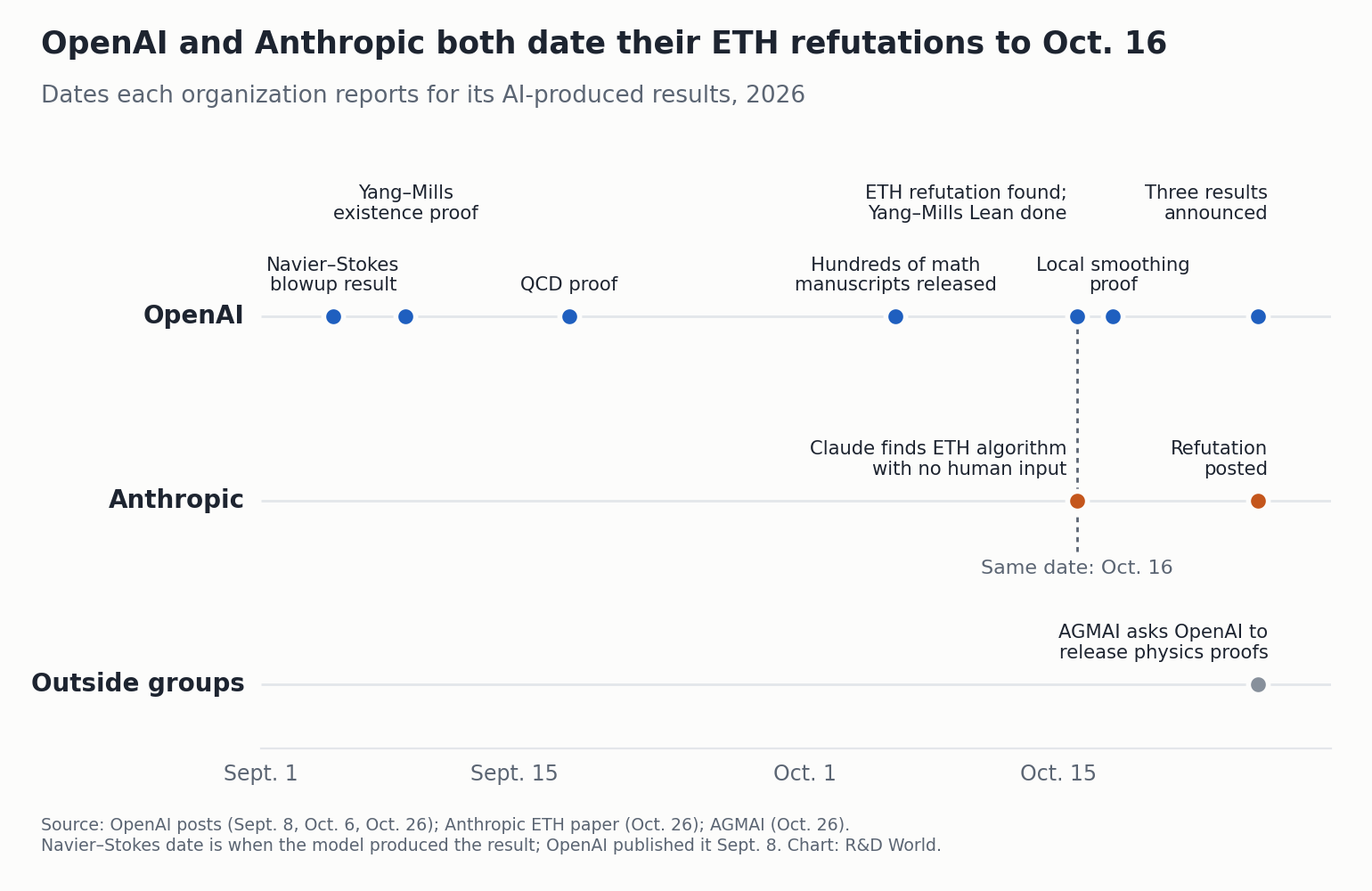
Timeline of dates OpenAI and Anthropic report for AI-produced results from Sept. 5 to Oct. 26, 2026; both labs date their Exponential Time Hypothesis refutations to Oct. 16

Credit: R&D World

Hours after OpenAI’s announcement, Anthropic posted a separate claimed refutation of the Exponential Time Hypothesis, credited to “Claude (Anthropic).” The paper says an internal Claude research model found the core algorithm without human input on Oct. 16, the same discovery date OpenAI reports; Anthropic researchers subsequently helped improve its presentation. The release includes a Lean formalization. Anthropic cautions that the theoretical result does not establish a practical speedup for solving real-world problems.

Tell Us What You Think! Cancel reply

You must be logged in to post a comment.

Related Articles Read More >

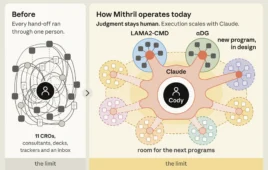
Anthropic acquires a one-person biotech that used Claude to coordinate 11 labs
Jellyfish: Claude Code bills hit $252 a month per developer as software factories automate code production among early adopters
Bar chart of first-half 2026 R&D: Anthropic $9.74 billion, above the ongoing R&D of Merck, Eli Lilly, Johnson & Johnson, Bristol Myers Squibb, Pfizer, AbbVie and Amgen
Anthropic’s R&D budget now rivals Eli Lilly’s
Two methane maps of the same EMIT scene: NASA's standard L2B enhancement, grainy with two small outlined plumes, above MAPL-EMIT output showing elongated plumes against a clean dark background.
Google AI finds more methane plumes in NASA satellite data
rd newsletter
EXPAND YOUR KNOWLEDGE AND STAY CONNECTED
Get the latest info on technologies, trends, and strategies in Research & Development.

R&D World Digital Issues

Fall 2025 issue

Browse the most current issue of R&D World and back issues in an easy to use high quality format. Clip, share and download with the leading R&D magazine today.

R&D 100 Awards
Research & Development World
  • Subscribe to R&D World Magazine
  • Sign up for R&D World’s newsletter
  • Contact Us
  • About Us
  • Drug Discovery & Development
  • Pharmaceutical Processing
  • Global Funding Forecast

Copyright © 2026 Arrowfly LLC. All Rights Reserved. The material on this site may not be reproduced, distributed, transmitted, cached or otherwise used, except with the prior written permission of Arrowfly
Privacy Policy | Advertising | About Us

Search R&D World

  • R&D World Home
  • Topics
    • Aerospace
    • Automotive
    • Biotech
    • Careers
    • Chemistry
    • Environment
    • Energy
    • Life Science
    • Material Science
    • R&D Management
    • Physics
  • Technology
    • 3D Printing
    • A.I./Robotics
    • Software
    • Battery Technology
    • Controlled Environments
      • Cleanrooms
      • Graphene
      • Lasers
      • Regulations/Standards
      • Sensors
    • Imaging
    • Nanotechnology
    • Scientific Computing
      • Big Data
      • HPC/Supercomputing
      • Informatics
      • Security
    • Semiconductors
  • R&D Market Pulse
  • R&D 100
    • 2026 R&D 100 Award Winners
    • 2026 Professional Award Winners
    • 2026 Special Recognition Winners
    • R&D 100 Awards Event
    • R&D 100 Submissions
    • Winner Archive
  • Resources
    • Research Reports
    • Digital Issues
    • Educational Assets
    • Subscribe
    • Video
    • Webinars
    • PharmSci360
    • Content submission guidelines for R&D World
  • Global Funding Forecast
  • Top Labs
  • Advertise
  • SUBSCRIBE