Research & Development World

  • R&D World Home
  • Topics
    • Aerospace
    • Automotive
    • Biotech
    • Careers
    • Chemistry
    • Environment
    • Energy
    • Life Science
    • Material Science
    • R&D Management
    • Physics
  • Technology
    • 3D Printing
    • A.I./Robotics
    • Software
    • Battery Technology
    • Controlled Environments
      • Cleanrooms
      • Graphene
      • Lasers
      • Regulations/Standards
      • Sensors
    • Imaging
    • Nanotechnology
    • Scientific Computing
      • Big Data
      • HPC/Supercomputing
      • Informatics
      • Security
    • Semiconductors
  • R&D Market Pulse
  • R&D 100
    • 2026 R&D 100 Award Winners
    • 2026 Professional Award Winners
    • 2026 Special Recognition Winners
    • R&D 100 Awards Event
    • R&D 100 Submissions
    • Winner Archive
  • Resources
    • Research Reports
    • Digital Issues
    • Educational Assets
    • Subscribe
    • Video
    • Webinars
    • PharmSci360
    • Content submission guidelines for R&D World
  • Global Funding Forecast
  • Top Labs
  • Advertise
  • SUBSCRIBE

Northwestern and Western Digital demonstrate a new way to write magnetic memory

By Brian Buntz | October 22, 2026

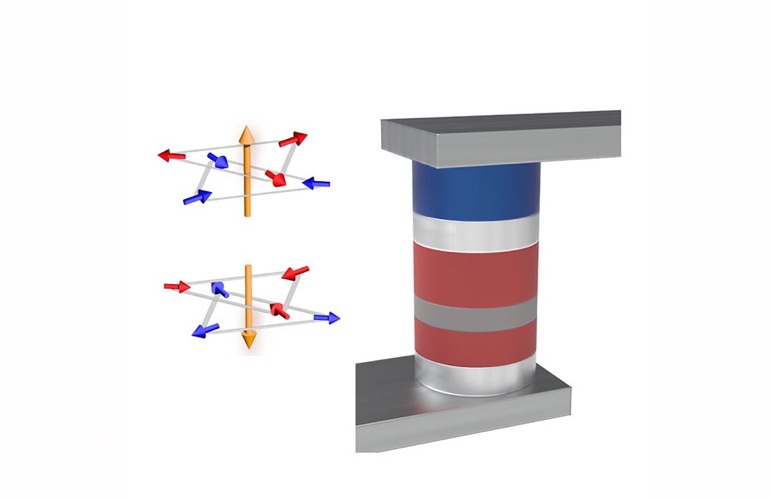
Illustration of an antiferromagnetic tunnel junction pillar beside the two spin configurations of platinum-manganese that store a bit.

Credit: Northwestern University

A new switching mechanism writes magnetic bits in materials that resist interference from stray magnetic fields. Northwestern University engineers and collaborators at Western Digital demonstrated the mechanism in nanoscale antiferromagnetic tunnel junctions, passing current through the same two-terminal structure to write and read data at room temperature. Their Nature paper, published Oct. 21, describes a potential storage element for denser magnetic memory.

Antiferromagnets have atomic spins that balance out, leaving no net magnetization. This reduces magnetic interference between neighboring bits and could allow closer packing. Their spin dynamics can also reach terahertz frequencies, attracting interest in faster memory. The new study demonstrates a way to write these materials electrically; its speed measurements used microsecond-to-millisecond pulses.

The devices use the same basic two-terminal layout as spin-transfer-torque MRAM, or magnetoresistive random-access memory. Commercial MRAM uses ferromagnets; Samsung began mass-producing embedded MRAM in 2019. The Northwestern devices instead sandwich a thin magnesium oxide barrier between two layers of platinum-manganese antiferromagnet, PtMn3. For context, PtMn3 (often written Mn3Pt) is a platinum-manganese alloy in which the manganese atoms’ magnetic moments form triangles, each spin pointing 120° from its neighbors, so they largely cancel out. A current pulse through the junction switches the magnetic configuration, and a resistance measurement reads the bit.

The authors call the writing mechanism octupole-driven spin-transfer torque, referring to the magnetic pattern formed by PtMn3’s triangular spin arrangement.

“The conventional wisdom was that you should not have spin-transfer torque or giant or tunneling magnetoresistance with these sorts of materials,” Pedram Khalili, a Northwestern professor of electrical and computer engineering, said in the university’s announcement.

Three researchers at Western Digital, the hard-drive maker, fabricated the devices, including pillars as small as 50 nanometers. According to the preprint’s methods, the films were deposited at room temperature on a 150-millimeter silicon wafer using sputtering, a process that bombards a target with ions to release material onto a surface. The process required no post-deposition annealing. The strongest device reached 363% tunneling magnetoresistance (TMR), the resistance contrast used to distinguish bit states.

The advance builds on Khalili’s group’s 2024 devices, which used a separate platinum channel for writing. The new mechanism sends the write current directly through the junction used for readout.

Turning the devices into memory products will require improvements in speed, endurance and consistency. Most measurements used 1-millisecond write pulses; simulations modeled 50-picosecond pulses. The authors told Nature’s reviewers that limited endurance restricted measurements per device. Across 50 devices, 32 had TMR below 100%. Switching and readout disappeared between roughly 87 and 127 °C and returned after cooling, according to the supplementary information. Northwestern lists other antiferromagnetic materials, direct tests of terahertz dynamics and integration with semiconductor electronics as next steps.
Tell Us What You Think! Cancel reply

You must be logged in to post a comment.

Related Articles Read More >

Eggshell-inspired shield cut projectile speed by 65% in simulation, but light-gas gun testing has not confirmed it 
The Space Systems Division (05)-developed Parallelogram Synchronized Truss Assembly (PaSTA), seen Aug. 12, 2025, is a mechanism that will be integrated into the Life-Extension In-orbit Servicer (LEXI) and Astroscale Prototype Servicer for Refueling (APS-R) spacecrafts.
One SwRI R&D 100 winner turns buckled fiberglass into a spacecraft truss. The other models freight rail with 900 hours of BNSF field data
Researchers develop sawdust-based foam as polystyrene bans force industry to adapt
Researchers develop compostable PLA that potentially could be used for biomedical applications
rd newsletter
EXPAND YOUR KNOWLEDGE AND STAY CONNECTED
Get the latest info on technologies, trends, and strategies in Research & Development.

R&D World Digital Issues

Fall 2025 issue

Browse the most current issue of R&D World and back issues in an easy to use high quality format. Clip, share and download with the leading R&D magazine today.

R&D 100 Awards
Research & Development World
  • Subscribe to R&D World Magazine
  • Sign up for R&D World’s newsletter
  • Contact Us
  • About Us
  • Drug Discovery & Development
  • Pharmaceutical Processing
  • Global Funding Forecast

Copyright © 2026 Arrowfly LLC. All Rights Reserved. The material on this site may not be reproduced, distributed, transmitted, cached or otherwise used, except with the prior written permission of Arrowfly
Privacy Policy | Advertising | About Us

Search R&D World

  • R&D World Home
  • Topics
    • Aerospace
    • Automotive
    • Biotech
    • Careers
    • Chemistry
    • Environment
    • Energy
    • Life Science
    • Material Science
    • R&D Management
    • Physics
  • Technology
    • 3D Printing
    • A.I./Robotics
    • Software
    • Battery Technology
    • Controlled Environments
      • Cleanrooms
      • Graphene
      • Lasers
      • Regulations/Standards
      • Sensors
    • Imaging
    • Nanotechnology
    • Scientific Computing
      • Big Data
      • HPC/Supercomputing
      • Informatics
      • Security
    • Semiconductors
  • R&D Market Pulse
  • R&D 100
    • 2026 R&D 100 Award Winners
    • 2026 Professional Award Winners
    • 2026 Special Recognition Winners
    • R&D 100 Awards Event
    • R&D 100 Submissions
    • Winner Archive
  • Resources
    • Research Reports
    • Digital Issues
    • Educational Assets
    • Subscribe
    • Video
    • Webinars
    • PharmSci360
    • Content submission guidelines for R&D World
  • Global Funding Forecast
  • Top Labs
  • Advertise
  • SUBSCRIBE