At least 11 states have enacted bans on expanded polystyrene (EPS), which is commonly used in packing peanuts and food packaging, due to environmental harm. The food packaging industry is now looking for compliant alternatives. However, these tend to be more expensive than conventional polystyrene.
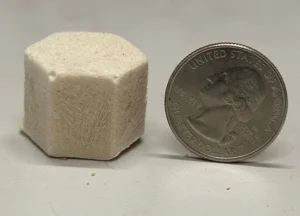
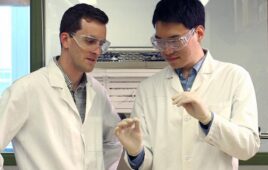
This small piece of foam was created from processed sawdust, a cellulose binder and citric acid cross-linker.
Adapted from ACS Applied Polymer Materials 2026, DOI: 10.1021/acsapm.6c00854
Researchers have created a sustainable alternative to polystyrene using sawdust as the main starting material. The manufacturing of polystyrene requires the consumption of natural gas, coal and crude oil and generates carbon monoxide, nitrogen oxides and SO2.
“If you can find uses for waste products, real uses that don’t hurt the situation or the application, that have utility, then that’s a win. It can be cheaper, it can be convenient, and maybe the most important thing is that it gives anyone another option as a starting material,” said Todd Emrick, corresponding author and professor of polymer science and engineering at the University of Massachusetts Amherst.
Conventional styrene production has a footprint of approximately 1.06 kg of CO2 equivalent per kg of styrene produced. Additionally, microplastic polystyrene particles have been found to interact with human cells in laboratory studies.
Unlike other plastics that can be melted and reformed, polystyrene requires specialized equipment and facilities for recycling. Estimates indicate that polystyrene likely takes hundreds, if not thousands, of years to break down.
“The synthetics have some really, really slow degradation processes, and that’s a double-edged sword. Robust over a long time is good for lots of things. But then you get to a waste problem,” said Emrick.
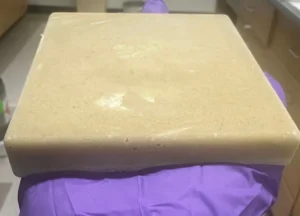
By starting with sawdust waste and other bio-based ingredients, this foam material could be a more sustainable packaging or building material than polystyrene.
Credit: Todd Emerick
The researchers created a prototype foam that incorporates cellulose binders and other additives to form rigid or flexible materials. Some versions matched polystyrene’s strength and impact resistance.
The scientists blended sawdust with different combinations of cellulose binders and cross-linking ingredients. Then, they poured the mixture into molds, froze them and freeze-dried them to remove all the moisture.
The prototype foams’ properties varied depending on the cellulose binders: carboxymethyl cellulose versions were stiffer than polystyrene, and hydroxypropyl cellulose produced a softer material.
The researchers also used two different types of sawdust: fine processed wood powder and coarse unprocessed mill waste. They observed minimal differences between foams made with processed versus unprocessed sawdust.
“I was surprised how similar their properties were,” said Emrick. “We sort of get trained to make sure all starting materials are perfectly pure, and the concept of using waste as a starting material is catching on, but it’s still a little bit foreign to a researcher.”
Stability tests showed that the biobased foams containing cross-linking ingredients absorbed and released water while resisting dissolution in acetone, unlike polystyrene. Some foam samples were also coated in beeswax. The coating improved the water resistance when exposed to high humidity and did not impact the material’s mechanical properties.
Physical Sciences Incorporated, which collaborated on the research, conducted impact tests with a 10-pound (4.5-kilogram) weight and observed that the biopolymer foams dispersed energy better, bouncing the weight 21% less distance than polystyrene of a similar thickness.
Now, the researchers are looking to test the foam’s long-term stability and performance under extreme temperatures and real-world conditions.
The UMass Amherst team is not the first to pursue wood-based alternatives to EPS. In 2019, researchers at Washington State University developed a foam substitute using cellulose nanocrystals that surpassed polystyrene’s insulating properties. The cellulose nanocrystals were extracted from wood pulp via acid hydrolysis, a more processed input than raw sawdust.
On the commercial side, Finnish-Swedish forest products company Stora Enso has developed two wood-fiber foam products targeting the same niche: Fibrease, a flexible, memory-foam-like material designed to replace polyurethane foams or EPS in cold-chain and insulation contexts, and Papira, a rigid, shock-absorbing wood-fiber foam currently in the pilot stage designed to replace EPS and PE foams that can be recycled in the paper stream.
The UMass work differs in its use of sawdust waste as a starting material rather than refined fiber inputs, which could give it a cost and sourcing advantage if it reaches commercial scale.