The Trump administration is dismantling the Ocean Observatories Initiative (OOI), a $368 million network of over 900 deep-ocean instruments that provide researchers with real-time, long-term data on marine ecosystems, coastal environments and global climate patterns.
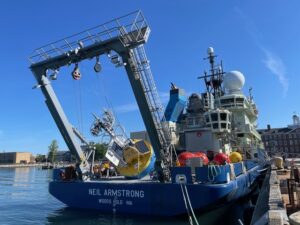
Image from work supported by the U.S. National Science Foundation Ocean Observatories Initiative. Credit: Sheri N. White © WHOI
This could lead to permanent gaps in long-term oceanographic datasets, disrupting longitudinal studies on climate change and ocean health. The data the OOI provides is difficult, dangerous and expensive to obtain through ship expeditions. The loss of the OOI could threaten the U.S.’s scientific leadership and result in the loss of significant expertise.
The NSF will remove all water infrastructure from the Irminger Sea, Station Papa and the Endurance and Pioneer Arrays. The recovered equipment will be retained by the operating institutions pending further guidance from NSF. The Regional Cabled Array, which provides power and bandwidth connectivity through a network of fiber-optic cables, will remain operational for the foreseeable future. All previously collected data will remain accessible through the OOI Data Center.
“Right now, our focus is on managing the transition responsibly, including the recovery and stewardship of OOI assets, preserving access to the data archive and doing what we can to retain the highly specialized expertise that made the program successful. We are also exploring whether some capabilities can continue through partnerships or other arrangements so that the investments made in OOI continue to benefit the oceanographic community well into the future,” Suzanne Pelisson, director of public relations at the Woods Hole Oceanographic Institution, which leads the consortium that operates the OOI, said in an email to R&D World.
The OOI is funded by the National Science Foundation (NSF) and has been operational since 2016, with an intended 25-year lifespan. The administration has previously tried to decrease the OOI’s funding by 80% in 2025 and 2026. Congress restored funding both years.
The OOI operates across the Atlantic and Pacific oceans with global, coastal and cabled arrays that monitor climate processes, coastal sea levels, fishery health and seismic activity. The sensors are fixed to the sea floor, some as deep as 9,200 feet. The network also consists of remotely controlled robotic vehicles and gliders.
Scientists use data from the OOI to study the Atlantic Meridional Overturning Circulation, carbon sequestration, ocean-atmosphere interaction, fisheries and ecosystems and more.
“These long-term observations not only improve weather and climate predictions but also help us track the health of the ocean and make informed decisions in a rapidly changing world. Losing those observations will affect research on climate, ocean circulation, air-sea interaction, ecosystems and ocean technology, while also reducing the long-term records that help scientists understand change over time,” Pelisson said in her email.
NSF spokesman Michael England told the New York Times that the decision “aligns with NSF’s wider strategy to have a nimbler approach to prioritizing support for evolving scientific priorities and emerging technologies as well as a deliberate approach to smart life cycle management within its portfolio of research infrastructure.”
Ship-based removal operations began off the coasts of Oregon, Washington, Alaska, North Carolina and the Irminger Sea this month. The entire removal process is expected to take approximately 15 months. Seismic instruments positioned around an active underwater volcano off the coast of Oregon are scheduled to remain operational until 2028.
“The impacts extend beyond WHOI. OOI has been a major customer and testing ground for the U.S. ocean instrumentation community. The descoping will likely reduce revenue for many small ocean technology companies and eliminate an important environment where engineers, scientists and vendors worked together to improve instrument reliability, calibration methods and new observing technologies. The loss will be felt across both the ocean science and ocean technology communities,” Pelisson said in an email.
The OOI encourages investigators to continue using OOI datasets in proposals and publications, referencing OOI-enabled science outcomes and identifying opportunities for research using the existing data.
“We are profoundly grateful for the extraordinary efforts of the scientists, engineers, operators, educators, students and partners who made this facility possible and who continue to advance its legacy through the use of its data,” Jim Edson, a principal investigator at the OOI, said in a statement.
The OOI “was not only a science program, it was also a major engine for U.S. ocean technology innovation,” Pelisson said. “Nothing can fully replicate the capabilities of OOI.”