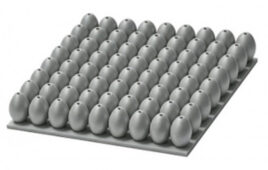
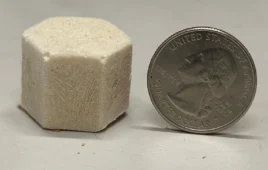
When researchers Marc Hillmyer and Christopher Ellison created their compostable plastic, they focused on accelerating PLA’s degradation without sacrificing other properties such as strength and shelf life.
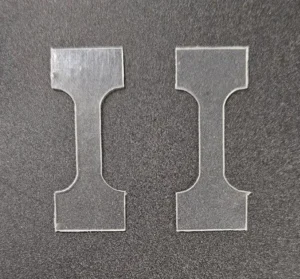
PLA plastic (left piece) usually takes months to break down in industrial composting facilities, but incorporating a sprinkling of an organic additive dramatically speeds the process for a modified PLA plastic (right piece) to less than three weeks.
Credit: Jinsol Yook
In a paper published in ACS Central Science, the researchers describe polylactide (PLA) blends that reach 90% biodegradation in 11 days under composting conditions and hold up on the shelf, maintaining their mechanical properties almost as well as standard PLA after 11 months at room temperature.
PLA, which is widely used in packaging and biomedical applications, accounts for roughly two-thirds of total bio-based and biodegradable plastics production worldwide, but it can only be composted in an industrial composting facility, which only 18% of the U.S. population has access to.
The researchers wanted to find a better way to create compostable PLA that allowed it to break down in home composting. To do so, they blended PLA with small amounts of organic anhydrides, called masked acids, because they activate and catalyze the degradation of the plastic when exposed to water.
The team created two plastic films with different masked acids: phthalic anhydride (PAn) and 2-sulfobenzoic acid cyclic anhydride (SAn). SAn is strong enough to break down PLA with as little as 100 ppm to 2 wt%.
Durability data backs up the degradation claims
PLA blended with 0.01 wt% SAn, a loading of 100 ppm, showed no significant molecular weight decrease after 11 months at room temperature. The 0.05 wt% blend held up almost as well; its molar mass dropped by 36% from 69 kg/mol to 44 kg/mol. Both blends retained mechanical properties comparable to unmodified PLA.
The researchers further tested the blend with cyclic conditioning tests: three days at ambient conditions followed by three days of high humidity (60 to 80% relative humidity), repeated twice. Both blends came through two full cycles with mechanical properties still comparable to neat PLA.
The team also ran a head-to-head respirometry comparison. Using polyethylene terephthalate (PET) as a negative control and cellulose as a positive control, they found cellulose reached 90% biodegradation after 62 days at 58 °C, and unmodified PLA reached 83% after 90 days. PLA blended with 0.1 wt% SAn hit 90% biodegradation in 11 days and complete breakdown in 21 days, faster than cellulose.
“I think we see a path here,” Hillmyer said, “because it’s low concentrations of stuff that we can get, and it has a big effect, so from a standpoint of getting out of the laboratory and into real products, we both see a path that way.”
A possible path into biomedical applications
PLA is also commonly used in biomedical applications, including sutures, orthopedic fixation hardware and drug delivery systems. The material breaks down into its component molecules, and the body naturally processes these. Although their paper focuses on packaging applications, the PLA blend could be used in biomedical applications as well, though further testing is needed.
“Biomedical applications are also on the table, because you may want an implant that degrades more rapidly in certain applications,” Hillmyer said. “We have low levels of additives, but you have to worry about the unintended consequences of those additives in a biological environment. That’s to be studied, to be explored, but we’re starting from a good point, in the sense that there’s very little of it in there.”
Microplastics aren’t a major concern, Hillmyer and Ellison said, because as the particles form, their increased surface area speeds up further breakdown until they’re fully broken down into molecules.
“This is different from polyolefins or other polymers that don’t have a degradation profile,” Ellison said. “Those become microplastics and nanoplastics and can exist for much longer periods. But aliphatic polyesters, these kinds of materials, have hydrolysis and biodegradation pathways.”
What the research doesn’t yet answer
“We don’t want to create another problem for composting that is unanticipated. As much as we can, we want to investigate that we’re not solving one problem while creating another,” Ellison said.
“We need to do, and we are doing, more compost testing, looking at lower temperatures. If you compost nearer to room temperature, or something more representative of home compost, how would the speed of composting for PLA change with these additives? Part of that is also learning about the full range of tunability, what concentrations are required, is it the same as what we report in the paper?” he said.
For both packaging and biomedical applications, the researchers are hoping that a small enough intervention, tuned carefully, can make PLA more biodegradable without sacrificing the properties that make it useful. Whether that will hold up commercially still depends on questions the current paper doesn’t answer: how the blend behaves outside of lab conditions and whether it behaves in a biological environment the same way it does on the shelf or in the compost bin.
“That’s something that in the sustainable plastics arena can be challenging, no doubt,” Hillmyer said, “but I think we’re optimistic about where this could take us.”