For years, international climate targets have been calculated using the assumption that the world’s northern permafrost would act as a carbon sink through the end of the century. Now, a paper published in Science Advances finds that the northern land carbon sink will become a carbon source in the 2050s.
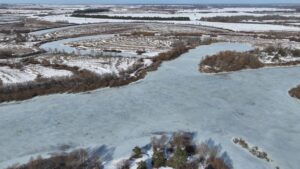
Permafrost in Russia. Adobe
The northern permafrost region, which covers 15% of the Northern Hemisphere’s land surface, holds approximately one-third of the Earth’s soil organic carbon, and the area is warming three times faster than the global average. CMIP6 models, which inform Intergovernmental Panel on Climate Change (IPCC) projections, treat the zone as a net carbon sink through 2100 and predict that rising temperatures will boost plant productivity, driving continuous soil carbon accumulation
The CENTURY framework, built for grasslands, completely ignores depth measurements
The CENTURY model framework, which ORCHIDEE-MICT and most CMIP6 models are built on, was developed in the 1980s for grassland soils, not Arctic permafrost. The framework uses conceptual carbon pools defined by turnover time, rather than physical depth, making it ill-suited to represent Yedoma or deep peat deposits. This means that the software guiding global climate policy ignores physical depth, missing massive carbon deposits.
The team updated the ORCHIDEE-MICT model to simulate two deep carbon formation processes. The model simulated Yedoma sedimentation beginning 21,000 years ago and spatially variable peatland inception during the Holocene. Previously, Yedoma and peatland carbon accumulation were developed in separate branches of ORCHIDEE-MICT and had never been integrated into a single framework.
The new ORCHIDEE-MICT model incorporates up to 20 meters of Yedoma and 10 meters of peat carbon across all northern lands above 30 degrees of latitude north and runs historical simulations from 1900 to 2014 and future projections to 2100 under three scenarios.
Including the deep carbon data raises the estimated preindustrial total organic carbon stock across the northern hemisphere to 2,028 Pg C, 226 Pg C higher than the old model. That extra 226 Pg C is primarily concentrated in fast-turnover “active” and “slow” pools rather than the highly stable passive pool, meaning it is more vulnerable to decomposition once thawed.
The permafrost could become a carbon source in 25 years
Under the old model, total organic carbon rises continuously through 2100 under low emissions and under high emissions it peaks around 2065 before declining, but the permafrost region accumulates so much carbon beforehand that it still ends the century at a net gain of 42 to 65 Pg C. Under the updated model, the permafrost becomes a carbon source around 2055 under high emission scenarios and ends the century at a net carbon loss of 3 to 32 Pg C relative to 1900.
Additionally, previously undermonitored nonsummer emissions have increased substantially, with more than 30% of permafrost ecosystems already functioning as net carbon sources, which old models also were not capturing.
The updated ORCHIDEE-MICT model doesn’t include thermokarst lake formation and abrupt thaw, wildfire-permafrost interactions, methane emissions, changes in northern vegetation dynamics and nutrient cycle feedbacks, all of which could accelerate the timeline and worsen the magnitude of carbon loss. The researchers state that their updated 2050 estimate represents a conservative lower bound, meaning the permafrost could become a carbon source even sooner.
If the northern soils become a net carbon source in the 2050s rather than remaining a sink through 2100 as the updated model suggests, the remaining carbon budget calculated for the 2 degrees Celsius target is an overestimate. Human emissions would need to be cut faster to remain within the target to account for this.
The recurring pattern of underestimation
CENTURY is not the first framework to fail to accurately simulate climate scenarios. For years, IPCC-class models predicted that the collapse of the Atlantic Meridional Overturning Circulation (AMOC), a system of ocean currents that pumps warm water north, was highly unlikely. Researchers updated ocean models to precisely map early warning signals, specifically looking at how freshwater from melting ice blocks ocean sinking. Compounding early-warning models now suggest a collapse could realistically trigger between mid-century and 2100. The collapse could decrease European temperatures by 10 to 15 degrees Celsius.
Similarly, old ice sheet models viewed Antarctica as relatively stable through 2100, only contributing to global sea level rise by a few centimeters. In 2016, scientists updated the models to include hydrofracturing and Marine Ice Cliff Instability, which changed the estimates to over 1 meter under high-emission scenarios.
Similar to the Arctic permafrost, the Amazon rainforest has long been considered a carbon sink. Models predicted it would continue to absorb carbon dioxide into the late 21st century. Then, models began to integrate localized data on tree mortality from droughts, rising temperatures and human deforestation, revealing that large parts of the rainforest were already acting as a carbon source.
Studies like these reveal that every climate estimate should be treated as a conservative lower bound. Consistently, new information reveals scenarios that are more drastic than previously estimated. Unfortunately, humanity, and the Earth as a whole, may not have the time to wait for more accurate predictions. Already, climate change is displacing entire communities and driving species to extinction. Climate modeling remains vital for predicting the effects of climate change, and each iteration reinforces the importance of decreasing emissions as much and as fast as possible.