Research & Development World

  • R&D World Home
  • Topics
    • Aerospace
    • Automotive
    • Biotech
    • Careers
    • Chemistry
    • Environment
    • Energy
    • Life Science
    • Material Science
    • R&D Management
    • Physics
  • Technology
    • 3D Printing
    • A.I./Robotics
    • Software
    • Battery Technology
    • Controlled Environments
      • Cleanrooms
      • Graphene
      • Lasers
      • Regulations/Standards
      • Sensors
    • Imaging
    • Nanotechnology
    • Scientific Computing
      • Big Data
      • HPC/Supercomputing
      • Informatics
      • Security
    • Semiconductors
  • R&D Market Pulse
  • R&D 100
    • 2026 R&D 100 Award Winners
    • 2026 Professional Award Winners
    • 2026 Special Recognition Winners
    • R&D 100 Awards Event
    • R&D 100 Submissions
    • Winner Archive
  • Resources
    • Research Reports
    • Digital Issues
    • Educational Assets
    • Subscribe
    • Video
    • Webinars
    • PharmSci360
    • Content submission guidelines for R&D World
  • Global Funding Forecast
  • Top Labs
  • Advertise
  • SUBSCRIBE

Cheap asphalt provides “green” carbon capture

By R&D Editors | January 7, 2015

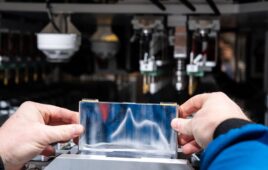
Each grain of a powder drawn from asphalt has the ability to capture more than its own weight in carbon dioxide under pressure. The material invented at Rice Univ. is intended to separate carbon dioxide from streams at natural gas wellheads. Image: Jeff Fitlow The best material to keep carbon dioxide from natural gas wells from fouling the atmosphere may be a derivative of asphalt, according to Rice Univ. scientists.

The Rice laboratory of chemist James Tour followed up on last year’s discovery of a “green” carbon capture material for wellhead sequestration with the news that an even better compound could be made cheaply in a few steps from asphalt, the black, petroleum-based substance primarily used to build roads.

The research appears in Applied Materials and Interfaces.

The best version of several made by the Tour lab is a powder that holds 114% of its weight in carbon dioxide. Like last year’s material, these new porous carbon materials capture carbon dioxide molecules at room temperature while letting the desired methane natural gas flow through.

The basic compound known as asphalt-porous carbon (A-PC) captures carbon dioxide as it leaves a wellhead under pressure supplied by the rising gas itself (about 30 atmospheres, or 30 times atmospheric pressure at sea level). When the pressure is relieved, A-PC spontaneously releases the carbon dioxide, which can be piped off to storage, pumped back downhole or repurposed for such uses as enhanced oil recovery.

“This provides an ultra-inexpensive route to a high-value material for the capture of carbon dioxide from natural gas streams,” Tour said. “Not only did we increase its capacity, we lowered the price substantially.” He said they tried many grades of asphalt, some costing as little as 30 cents per pound.

Tour’s goal is to simplify the process of capturing carbon from wellheads at sea, where there’s limited room for bulky equipment. The ability of A-PC to capture and release carbon over many cycles without degrading makes it practical, he said.

The paper’s lead authors, postdoctoral associate Almaz Jalilov and graduate student Gedeng Ruan, and their Rice colleagues made A-PC by mixing asphalt with potassium hydroxide at high temperature; they turned it into a porous carbon with a lot of surface area: 2,780 square meters per gram. That material captured 93% of its weight in carbon dioxide. Further experiments showed processing A-PC with ammonia and then hydrogen increased its capacity to 114%.

Tour said the lab is continuing to tweak the material but noted that it’s already better for carbon capture than other materials in current use. Amine-based materials now used by industrial facilities like power plants to absorb carbon dioxide are expensive and corrosive and can only capture about 13% carbon dioxide by weight. Materials in development based on metal organic frameworks are far more expensive to produce and don’t show as great a selectivity for carbon dioxide over methane, he said.

Source: Rice Univ.

Related Articles Read More >

Inside the Lab: Can AI Solve the Critical Materials Challenge?
DOE’s fusion voucher program opens to consortia and pilot-plant reviews
A researcher handles a prismatic battery cell on PNNL’s manufacturing line.
DOE’s BattMan brings four national labs together to de-risk battery scale-up
INL’s $60 million nuclear AI project will spend the first year testing where AI agents can help and where they might hurt 
rd newsletter
EXPAND YOUR KNOWLEDGE AND STAY CONNECTED
Get the latest info on technologies, trends, and strategies in Research & Development.

R&D World Digital Issues

Fall 2026 issue

Browse the most current issue of R&D World and back issues in an easy to use high quality format. Clip, share and download with the leading R&D magazine today.

R&D 100 Awards
Research & Development World
  • Subscribe to R&D World Magazine
  • Sign up for R&D World’s newsletter
  • Contact Us
  • About Us
  • Drug Discovery & Development
  • Pharmaceutical Processing
  • Global Funding Forecast

Copyright © 2026 Arrowfly LLC. All Rights Reserved. The material on this site may not be reproduced, distributed, transmitted, cached or otherwise used, except with the prior written permission of Arrowfly
Privacy Policy | Advertising | About Us

Search R&D World

  • R&D World Home
  • Topics
    • Aerospace
    • Automotive
    • Biotech
    • Careers
    • Chemistry
    • Environment
    • Energy
    • Life Science
    • Material Science
    • R&D Management
    • Physics
  • Technology
    • 3D Printing
    • A.I./Robotics
    • Software
    • Battery Technology
    • Controlled Environments
      • Cleanrooms
      • Graphene
      • Lasers
      • Regulations/Standards
      • Sensors
    • Imaging
    • Nanotechnology
    • Scientific Computing
      • Big Data
      • HPC/Supercomputing
      • Informatics
      • Security
    • Semiconductors
  • R&D Market Pulse
  • R&D 100
    • 2026 R&D 100 Award Winners
    • 2026 Professional Award Winners
    • 2026 Special Recognition Winners
    • R&D 100 Awards Event
    • R&D 100 Submissions
    • Winner Archive
  • Resources
    • Research Reports
    • Digital Issues
    • Educational Assets
    • Subscribe
    • Video
    • Webinars
    • PharmSci360
    • Content submission guidelines for R&D World
  • Global Funding Forecast
  • Top Labs
  • Advertise
  • SUBSCRIBE