Research & Development World

  • R&D World Home
  • Topics
    • Aerospace
    • Automotive
    • Biotech
    • Careers
    • Chemistry
    • Environment
    • Energy
    • Life Science
    • Material Science
    • R&D Management
    • Physics
  • Technology
    • 3D Printing
    • A.I./Robotics
    • Software
    • Battery Technology
    • Controlled Environments
      • Cleanrooms
      • Graphene
      • Lasers
      • Regulations/Standards
      • Sensors
    • Imaging
    • Nanotechnology
    • Scientific Computing
      • Big Data
      • HPC/Supercomputing
      • Informatics
      • Security
    • Semiconductors
  • R&D Market Pulse
  • R&D 100
    • 2025 R&D 100 Award Winners
    • 2025 Professional Award Winners
    • 2025 Special Recognition Winners
    • R&D 100 Awards Event
    • R&D 100 Submissions
    • Winner Archive
  • Resources
    • Research Reports
    • Digital Issues
    • Educational Assets
    • R&D Index
    • Subscribe
    • Video
    • Webinars
    • Content submission guidelines for R&D World
  • Global Funding Forecast
  • Top Labs
  • Advertise
  • SUBSCRIBE

3D Electron Microscopy Uncovers the Complex Guts of Desalination Membranes

By Pennsylvania State University | September 19, 2018

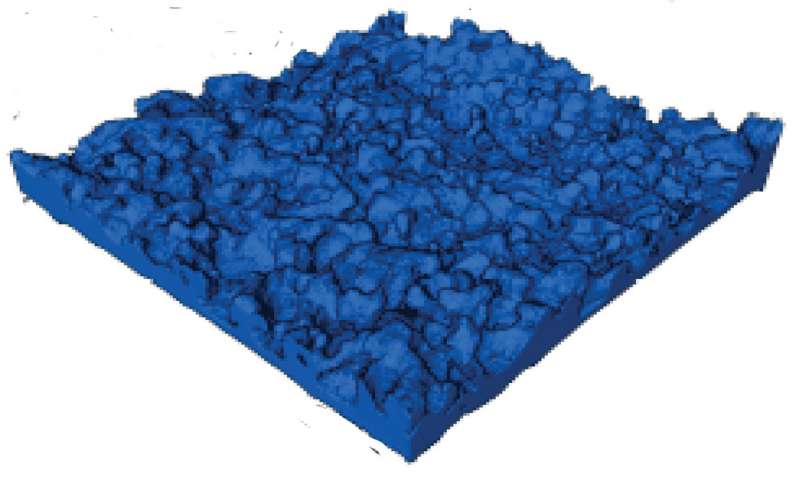
Internal structure of the polyamide thin film. Credit: Enrique Gomez, Penn State

Careful sample preparation, electron tomography and quantitative analysis of 3-D models provides unique insights into the inner structure of reverse osmosis membranes widely used for salt water desalination wastewater recycling and home use, according to a team of chemical engineers.

These reverse osmosis membranes are layers of material with an active aromatic polyamide layer that allows water molecules through, but screens out 99 to 99.9 percent of the salt.

“As water stresses continue to grow, better membrane filtration materials are needed to enhance water recovery, prevent fouling, and extend filtration module lifetimes while maintaining reasonable costs to ensure accessibility throughout the world,” said Enrique Gomez, professor of chemical engineering, Penn State. “Knowing what the material looks like on the inside, and understanding how this microstructure affects water transport properties, is crucial to designing next-generation membranes with longer operational lifetimes that can function under a diverse set of conditions.”

Gomez and his team looked at the internal structure of the polyamide film using high-angle annular dark field scanning transmission electron microscopy (HAADF-STEM) tomography. HAADF-STEM’s image intensity is directly proportional to the density of the material, allowing mapping of the material to nanoscale resolution.

“We found that the density of the polyamide layer is not homogeneous,” said Gomez. “But instead varies throughout the film and, in this case, is highest at the surface.”

This discovery changes the way the engineers think about how water moves through this material, because the resistance to flow is not homogeneous and is highest at the membrane surface.

HAADF-STEM allowed the researchers to construct 3-D models of the membrane’s internal structure. With these models, they can analyze the structural components and determine which characteristics must remain for the membrane to function and which could be manipulated to improve membrane longevity, antifouling, and enhance water recovery.

Another characteristic revealed through HAADF-STEM was the presence, or rather absence, of previously reported enclosed voids. Researchers thought that the membranes fine structure would contain enclosed void spaces that could trap water and alter flow patterns. The 3-D models show that there are few closed voids in the state-of-the-art material studied.

“Local variations in porosity, density and surface area will lead to heterogeneity in flux within membranes, such that connecting chemistry, microstructure and performance of membranes for reverse osmosis, ultrafiltration, virus and protein filtration, and gas separations will require 3-D reconstructions from techniques such as electron tomography,” the researchers report in a recent issue of Proceedings of the National Academy of Sciences.

The researchers would like to push the resolution of this technique to below 1 nanometer resolution.

“We don’t know if sub nanometer pores exist in these materials and we want to be able to push our techniques to see whether these channels exist,” said Gomez. “We also want to map how flow moves through these materials to directly connect how the microstructure affects water flow, by marking or staining the membrane with special compounds that can flow through the membrane and be visualized in the electron microscope.”


Related Articles Read More >

New engineered proteins could make disease tracking portable and precise
New method achieves 89% defluorination of PFOA in lab tests
MIT team uses mysterious cell structure to record genetic activity
Detail of cola drink with ice cubes, fresh beverages background.
If a YouTuber can reverse-engineer Coke, is your trade secret safe?
rd newsletter
EXPAND YOUR KNOWLEDGE AND STAY CONNECTED
Get the latest info on technologies, trends, and strategies in Research & Development.
RD 25 Power Index

R&D World Digital Issues

Fall 2025 issue

Browse the most current issue of R&D World and back issues in an easy to use high quality format. Clip, share and download with the leading R&D magazine today.

R&D 100 Awards
Research & Development World
  • Subscribe to R&D World Magazine
  • Sign up for R&D World’s newsletter
  • Contact Us
  • About Us
  • Drug Discovery & Development
  • Pharmaceutical Processing
  • Global Funding Forecast

Copyright © 2026 WTWH Media LLC. All Rights Reserved. The material on this site may not be reproduced, distributed, transmitted, cached or otherwise used, except with the prior written permission of WTWH Media
Privacy Policy | Advertising | About Us

Search R&D World

  • R&D World Home
  • Topics
    • Aerospace
    • Automotive
    • Biotech
    • Careers
    • Chemistry
    • Environment
    • Energy
    • Life Science
    • Material Science
    • R&D Management
    • Physics
  • Technology
    • 3D Printing
    • A.I./Robotics
    • Software
    • Battery Technology
    • Controlled Environments
      • Cleanrooms
      • Graphene
      • Lasers
      • Regulations/Standards
      • Sensors
    • Imaging
    • Nanotechnology
    • Scientific Computing
      • Big Data
      • HPC/Supercomputing
      • Informatics
      • Security
    • Semiconductors
  • R&D Market Pulse
  • R&D 100
    • 2025 R&D 100 Award Winners
    • 2025 Professional Award Winners
    • 2025 Special Recognition Winners
    • R&D 100 Awards Event
    • R&D 100 Submissions
    • Winner Archive
  • Resources
    • Research Reports
    • Digital Issues
    • Educational Assets
    • R&D Index
    • Subscribe
    • Video
    • Webinars
    • Content submission guidelines for R&D World
  • Global Funding Forecast
  • Top Labs
  • Advertise
  • SUBSCRIBE