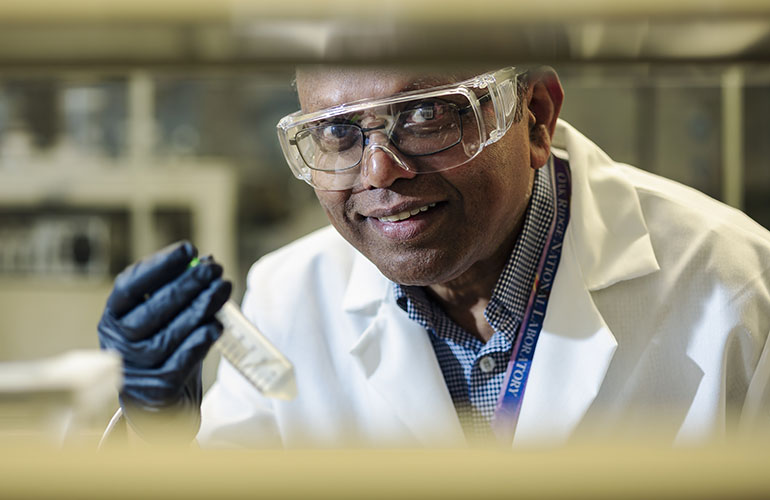
Parans Paranthaman conducts lithium extraction research using brines at Oak Ridge National Laboratory. Credit: Carlos Jones/ORNL, U.S. Department of Energy.
M. Parans Paranthaman, Ph.D., a Corporate Fellow and UT-Battelle Distinguished Inventor in the Chemical Sciences Division at Oak Ridge National Laboratory (ORNL), has built a career around carrying research to a working technology. Since joining ORNL in 1993, he has helped develop superconducting wire technologies, battery materials and methods for recovering lithium from oilfield wastewater. The R&D 100 Researcher of the Year has more than 500 peer-reviewed papers, 65 issued U.S. patents and more than 110 inventions, and 14 companies have licensed technologies he helped develop. His h-index, which reflects both how much a researcher publishes and how often that work is cited, is 84. Physicist Jorge Hirsch, who proposed the metric in 2005, wrote that an h-index of 40 after 20 years marks an “outstanding” scientist.
A clear rule connects Paranthaman’s achievements. “You have to focus, because if you lose focus, you can’t deliver,” he said. “I don’t go by regular hours and days. I focus on the technology.” He emphasizes completion with a baseball analogy he uses with his mentees: “It doesn’t matter that you can say, ‘I am the hard hitter.’ If you don’t get a home run, if you don’t assist anyone, it’s zero runs. That’s why you have to complete. Deliverables and completion are very, very important.”
Paranthaman credits his high school teachers, who introduced him to chemistry, physics and math, for inspiring him. “My inspiration mainly came from my high school teachers,” he said. After earning bachelor’s and master’s degrees in chemistry from Madurai Kamaraj University, he pursued a doctorate in materials science and solid-state chemistry at the Indian Institute of Technology Madras, where “I was inspired by so many visitors, colleagues and professors.” Postdoctoral work at the University of Texas at Austin brought him to John B. Goodenough, Ph.D., who later shared the 2019 Nobel Prize in Chemistry for the lithium-ion battery at 97, “the oldest person to win a Nobel Prize,” Paranthaman noted. Working with Goodenough meant bringing him results. “You wait outside his office with the data. He will be very busy. You have to show him. Then he gets excited and explains the mechanism.”
Paranthaman has since paid that inspiration forward, mentoring or co-advising more than 180 people, including doctoral and master’s students, postdoctoral researchers, undergraduates, college teachers and some 70 high school teachers.
Many of those mentees are undergraduate interns who arrive unsure what to specialize in or whether to pursue an advanced degree. “I make sure to tell them undergraduate is not enough; go to graduate school,” he said. He says he has a high success rate turning interns into graduate students, and he gives them “freedom to think.” Even during short stints, they’re excited to come up with new ideas, working “toward a patent and in many cases publications.”
Mentoring high school teachers is a priority for Paranthaman as well. “We work especially with a lot of high school teachers in the Appalachian region,” he said. Few of those schools have proper science labs. “When they come here, we expose them to research and teach them, so they can go and start science labs in their high school curriculum,” he said. “So many of those high school teachers are still in touch with me.”
From superconducting tape to oilfield lithium
One of Paranthaman’s signature contributions sits between a strip of nickel and a superconducting film. In the 1990s, Oak Ridge researchers were developing RABiTS, short for rolling-assisted biaxially textured substrates, a way to manufacture long lengths of superconducting tape. Rolling and heating nickel aligned its crystal grains, creating a template for the superconductor. Growing the film, however, could oxidize the nickel and destroy that alignment. Paranthaman developed the buffer-layer architecture that protected the metal and transferred its crystal orientation to the superconducting film, helping enable kilometer-length tapes. Decades later, he still works with SuperPower, a New York wire maker owned by Japan’s Furukawa Electric that licensed ORNL technology in the 1990s and 2000s. The company now supplies superconducting wire for fusion magnets, including several hundred kilometers of tape for Tokamak Energy’s ST80-HTS prototype. “So it’s all coming back again,” he said.
A more recent payoff took him to Midland, Texas. There, Element3, a Fort Worth company founded in 2021, built a plant that recovers lithium from produced water, the salty wastewater that comes up alongside oil and gas. Oil fields generate a lot of it: about four barrels of water for every barrel of oil. The plant draws on water from the Permian Basin, the vast oil field spanning West Texas and southeastern New Mexico. In 2024, Element3 licensed seven ORNL lithium-recovery technologies that Paranthaman and his ORNL colleagues developed, including membrane extraction techniques and new separation methods. In February, Paranthaman attended the ribbon cutting for the plant, which Texas Gov. Greg Abbott billed as the first in the U.S. to make lithium carbonate from oilfield waste. “That was really fulfilling, to see a very recent technology go from the lab into the commercial space,” Paranthaman said.
The superconductor playbook still applies. “What I learned from superconductivity, how we did it, I use the same strategy even now: how to do research at the lab level and then take it to commercialization.”
“Brines to batteries, mines to magnets”
Paranthaman sums up his current focus in two phrases: “brines to batteries” and “mines to magnets.” Element3 covers the first. For the second, ORNL is negotiating to license rare-earth recovery technology to Momentum Technologies, a Dallas company that already recycles batteries and magnets and plans to recover rare earths, lithium and other elements from them. Next on the list are gallium and germanium, which wide-bandgap semiconductors depend on. China began requiring export licenses for both in 2023 and banned their export to the U.S. in December 2024. It suspended that ban in November 2025 through Nov. 27, 2026, but the license requirements remain. Paranthaman expects the Momentum work to move quickly because the company has “already done battery and magnet recycling, so they have all the infrastructure to work on this new material with us and take it forward.”
That kind of head start is part of why he thinks the timeline has changed. “In the ’90s, any technology took 10 to 15 years to commercialize,” he said. “With the advancements we have now, you can do it in two to three years.” Asked what made the difference, he named funding, facilities and a workforce, and then the step where lab technologies often stall: scale-up. Through DOE projects, Oak Ridge can carry a technology to pre-pilot scale before a company takes it over. “We help companies with the pre-pilot-scale demonstration at a national lab,” he said. “Then it’s easy for them, because we have already done the groundwork.”
Even from a national lab, Paranthaman keeps a close read on industry through his partners, a relationship he describes as a loop: “You tell them your ideas, they test them and give feedback back and forth.” That exchange, along with visits to sites such as the lithium plant Rio Tinto built at its Boron, Calif., operation, shows him what companies are actually ramping up, and right now the pace is fast. “Like 90% are coming from China, so everything is blocked,” he said of rare earths. The U.S. has gone from having no rare-earth magnet manufacturers to at least 10 to 15 companies working on them, he estimates, and MP Materials is already producing magnets.
Asked how countries and companies can improve the odds that their R&D spending turns into technology people actually use, Paranthaman pointed to a problem bigger than any single partner. “One thing that is lacking here is long-term commitment,” he said. “Japan and other countries commit for the longer term. Here we have to go through different governments and administrations, and things change.” The U.S. has the plans, he said, “but we cannot execute them.” His career has tracked those changes, from superconductors to photovoltaics to batteries and now the domestic supply chain. “Since we work for the Department of Energy, we go by what the government wants us to do,” he said. “So we have to be ready.”
His enthusiasm has outlasted those shifts. “I still get excited to come to work, even after 33 years,” he said. “People ask me when I’m going to retire. I say my boss, John Goodenough, was almost 40 years older than me, and he was still working.”



Tell Us What You Think!
You must be logged in to post a comment.