The revolution will not be televised. The revolution will not feature protests at the factory gates or workers marching against the machines. The revolution will not be debated on cable news or hashtagged into a culture war. The revolution will arrive on a Tuesday at a facility short of 47 technicians, and it will clock in without fanfare. The Fourth Industrial Revolution is finally here. The machines just hum.
For all the talk about Industry 4.0, a term that surfaced in Germany in 2011, digital maturity on the factory floor has remained uneven. Many plants still operate with islands of automation, fragile integrations and far more specific domain knowledge than most executives are willing to admit.
These plants have automated processes, but these processes have limited communication with each other, creating “islands” that data and information have to jump between.
Industry 4.0, named for the so-called fourth industrial revolution, describes the joining of technologies such as artificial intelligence and automation, fundamentally shifting how the global production and supply chain operates.
The central vision for Industry 4.0 is that the entire production line would be layered with IoT sensors, centralized AI and analytics platforms and automated equipment that can learn and adjust automatically. This is the “smart factory” that runs with minimal human involvement. This minimal human involvement is becoming more and more necessary as the growing labor crisis is growing more urgent. In essence, old employees are retiring, but fresh graduates aren’t replacing them.
The labor crisis: a global phenomenon
The labor market explains why the temperature is changing now. Roughly 400,000 manufacturing jobs sit open month after month in the U.S., a level that keeps “fully staffed” out of reach for most facilities. The workforce that does show up is aging, with an average age of about 44 in manufacturing, while the share of young men entering the labor force has collapsed by a third since the late 1980s; just one in 12 manufacturing workers is younger than 25 today. As of Sept. 2025, there were 12.7 million people in U.S. manufacturing jobs, well below the 17.2 million in 2000. By 2033, the industry may need 3.8 million new workers, with 1.9 million of those roles at risk of going unfilled if challenges remain, Deloitte reports.
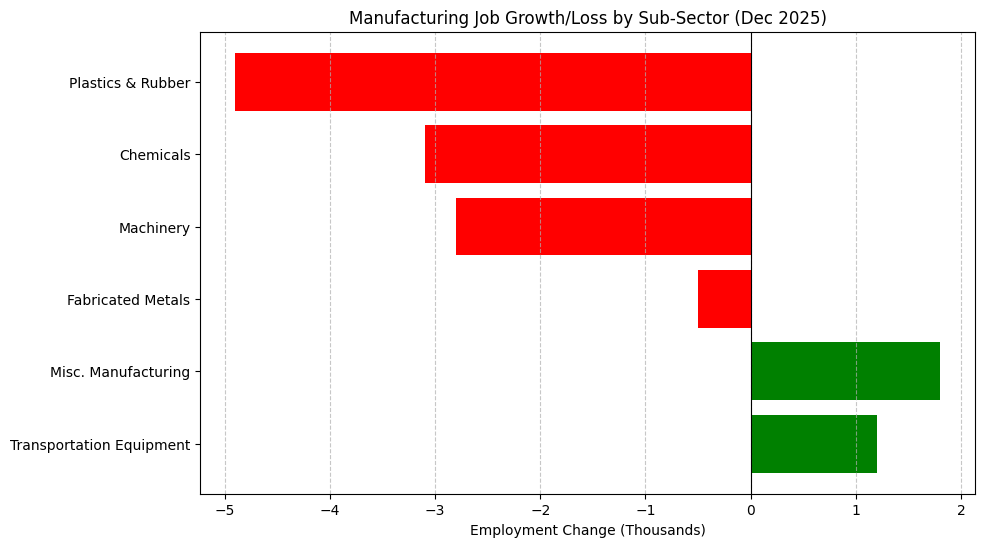
Data from BLS
The problem extends beyond the U.S. Germany’s Federal Employment Agency counted 439,000 skilled-worker vacancies in 2024, with mechanical engineering among the hardest hit. The European Labour Authority identified “plant and machine operators and assemblers” as the second most common shortage occupations in Europe in 2024, stating that Workers in sectors such as manufacturing will probably face dismissal due to AI and ML technologies. Manufacturing vacancy rates range across the continent, from 0.5% in Spain to 4.2% in the Netherlands.
Japan’s Tankan survey reveals that labor conditions are at their tightest in three decades, with two-thirds of Japanese companies now reporting a serious business impact from the shortage. South Korea crossed into “super-aged society” status last December: 20% of its population is now 65 or older, and projects its working-age population will shrink by a quarter over the next two decades. China, which has one of the world’s biggest industrial labor pools, said in 2022 that it faced a forecast shortfall of 30 million manufacturing workers by the mid-2000s. Now, youth unemployment runs near 17%. In other words, the generation that built the world’s factory floors is retiring. The generation that was supposed to replace them is showing up in smaller numbers.
The trend has broader generational dynamics. McKinsey reports that the rate of young workers entering the field is not enough to fill vacancies. Once hired, Gen Z workers are more likely to leave than older workers. “According to the research, Gen Z workers’ motivations for taking, keeping, or leaving a job are similar to those of older cohorts, although compensation is somewhat less of a draw compared with factors such as career development and advancement, flexibility, meaningful work, and caring leadership,” McKinsey states.
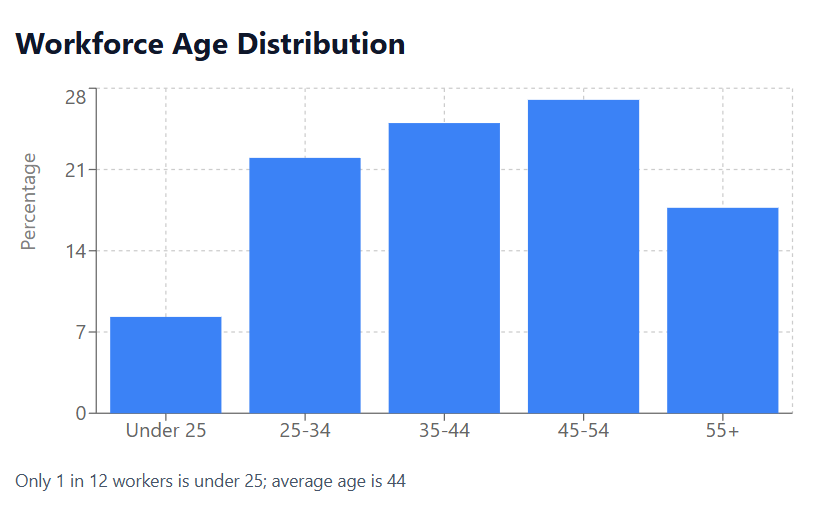
Data from BLS
Offering higher salaries isn’t solving the problem. In addition to pay, Gen Z wants flexibility and control over their career paths. When one consumer goods manufacturer restructured their system to focus on flexibility, staffing levels rose 25 percentage points and losses due to unscheduled line shutdowns fell by 70%, McKinsey reports.
The specialized engineering and IT recruiting and staffing firm 180 Engineering attributes the labor crisis to the complex skillsets required, retiring baby boomers, low numbers of young workers entering the workforce and a poor perception of manufacturing work. According to Soter Analytics surveyed more than 2,000 Gen Z respondents and found that only 14% would consider industrial work as a career, Fast Company reports.
The manufacturing industry also has something of an image problem. “The biggest misperception about manufacturing is what modern manufacturing really looks like; people just don’t know,” Carolyn Lee, president of the Manufacturing Institute, told CNBC. “They think that it’s antiquated or that you come in and you do one job. They don’t know that modern manufacturing today is all about technology.”
Additionally, education is moving away from the hands-on skills of vocational schools and placing more emphasis on traditional universities. A survey of 18 to 20-year-old Americans found that 74% perceive a stigma associated with choosing vocational schools over traditional colleges. The rapid advancement in technology is also leaving schools scrambling to keep students up to date.
Flexible manufacturing systems
The response is much the same as the prognosticators of Industry 4.0 imagined. That is, a layered suite of technologies working together to solve different parts of the same problem. At the base sits traditional automation. That includes robotic arms, conveyors, programmable logic controllers and other hardware types that have occupied factory floors for decades.
Flexible manufacturing systems (FMS) are taking over for ‘fixed’ automation. FMS is defined as “an integrated, computer-controlled manufacturing configuration that holds a mix of efficiency of automation with the adaptability of custom production.”
FMS can quickly switch between producing different products or product variations without major retooling, meaning a single assembly line can produce several products, eliminating the need for specialized human workers for each product. FMS uses computer numerical control (CNC) machines, automated material handling systems (like robotic arms and conveyors), and centralized computer control to manage production.
When skilled workers were abundant, the five-to-eight-year ROI on flexible systems made them a luxury. Now, with 400,000 open positions and rising labor costs, those same systems deliver payback in one to three years, according to McKinsey. Now, a $2 million FMS installation that eliminates the need for three specialized operators at $70,000 annually pays for itself before the warranty expires.
But implementation reveals gaps between promise and reality. Legacy equipment built in the 1990s wasn’t designed to communicate with modern control systems. Manufacturers now face a choice: expensive retrofits to bridge incompatible protocols or replacement cycles that strain capital budgets. The result is slower adoption than Industry 4.0 proponents predicted, with many plants running hybrid systems that create islands of automation.
FMS represents the bridge from ‘fixed’ automation to modern smart manufacturing. The global FMS market was valued at $14.2 billion in 2024 and is estimated to grow to $22.2 billion by 2030. According to Six Sigma, FMS has reduced setup times by 75% compared to traditional methods.
In the past, manufacturing costs were driven by mass production; today, they are driven by mass customization, the ability to produce a wide variety of products to meet expanding market demand.
IoT, Sensors and Connectivity
Internet of Things (IoT) sensors installed in machinery allow companies to monitor performance in real time and spot issues as they arise to prevent breakdowns. IoT sensors are becoming the nervous system of modern manufacturing.
According to Polaris Market Research, the global IoT sensors market was valued at USD 12.3 billion in 2024 and is anticipated to grow at a CAGR of 25.70% from 2025 to 2034 to a projected market value of $98.2 billion. According to data from Statistica, the number of industrial IoT connections worldwide grew from 1.32 billion industrial devices in 2018 to 4.37 billion devices in 2024.
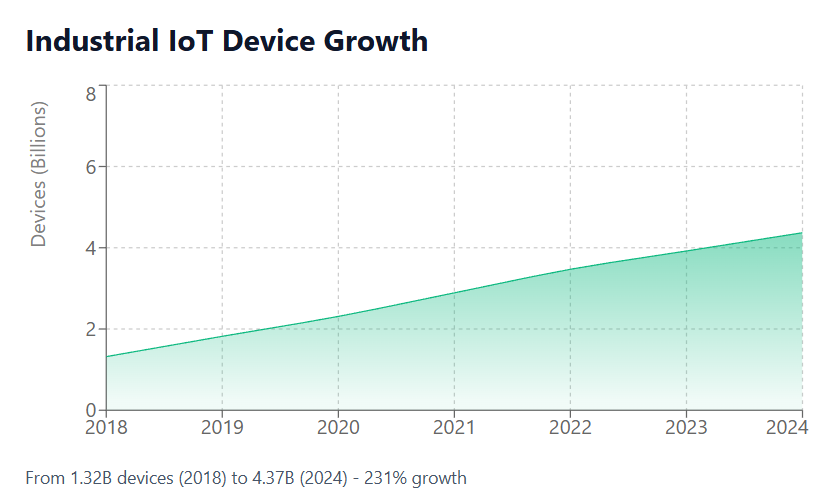
Data from Polaris Market Research
The integration of IoT sensors plays a vital role in enabling factories to automate tasks and monitor devices and machinery. Facilities can leverage IoT technologies to create connections and facilitate communication between devices. Machines can communicate with each other as well as with human operators, allowing for autonomous workflows, predictive analytics and rapid adjustments.
Siemens’ smart factory in Amberg, Germany, demonstrates the workforce transformation. The facility achieves 99.98% quality output with far fewer quality inspectors than traditional plants require. IoT sensors catch deviations in real-time, automatically adjusting processes without human intervention.
The challenge is who maintains these systems. A facility that once needed 20 machine operators now needs 15 operators and 2 data analysts who can interpret sensor outputs. Plants need workers who understand both manufacturing processes and data analytics.
Machine learning and computer vision
AI visual inspection helps to maintain quality control by detecting defects and deformations. The adoption of AI for this task is increasing, with more and more AI systems monitoring production lines. AI can detect patterns and issues that the human eye cannot detect with the help of computer vision technologies. Computer vision technology combines AI, image processing and machine learning to allow machines to see and interpret visual input.
According to Averroes, modern computer vision systems can achieve a 97% inspection accuracy. An industry analysis by Deloitte found that AI visual inspection has reduced defect escape rates by up to 83% across the manufacturing industry.
A semiconductor manufacturer in Taiwan reported a 10% reduction in scrap rates and 50% throughput increase after implementing visual inspection AI. In doing so, the facility eliminated 40 quality inspector positions. However, it also added 8 machine vision engineers and 12 process analysts who use defect data to improve upstream manufacturing.
Repetitive visual inspection jobs are vanishing. Meanwhile, positions requiring interpretation—root cause analysis, process optimization, exception handling—remain human. Companies need fewer people overall, but those people need higher skills.
As well as defect detection, AI can be used to detect damage in products and wear and tear of equipment. AI visual inspection relies on deep learning to identify a wide range of defects and imperfections, distinguish between critical and non-critical flaws and incorporate data-driven insights. The systems can be trained on datasets of labeled images to differentiate between defective and normal products.
Agentic AI
Agentic AI represents the sharpest break from the past. Where conventional automation executes pre-programmed rules and generative AI produces content on command, agentic systems reason through multi-step problems and act on their conclusions.
While agentic systems tend to be inherently probabilistic rather than deterministic, complicating their use in high-stakes environments, agentic systems are emerging that can order replacement parts and generate a repair guide before a technician arrives. BMW’s purchasing division now runs ten specialized AI agents that handle tender analysis and supplier data, supporting 1,800 users and fielding more than 10,000 search queries. Robotics manufacturer KUKA deploys agents that push predictive maintenance alerts to field technicians, “Hydraulic valve C, abnormal pressure, expected failure in three days,” then queue the parts and walk junior staff through repairs that once required senior expertise.
Agentic AI represents a transformative shift in artificial intelligence from systems that follow preset rules to agents that act with autonomy, initiative and adaptability. This extends the possibilities for automation from repetitive tasks to dynamic, automated workflows.
BMW’s implementation reveals the shift. What previously required 850 purchasing professionals now operates with 80% agent autonomy and 20% human oversight. Those remaining humans aren’t doing routine tender analysis; they’re handling exceptions, building supplier relationships and making strategic decisions the agents flag but can’t resolve.
This creates a new hiring challenge. The Chief Digital Officer role, which was rare a decade ago, is now standard at industrial companies. These executives need teams who can deploy, monitor and improve AI agents.
The human element
AI is predicted to eliminate 1.8 million jobs across all industries, but create 2.3 million new positions. Traditional assembly roles are declining while demand grows for technicians that can work with robots, perform maintenance on advanced equipment and use data to keep production running.
Rather than merely eliminating workers, AI is changing roles and responsibilities. Manufacturers are hiring in categories that didn’t exist 15 years ago: IoT network specialists, computer vision engineers, AI training specialists, digital twin architects and robotics coordinators.
Moving forward, machine operators will likely train as flexible generalists who are capable of overseeing an entire production line using digital tools and AI systems.
The challenge is speed. While AI can automate a quality inspection job overnight, training a machine operator to become a data analyst takes 6-12 months. Deloitte estimates that 35% of manufacturing workers will need up to six months of additional training, 9% will require a full year and 10% might need more than that.
Advanced technology may be something of a double-edged sword. While robots, for instance, can automate some tasks, the integration of some technologies may help to attract younger workers. 33% of Gen Z want to work for a company using new technologies, and 30% said they feel more equipped to learn new technologies than the generations before them. Gen Z’s digital fluency makes them strong candidates for the manufacturing industry as it continues to integrate innovations.
Conclusion
While the automation revolution will not be televised, automation economics have fundamentally shifted. Technologies that required eight-year payback periods now deliver ROI in 18 months. Computer vision has effectively solved routine quality inspection. Flexible manufacturing systems can handle product variety that would have required dedicated lines a decade ago.
What remains to be seen is whether manufacturers can train workers fast enough to operate these systems; whether agentic AI can earn the trust required for true autonomy to take pressure off industrial recruitment efforts; whether the jobs being created can be filled at the same rate traditional roles are disappearing; whether smaller manufacturers can afford the transition or whether Industry 4.0 becomes the privilege of capital-rich corporations.
The plants that will thrive in 2030 aren’t obvious yet. They might be the ones that automated earliest and trained hardest. Or they might be the ones that found the right balance between technology and human judgment, between efficiency and resilience, between what algorithms can optimize and what still requires someone who’s seen 47 Tuesdays just like this one.