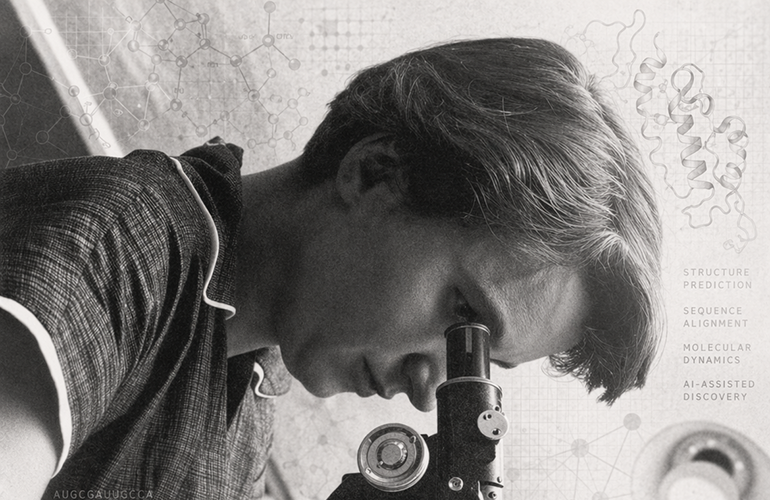
Image derived from a shot of Rosalind Franklin with microscope in 1955, MRC Laboratory of Molecular Biology. Courtesy of Wikimedia Commons.
GPT-Rosalind, named for the chemist Rosalind Franklin, is OpenAI’s first life-sciences model. Access is limited as a research preview in ChatGPT, Codex, and the API for qualified customers under OpenAI’s trusted-access program. Framed around evidence synthesis, hypothesis generation, experimental planning, and multi-step research tasks. OpenAI describes it as a “frontier reasoning model” and the first release in a “GPT-Rosalind life sciences model series.” Access to GPT-Rosalind is gated, but early access partners include Moderna, Retro Biosciences, Genentech and Thermo Fisher Scientific.
We do not have Rosalind access. But the plugin layer OpenAI announced alongside it, AlphaFold, PubMed/NCBI Entrez, UniProt, PRIDE, and others, is available today in Codex.
1. A 3-D zoomable fold confidence atlas
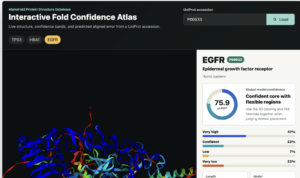
Human TP53 rendered from its AlphaFold model, colored by pLDDT confidence. Check out the interactive version.
In my first test, Codex turned a UniProt ID into an interactive 3D AlphaFold confidence atlas. Type a UniProt accession, and the embed pulls the corresponding AlphaFold structure, renders it as a rotatable 3D model, colors the fold by pLDDT confidence, and displays the predicted aligned error heatmap alongside confidence-band fractions. The default example is human TP53, the tumor suppressor gene.
The build took about 11 minutes start to finish. Codex (using GPT-5.4 xhigh) first queried the AlphaFold API against three test proteins, TP53, hemoglobin HBA1 and EGFR, to confirm the response shape it would need to parse.
After that, Codex wrote the embed as a single self-contained HTML fragment using 3Dmol.js for the structure viewer, validated rendering with desktop and mobile screenshots, and checked that the 3D canvas was actually drawing pixels rather than sitting blank. The embed calls AlphaFold’s public API directly from the browser.
2. PubMed evidence constellation
Next up, Codex turned a biomedical search term into a live PubMed evidence map. Enter a query, and the embed uses NCBI Entrez to pull PubMed results, classify papers into broad evidence types, and plot them by publication year. Each point represents a paper; hovering reveals the title, journal, date, and authors, while clicking opens the underlying PubMed or PMC record.
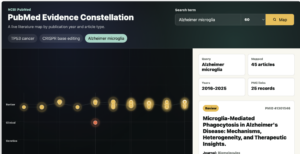
A live PubMed query plotted by year and evidence type, with each dot a paper. Check out the interactive version.
This build took about 7 minutes. Codex first ran test queries through NCBI E-Utilities to confirm the esearch and esummary response fields and verify that PubMed returns permissive CORS headers for browser requests. It then wrote the embed in vanilla HTML, CSS, and JavaScript, with no external charting library, to keep the fragment self-contained for a WordPress Custom HTML block. After an initial mobile test showed the constellation was getting crushed at 390 pixels wide, Codex added horizontal scrolling at narrow widths.
After Codex built the AlphaFold atlas and the PubMed constellation in something like 18 combined minutes, it was clear that the latest models can fly with relative ease through tasks that would have taken humans hours of work. But as Stanford’s 2026 AI Index recently indicated, genAI’s model’s remain “jagged.” On ChemBench, a chemistry evaluation with more than 2,700 question-answer pairs (a format in which LLMs excel), the best frontier models outperform the best human chemists. The Stanford report notes that “they struggle with basic tasks” (the report’s phrasing). On ClockBench, the same class of model reads analog clocks correctly about half the time.
Stanford’s report classifies AI in science into three categories: predictive modeling over scientific data, workflow assistance (literature synthesis, experiment design, data analysis), and autonomous scientific discovery. The tools Codex built sit in the middle category, which the report notes “expanded considerably in 2025.” The third category, autonomous discovery, “remains at an early stage.”




.jpg)