Research & Development World

  • R&D World Home
  • Topics
    • Aerospace
    • Automotive
    • Biotech
    • Careers
    • Chemistry
    • Environment
    • Energy
    • Life Science
    • Material Science
    • R&D Management
    • Physics
  • Technology
    • 3D Printing
    • A.I./Robotics
    • Software
    • Battery Technology
    • Controlled Environments
      • Cleanrooms
      • Graphene
      • Lasers
      • Regulations/Standards
      • Sensors
    • Imaging
    • Nanotechnology
    • Scientific Computing
      • Big Data
      • HPC/Supercomputing
      • Informatics
      • Security
    • Semiconductors
  • R&D Market Pulse
  • R&D 100
    • 2025 R&D 100 Award Winners
    • 2025 Professional Award Winners
    • 2025 Special Recognition Winners
    • R&D 100 Awards Event
    • R&D 100 Submissions
    • Winner Archive
  • Resources
    • Research Reports
    • Digital Issues
    • Educational Assets
    • Subscribe
    • Video
    • Webinars
    • PharmSci360
    • Content submission guidelines for R&D World
  • Global Funding Forecast
  • Top Labs
  • Advertise
  • SUBSCRIBE

Two Types of Sensors Designed to Provide Information on Vineyard Water Status

By Elhuyar Fundazoia | March 15, 2017

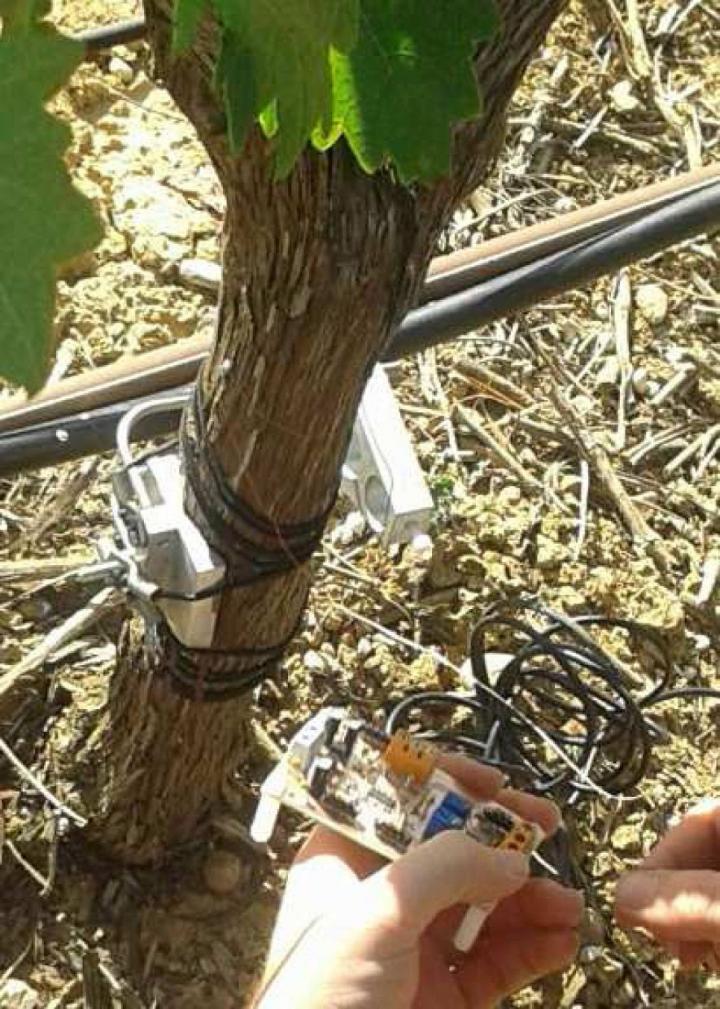
This is a test made in a vineyard. Source: NUP/UPNA-Public University of Navarre

The first of these sensors provides information without being in contact with the plant and works by capturing information in terahertz, one of the ranges in the electromagnetic spectrum located between microwaves (that a mobile phone or TV need to function) and infrared waves. “These devices transmit a signal in terahertz and measure what proportion of the signal is returned by the trunk of the vine,” explained Gonzaga Santesteban-García, lecturer in the Department of Agricultural Production and leader of the research project. “It involves reflectance technology without any contact with the plant. That way, we can check the plant’s water status. It is a technique that has not been used before for this purpose”. The results of this development have been published in the journals “Frontiers in Plant Science” and “Journal of Infrared, Millimeter and Terahertz Waves”.

The researchers have simplified the design of the sensor because a large bandwidth is not needed; it uses planar technology, which allows a high degree of miniaturization and thus considerably cuts the cost per unit, since many of its chips can be obtained commercially at a low price.

The second of the sensors developed is based on a totally different principle. In this case, the aim was to use magnetoelastic sensors to detect the changes that take place throughout the day and night in the size of the trunk or branches of the vine, in other words, they indicate how the vine is growing. Gonzaga-Santiesteban explained that sensors of this type offer two advantages over the classical dendrometers used by some wineries. “Firstly, this is a different technology enabling costs to be reduced and, secondly, we have made it more flexible so that these devices can be fitted not only to the trunk, as until now, but also to different parts of the vine, such as, for example, the cluster,” he added. The results of this development have also been partially published in the journal “IEEE Transactions on Magnetics”.


Related Articles Read More >

Abstract of modern high tech internet data center room with rows of racks with network and server hardware. 3d rendering
A startup says it found hidden memory behavior in NVIDIA GPUs and is building a security layer around it
Bioptimus launches massive patient data atlas to train its biology AI
Basecamp Research partners with Anthropic, NVIDIA to build the world’s largest genomic database
Could AI smell cancer? Science says yes
rd newsletter
EXPAND YOUR KNOWLEDGE AND STAY CONNECTED
Get the latest info on technologies, trends, and strategies in Research & Development.

R&D World Digital Issues

Fall 2025 issue

Browse the most current issue of R&D World and back issues in an easy to use high quality format. Clip, share and download with the leading R&D magazine today.

R&D 100 Awards
Research & Development World
  • Subscribe to R&D World Magazine
  • Sign up for R&D World’s newsletter
  • Contact Us
  • About Us
  • Drug Discovery & Development
  • Pharmaceutical Processing
  • Global Funding Forecast

Copyright © 2026 Arrowfly LLC. All Rights Reserved. The material on this site may not be reproduced, distributed, transmitted, cached or otherwise used, except with the prior written permission of Arrowfly
Privacy Policy | Advertising | About Us

Search R&D World

  • R&D World Home
  • Topics
    • Aerospace
    • Automotive
    • Biotech
    • Careers
    • Chemistry
    • Environment
    • Energy
    • Life Science
    • Material Science
    • R&D Management
    • Physics
  • Technology
    • 3D Printing
    • A.I./Robotics
    • Software
    • Battery Technology
    • Controlled Environments
      • Cleanrooms
      • Graphene
      • Lasers
      • Regulations/Standards
      • Sensors
    • Imaging
    • Nanotechnology
    • Scientific Computing
      • Big Data
      • HPC/Supercomputing
      • Informatics
      • Security
    • Semiconductors
  • R&D Market Pulse
  • R&D 100
    • 2025 R&D 100 Award Winners
    • 2025 Professional Award Winners
    • 2025 Special Recognition Winners
    • R&D 100 Awards Event
    • R&D 100 Submissions
    • Winner Archive
  • Resources
    • Research Reports
    • Digital Issues
    • Educational Assets
    • Subscribe
    • Video
    • Webinars
    • PharmSci360
    • Content submission guidelines for R&D World
  • Global Funding Forecast
  • Top Labs
  • Advertise
  • SUBSCRIBE