Research & Development World

  • R&D World Home
  • Topics
    • Aerospace
    • Automotive
    • Biotech
    • Careers
    • Chemistry
    • Environment
    • Energy
    • Life Science
    • Material Science
    • R&D Management
    • Physics
  • Technology
    • 3D Printing
    • A.I./Robotics
    • Software
    • Battery Technology
    • Controlled Environments
      • Cleanrooms
      • Graphene
      • Lasers
      • Regulations/Standards
      • Sensors
    • Imaging
    • Nanotechnology
    • Scientific Computing
      • Big Data
      • HPC/Supercomputing
      • Informatics
      • Security
    • Semiconductors
  • R&D Market Pulse
  • R&D 100
    • 2025 R&D 100 Award Winners
    • 2025 Professional Award Winners
    • 2025 Special Recognition Winners
    • R&D 100 Awards Event
    • R&D 100 Submissions
    • Winner Archive
  • Resources
    • Research Reports
    • Digital Issues
    • Educational Assets
    • Subscribe
    • Video
    • Webinars
    • PharmSci360
    • Content submission guidelines for R&D World
  • Global Funding Forecast
  • Top Labs
  • Advertise
  • SUBSCRIBE

Nature Inspires a Novel New Form of Computing, Using Light

By McMaster University | May 24, 2019

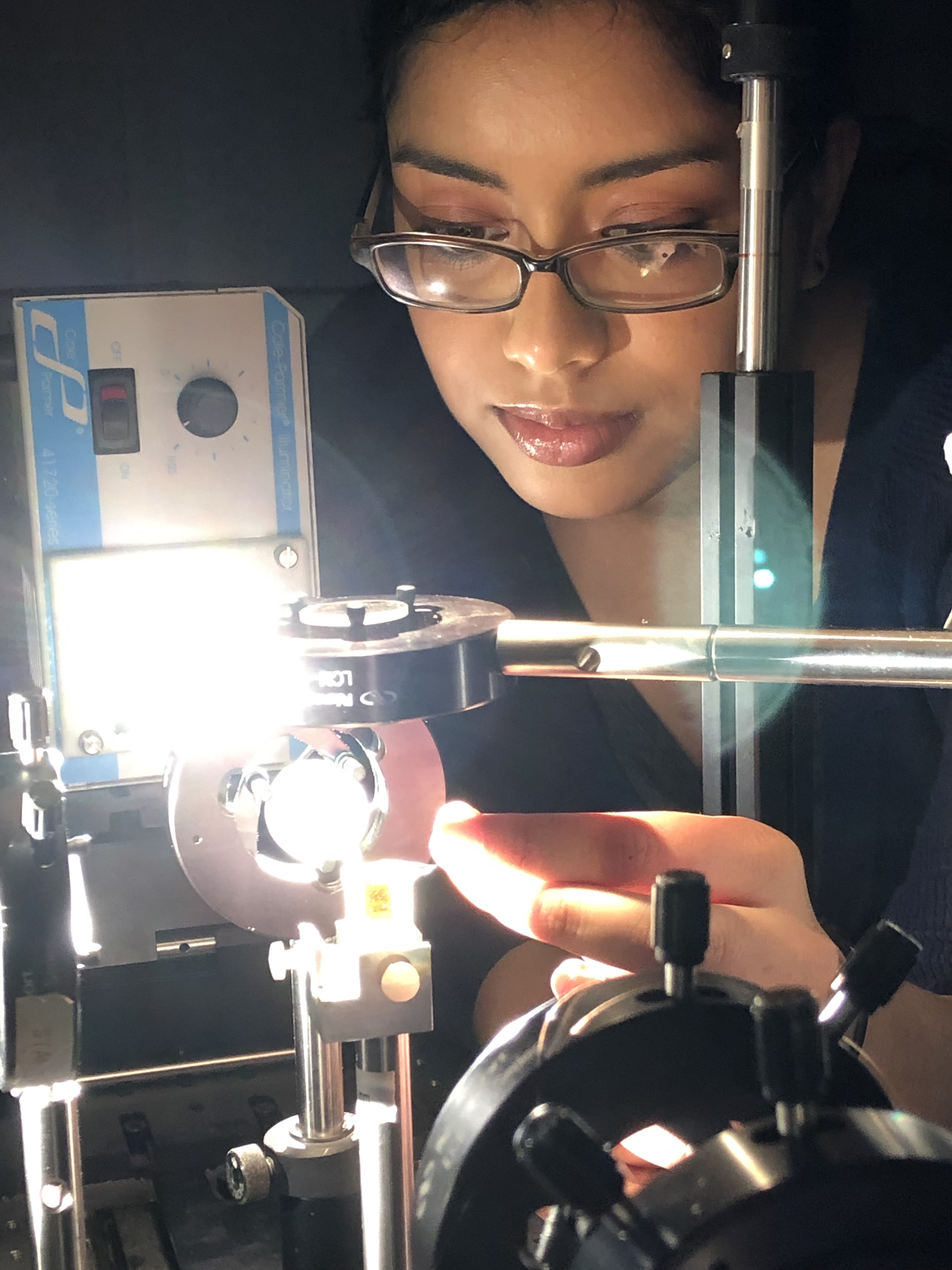
McMaster University researcher Fariha Mahmood demonstrates a novel new form of computing that can perform simple calculations by shining patterned bands of light through a polymer cube. (Credit: McMaster University)

McMaster researchers have developed a simple and highly novel form of computing by shining patterned bands of light and shadow through different facets of a polymer cube and reading the combined results that emerge.

The material in the cube reads and reacts intuitively to the light in much the same way a plant would turn to the sun, or a cuttlefish would change the color of its skin.

The researchers are graduate students in chemistry supervised by Kalaichelvi Saravanamuttu, an associate professor of chemistry and chemical biology whose lab focuses on ideas inspired by natural biological systems.

The researchers were able to use their new process to perform simple addition and subtraction questions.

“These are autonomous materials that respond to stimuli and do intelligent operations,” says Saravanamuttu. “We’re very excited to be able to do addition and subtraction this way, and we are thinking of ways to do other computational functions.”

The researchers’ work, published today in the journal Nature Communications, represents a completely new form of computing, one they say holds the promise of complex and useful functions yet to be imagined, possibly organized along the structures of neural networks.

The form of computing is highly localized, needs no power source and operates completely within the visible spectrum.

The technology is part of a branch of chemistry called nonlinear dynamics, and uses materials designed and manufactured to produce specific reactions to light.

A researcher shines layered stripes of light through the top and sides of a tiny, glass case holding the amber-colored polymer, itself roughly the size of a die used in a board game. The polymer starts as a liquid and transforms to a gel in reaction to the light.

A neutral carrier beam passes through the cube from the back, toward a camera that reads the results, as refracted by the material in the cube, whose components form spontaneously into thousands of filaments that react to the patterns of light to produce a new three-dimensional pattern that expresses the outcome.

“We don’t want to compete with existing computing technologies,” says co-author Fariha Mahmood, a master’s student in chemistry. “We’re trying to build materials with more intelligent, sophisticated responses.”
Related Articles Read More >

How a Duke-led HPC method brought cell-scale cancer simulation to a single cloud node 
Who has access to Claude Mythos-tier models (and beyond) will redefine cybersecurity, including in R&D
Abstract of modern high tech internet data center room with rows of racks with network and server hardware. 3d rendering
A startup says it found hidden memory behavior in NVIDIA GPUs and is building a security layer around it
Ex-Google founders bet quantum-compressed chemistry can crack covalent drug design
rd newsletter
EXPAND YOUR KNOWLEDGE AND STAY CONNECTED
Get the latest info on technologies, trends, and strategies in Research & Development.

R&D World Digital Issues

Fall 2025 issue

Browse the most current issue of R&D World and back issues in an easy to use high quality format. Clip, share and download with the leading R&D magazine today.

R&D 100 Awards
Research & Development World
  • Subscribe to R&D World Magazine
  • Sign up for R&D World’s newsletter
  • Contact Us
  • About Us
  • Drug Discovery & Development
  • Pharmaceutical Processing
  • Global Funding Forecast

Copyright © 2026 Arrowfly LLC. All Rights Reserved. The material on this site may not be reproduced, distributed, transmitted, cached or otherwise used, except with the prior written permission of Arrowfly
Privacy Policy | Advertising | About Us

Search R&D World

  • R&D World Home
  • Topics
    • Aerospace
    • Automotive
    • Biotech
    • Careers
    • Chemistry
    • Environment
    • Energy
    • Life Science
    • Material Science
    • R&D Management
    • Physics
  • Technology
    • 3D Printing
    • A.I./Robotics
    • Software
    • Battery Technology
    • Controlled Environments
      • Cleanrooms
      • Graphene
      • Lasers
      • Regulations/Standards
      • Sensors
    • Imaging
    • Nanotechnology
    • Scientific Computing
      • Big Data
      • HPC/Supercomputing
      • Informatics
      • Security
    • Semiconductors
  • R&D Market Pulse
  • R&D 100
    • 2025 R&D 100 Award Winners
    • 2025 Professional Award Winners
    • 2025 Special Recognition Winners
    • R&D 100 Awards Event
    • R&D 100 Submissions
    • Winner Archive
  • Resources
    • Research Reports
    • Digital Issues
    • Educational Assets
    • Subscribe
    • Video
    • Webinars
    • PharmSci360
    • Content submission guidelines for R&D World
  • Global Funding Forecast
  • Top Labs
  • Advertise
  • SUBSCRIBE