Research & Development World

  • R&D World Home
  • Topics
    • Aerospace
    • Automotive
    • Biotech
    • Careers
    • Chemistry
    • Environment
    • Energy
    • Life Science
    • Material Science
    • R&D Management
    • Physics
  • Technology
    • 3D Printing
    • A.I./Robotics
    • Software
    • Battery Technology
    • Controlled Environments
      • Cleanrooms
      • Graphene
      • Lasers
      • Regulations/Standards
      • Sensors
    • Imaging
    • Nanotechnology
    • Scientific Computing
      • Big Data
      • HPC/Supercomputing
      • Informatics
      • Security
    • Semiconductors
  • R&D Market Pulse
  • R&D 100
    • 2026 R&D 100 Award Winners
    • 2026 Professional Award Winners
    • 2026 Special Recognition Winners
    • R&D 100 Awards Event
    • R&D 100 Submissions
    • Winner Archive
  • Resources
    • Research Reports
    • Digital Issues
    • Educational Assets
    • Subscribe
    • Video
    • Webinars
    • PharmSci360
    • Content submission guidelines for R&D World
  • Global Funding Forecast
  • Top Labs
  • Advertise
  • SUBSCRIBE

NASA Uses Machine Learning to Discover New Planet

By Kenny Walter | January 3, 2018

NASA officials are touting machine learning as the catalyst that led to a newly discovered planet.

Last month, NASA officials announced the discovery of Kepler-90i using Google machine learning, an approach to artificial intelligence where computers learn patterns to identify intended targets amongst large quantities of data.

“We used machine learning to help identify planets that were missed by previous searches of the Kepler data,” Christopher Shallue, a senior software engineer with Google’s research team Google AI, said during a Dec. 14 conference call. “Machine learning really shines in situations where there is too much data for humans examine for themselves.”

The computers were able to identify planets by finding in Kepler data instances where the Kepler telescope recorded signals from planets beyond the solar system—known as exoplanets. The computer learned how to identify exoplanets in the light readings recorded by Kepler—the minuscule change in brightness captured when a planet passed in front of, or transited, a star.

The researchers used a neural network system, where the computer was able to sift through Kepler data and find weak transit signals from a previously-missed eight planet orbiting Kepler-90.

Kepler’s four-year dataset consists of 35,000 possible planetary signals. While automated tests and human eyes are often used to verify most of the promising signals in the data, the weakest signals often are missed.

The researchers first trained the neural network to identify transiting exoplanets using a set of 15,000 previously vetted signals from the Kepler exoplanet catalogue. In the test set, the neural network correctly identified true planets and false positives 96 percent of the time.

Then, with the neural network “learned” to detect the pattern of a transiting exoplanet, the researchers directed their model to search for weaker signals in 670 star systems that already had multiple known planets.

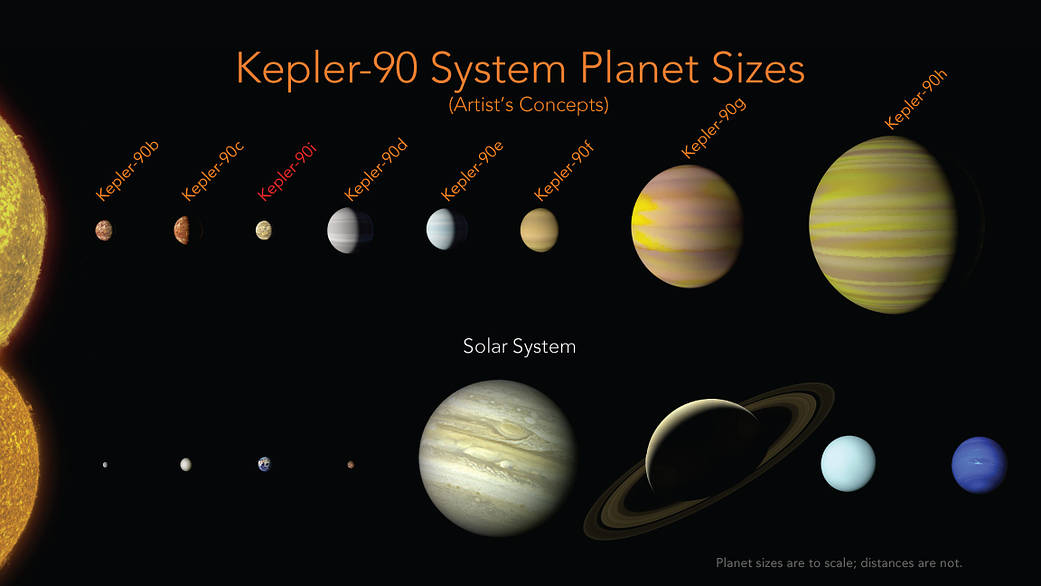
The discovery means that the Kepler-90 star—a Sun-like star that is 2,545 light-years from Earth—now has the same amount of planets orbiting it as the Sun does.

“The Kepler-90 star system is like a mini version of our solar system,” Andrew Vanderburg, a NASA Sagan Postdoctoral Fellow and astronomer at the University of Texas at Austin, said. “You have small planets inside and big planets outside, but everything is scrunched in much closer.”

Kepler-90i is an extremely hot, rocket planet that orbits Kepler-90 once every 14.4 days.

Other planetary systems probably hold more promise for life than Kepler-90. About 30 percent larger than Earth, Kepler-90i is so close to its star that its average surface temperature is believed to exceed 800 degrees Fahrenheit, on par with Mercury.

Its outermost planet, Kepler-90h, orbits at a similar distance to its star as Earth does to the Sun.

Related Articles Read More >

The UAE’s new space probe will crash into the asteroid it’s designed to study
Semiconductors, biomanufacturing and dual-use tech fill ISS National Lab’s startup cohort 
Eggshell-inspired shield cut projectile speed by 65% in simulation, but light-gas gun testing has not confirmed it 
The 100 most innovative companies of 2026: from NVIDIA and OpenAI to Eli Lilly and SpaceX
rd newsletter
EXPAND YOUR KNOWLEDGE AND STAY CONNECTED
Get the latest info on technologies, trends, and strategies in Research & Development.

R&D World Digital Issues

Fall 2026 issue

Browse the most current issue of R&D World and back issues in an easy to use high quality format. Clip, share and download with the leading R&D magazine today.

R&D 100 Awards
Research & Development World
  • Subscribe to R&D World Magazine
  • Sign up for R&D World’s newsletter
  • Contact Us
  • About Us
  • Drug Discovery & Development
  • Pharmaceutical Processing
  • Global Funding Forecast

Copyright © 2026 Arrowfly LLC. All Rights Reserved. The material on this site may not be reproduced, distributed, transmitted, cached or otherwise used, except with the prior written permission of Arrowfly
Privacy Policy | Advertising | About Us

Search R&D World

  • R&D World Home
  • Topics
    • Aerospace
    • Automotive
    • Biotech
    • Careers
    • Chemistry
    • Environment
    • Energy
    • Life Science
    • Material Science
    • R&D Management
    • Physics
  • Technology
    • 3D Printing
    • A.I./Robotics
    • Software
    • Battery Technology
    • Controlled Environments
      • Cleanrooms
      • Graphene
      • Lasers
      • Regulations/Standards
      • Sensors
    • Imaging
    • Nanotechnology
    • Scientific Computing
      • Big Data
      • HPC/Supercomputing
      • Informatics
      • Security
    • Semiconductors
  • R&D Market Pulse
  • R&D 100
    • 2026 R&D 100 Award Winners
    • 2026 Professional Award Winners
    • 2026 Special Recognition Winners
    • R&D 100 Awards Event
    • R&D 100 Submissions
    • Winner Archive
  • Resources
    • Research Reports
    • Digital Issues
    • Educational Assets
    • Subscribe
    • Video
    • Webinars
    • PharmSci360
    • Content submission guidelines for R&D World
  • Global Funding Forecast
  • Top Labs
  • Advertise
  • SUBSCRIBE