
The OpenClaw mascot, a lobster, presides over a fleet of agents.
Engineers manage agents now. So do scientists. So do the labs building AI.
“Engineering roles are becoming management roles where you manage AI agents.” That is how Vinay Pinnaka, co-founder and CTO of the Y Combinator-backed Silicon Valley fintech JustPaid, describes what the past year has done to his job.
“I built AI Gilfoyle,” Pinnaka said, referring to Mike Judge’s influential HBO comedy series, Silicon Valley.
In the show, Bertram Gilfoyle, after a promotion to VP of architecture, builds an AI version of himself to handle his messaging with co-workers. “I built AI Gilfoyle, who ships features to production for JustPaid,” Pinnaka continued. The AI works with its team while managing a team of agents who do infrastructure architecture review, planning, implementation, QA and operations.

JustPaid co-founders, from left: Anelya Grant, Daniel Kivatinos and Vinay Pinnaka.
Stateless agents, structured memory
The inspiration for JustPaid came from a desire to address institutional memory challenges inherent in enterprise organizations. “While we were building multiple products, I felt that adding more engineers always comes with its own downsides,” Pinnaka said. “First, there is ramp-up. Second, the historical knowledge about what JustPaid had done is very institutional.”
For JustPaid, that knowledge includes code, infrastructure, customer context and the finance logic behind the company’s billing software. Connecting those dots “requires someone who has at least some accounting background, or at least someone who has taken a finance class,” Pinnaka said.
Pinnaka wondered why AI couldn’t serve as the dot-connector. He set out to build an agent as a teacher before it became an agent as a worker. “I thought: ‘Why can’t I create an AI agent that teaches new people joining the team and gives them the full context already present in the system?’” Pinnaka said. “That was the initial goal.”
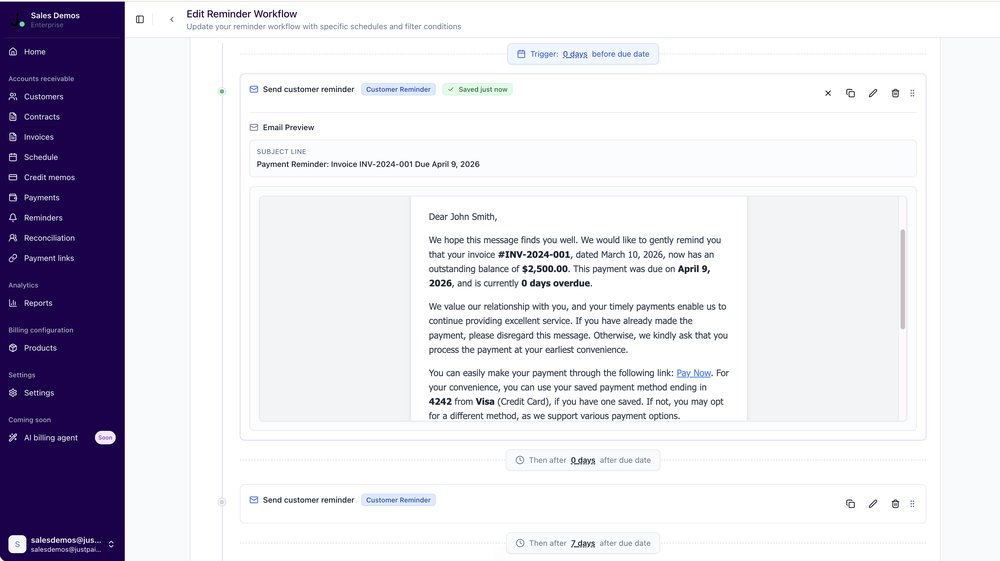
JustPaid’s reminder workflow editor builds scheduled email sequences keyed to invoice due dates, with payment-method details and pay links inserted automatically.
He started by feeding OpenClaw, a popular open-source agent framework, structured knowledge about the company. It worked. “I started by creating an AI employee with OpenClaw, creating or dumping the knowledge we already have into structured markdowns by company, customer, team, functionality and feature,” he said.
Heartbeat and soul file
Then the agent’s job description expanded. “Initially, it was a tool that helped people understand what was happening with our codebase, our infrastructure and the company,” Pinnaka said. “Then we slowly added one tool after another.”
It later became something of a Swiss Army knife of engineering, capable of managing infrastructure, QA and production triage. Now, he said, the system can watch production systems, triage errors and push work back to the human team.
“Right now, it can monitor our infrastructure,” Pinnaka said. “If there is an error in our logs, it automatically checks: Who is the customer? Why did it happen? Is there a fix already in place? If there is no fix, can we deploy one? It can do investigation and debugging like an engineer, create a PR and notify the team: this is a bug, and this customer is being affected.”
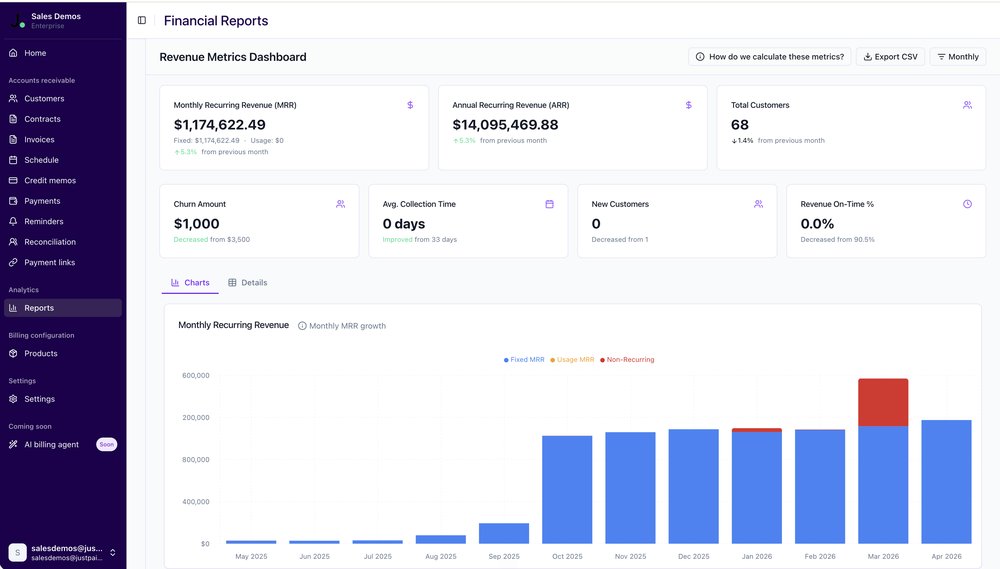
The Revenue Metrics Dashboard tracks MRR, ARR, churn and collection time alongside monthly recurring revenue trends.
That cadence runs on what Pinnaka calls a heartbeat, referring to the OpenClaw method of orchestrating periodic agent turns. “OpenClaw also has a heartbeat concept, similar to a manager checking in with an employee at specific hours in the day,” he said. “You can set up a heartbeat every 30 minutes to look at all the services that are running.” If the agent finds something worth flagging, it routes the question back to the right Slack channel.
Cadence is one layer of the design. Identity is another. “It started as a simple employee and became something that can autonomously drive development and debugging practices,” Pinnaka said. The mechanism that gives the agent a durable role is OpenClaw’s “soul file,” a configuration layer for character, instructions and delegation procedures. “The thing OpenClaw has that the existing tools lack is the soul file. You can assign a character, instructions and delegation procedures to OpenClaw so it acts according to those rules.” Claude Code and Codex allow some customization. OpenClaw’s soul file gives the agent a more persistent identity to work from.
Engineering as delegation
The Wall Street Journal profiled the company this spring as an early case of what happens when a working software team runs on a fleet of agents. Running that fleet, Pinnaka said, takes a specific skill set. “You need to know how to delegate work, parallelize tasks and context-switch without losing focus.”
An agent that can monitor production, create PRs and ship features is also a security surface. Pinnaka’s answer is to scope it tightly from the start. “OpenClaw is a very powerful tool. The way to use it is to lock it down to specific use cases and specific actions,” Pinnaka said. JustPaid keeps the agent narrowly scoped, modeled on NVIDIA’s NemoClaw sandboxing approach. “The agent has only read-only details. It cannot write things on its own.” Anything that requires a write goes through a separate tool and an approval step that pings a developer in Slack.

The JustPaid co-founders
While JustPaid’s core pitch is billing complexity across industries, it could potentially expand over time. When asked where the company might fit in R&D-heavy markets, Pinnaka pointed to the contract structures common in pharma, biotech and specialized healthcare services. “The idea is that, as long as the customer has one contract with complex billing needs, or multiple checkpoints in the contract that need to be billed separately, that is a good fit for us,” Pinnaka said. In pharma and biotech, he added, that could mean a large contract with milestones that must be met before the customer can be invoiced.
The same logic extends to lab operations, where procurement, usage and finance often sit in separate systems. When the conversation turned to lab equipment, reagent ordering and LIMS-style workflows, Pinnaka framed the opportunity in practical back-office terms: “You have to purchase equipment with a purchase order, match it with the contract, reconcile the amount and then pay. All of that happens with an accountant or finance person.”
“We can automate that,” he said.