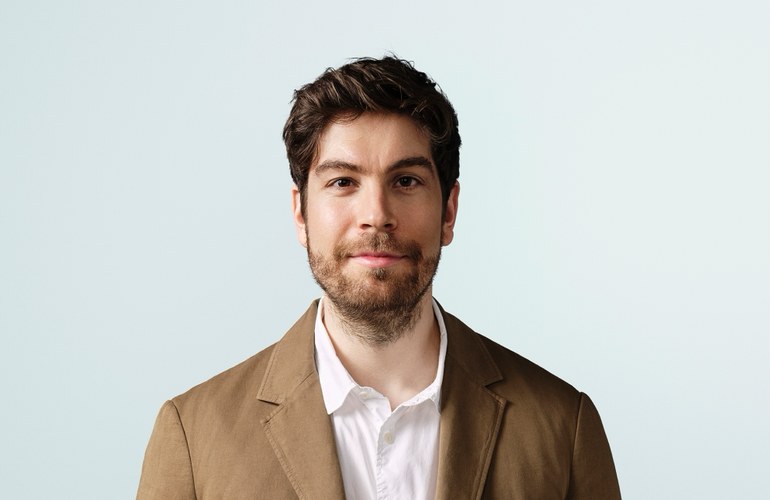
Max Jaderberg, president of Isomorphic Labs. Credit: Isomorphic Labs
AI will eventually design every drug, predicts Max Jaderberg, president of Isomorphic Labs, a drug-discovery company spun out of Google DeepMind that remains under Alphabet’s control. Its programs remain in preclinical development. Speaking at Bloomberg Tech in London on Nov. 2, Jaderberg described a future in which AI-designed molecules succeed more often in human trials, while acknowledging that progress in biology depends on real-world experiments and laboratory time.
Isomorphic uses its AI models to develop medicines, pursuing internal drug programs and partnerships with Eli Lilly, Novartis and Johnson & Johnson. As Jaderberg explained, pharmaceutical partners bring biological expertise and ideas for medicines; Isomorphic works to turn those ideas into molecules. Those collaborations can generate upfront payments, milestone payments and royalties, while Isomorphic funds its internal programs through discovery and clinical testing. Novartis expanded its agreement in February 2025, adding up to three research programs to an initial effort targeting three difficult biological targets with small-molecule drugs. “We’re not selling access to the models, we’re not selling tokens or API access,” Jaderberg said.
Demis Hassabis, CEO of both companies, has described Isomorphic’s mission as using AI to “solve all disease.” When Isomorphic announced its $2.1 billion funding round in May, he said the money would help expand its drug design engine. The company earmarked the funding for developing that technology, advancing therapeutic programs toward clinical trials and hiring AI, drug-design and clinical specialists. Bloomberg reported Nov. 4 that Isomorphic was in talks to raise roughly $5 billion at a valuation of about $50 billion, citing people familiar with the matter. The financing remained under negotiation, with terms subject to change.
For now, Isomorphic’s internal pipeline focuses on oncology, immunology and inflammation. In the Bloomberg interview, Jaderberg described its programs as “deep in pre-clinical development,” where researchers design molecules and test them in cells and animal models before advancing into human trials. He said concentrating on those disease areas lets Isomorphic assemble the clinical and biological expertise each program requires. At Davos on Jan. 20, Hassabis said Isomorphic expected its first clinical trials by the end of 2026, Reuters reported, leaving about eight weeks from Jaderberg’s November update.
Jaderberg put the industry’s failure rate at roughly 90% for medicines entering human trials. Candidates can prove toxic or fail to work as researchers expected. His argument is that AI could improve those odds by helping scientists understand and engineer molecules more precisely before testing them in patients.
Jaderberg described two complementary uses of AI: reasoning models that help researchers generate scientific hypotheses, and simulation models that approximate physical processes so researchers can test ideas computationally. The aim is to improve the odds that a molecule will work when researchers synthesize it and test it in the lab.


Tell Us What You Think!
You must be logged in to post a comment.