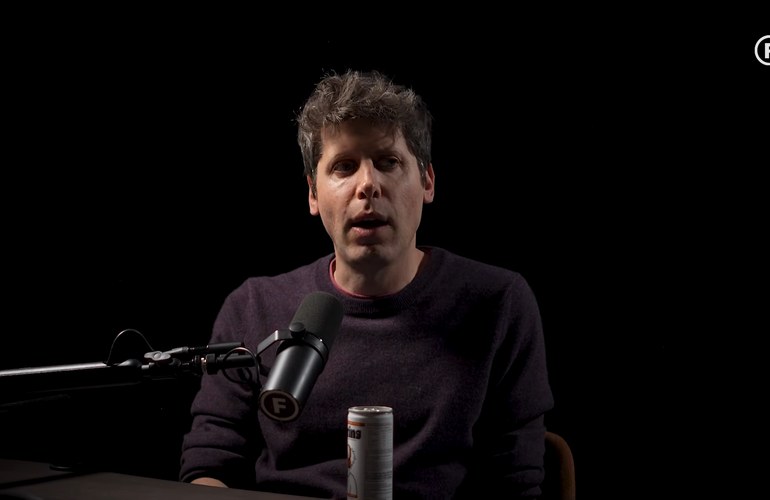
Sam Altman on the Nov. 3 episode of Raj Shamani’s Figuring Out podcast. Credit: Raj Shamani via YouTube
The CEO of OpenAI is “extremely excited to see how far we can push AI to discover new science.” AI developers are expanding their commercial ambitions from coding and other workplace applications into scientific research. In January, OpenAI chief financial officer Sarah Friar outlined how licensing, intellectual-property agreements and outcome-based pricing could let the company share in the value of those discoveries. Rival AI developer Anthropic, which makes Claude, has begun running its own drug-discovery programs.
In a Nov. 3 interview with podcaster Raj Shamani, Altman said OpenAI’s recent mathematics results had brought the prospect of a scientific-discovery machine closer than he expected. He singled out the company’s September Navier–Stokes announcement as a moment that made him nervous. His remarks followed a rapid sequence of releases: a claimed Navier–Stokes proof in September, 722 AI-generated mathematics manuscripts in early October, and further claimed advances in mathematics, computer science and theoretical physics later that month.
“The math results were quite amazing to me and it really made me think that we are closer to this milestone than I expected us to be,” Altman said.
Yann LeCun, Meta’s former chief AI scientist and a co-founder of AI startup Advanced Machine Intelligence, has questioned whether language models’ reasoning abilities in mathematics and code extend to understanding the physical world. Altman is more optimistic. He described the goal as “a machine that can help us understand the world better,” discovering insights in physics, medical treatments and energy sources that could enable advances people have yet to imagine.
The Navier–Stokes announcement made Altman nervous. Recalling the period before the September release, he told Shamani, “This is like the real deal.” He described AI tackling problems beyond what people had managed and called the announcement the last occasion he remembered feeling his heart pound with nerves. He told Stripe’s Cheeky Pint podcast on Oct. 29 that OpenAI had spent “order $10 million” on the proof.
The mathematical claims remain under scrutiny. OpenAI released a paper and public proof files in Lean, software for checking formal mathematical arguments. Its Navier–Stokes claim concerns fluid motion subject to a smooth external force. The Clay Mathematics Institute, which administers the Millennium Prize Problems, still lists the problem as active. Its prize rules require publication, at least two years of scrutiny and general acceptance by the global mathematics community.
The announcement also prompted a dispute over publication arrangements and research provenance involving mathematician Tristan Buckmaster, who had been working with mathematician Levent Alpöge on related fluid-equation problems. In a public statement, Buckmaster questioned whether private drafts submitted through OpenAI’s Codex coding tool had influenced its research, while saying he did not know whether their data had been used. OpenAI denied accessing their work before its public release.
The October manuscripts have also required corrections. OpenAI’s Oct. 7 update recorded three withdrawals and revisions to 14 other manuscripts, and reported Lean formalizations covering 300 of the remaining 719 top-line results, about 42%. The repository records further formalization additions and fixes later in October.
Altman traces the computing bet behind this work to GPT-4. OpenAI finished training that earlier-generation language model around August 2022, months before releasing it, he recalled. Seeing its capabilities gave the company confidence to commit to much more computing capacity for subsequent models. “We then decided we were going to go make a very big bet on compute,” he said in the interview’s account of the GPT-4 decision. He described the model as opening research directions that led to later reasoning models.
Drug discovery adds experimental and clinical tests. Formalized mathematical arguments can undergo software checks; a potential medicine requires laboratory work, safety testing, clinical trials and regulatory review. Drugmakers are committing money to accelerating that work: pharmaceutical company Eli Lilly and AI chipmaker NVIDIA announced in January that they would jointly invest up to $1 billion over five years in a research lab applying AI to drug discovery.
In an Oct. 21 interview with AI commentator Matthew Berman, Altman expressed hope that AI would produce a candidate treatment for a major disease within the next couple of years, with testing still to follow.
Anthropic is moving in a similar direction, as noted earlier. The company acquired Mithril Medicine, a one-person biotech developing treatments for rare forms of muscular dystrophy. According to Anthropic, Mithril took a possible treatment from an idea to promising results in mice in less than 18 months. Anthropic said a drug could be ready to enter human trials as soon as late 2028 if the candidates continue to hold up. In April, Anthropic also acquired another biotech startup called Coefficient Bio for roughly $400 million.


Tell Us What You Think!
You must be logged in to post a comment.