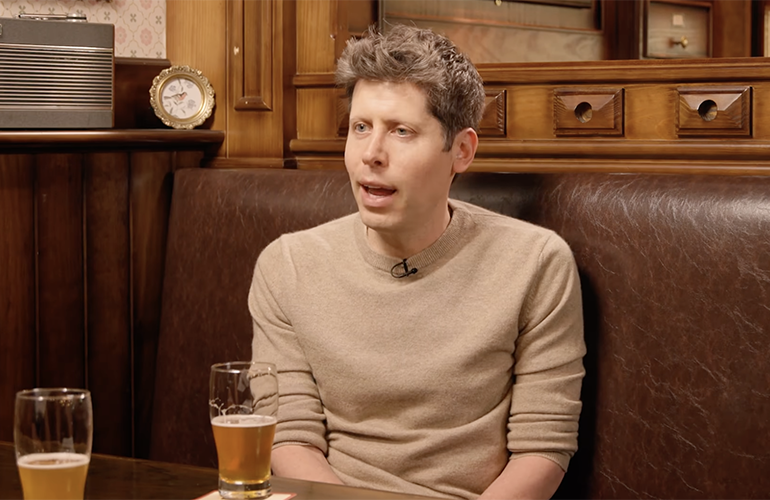
Sam Altman on the Oct. 29 episode of Stripe’s Cheeky Pint. Credit: Cheeky Pint via YouTube
OpenAI spent “order $10 million” on its claimed Navier–Stokes proof, CEO Sam Altman said. Or “maybe a little more” than that sum. But he expects the same work to cost about a hundredth of that within a year.
Speaking with Stripe co-founder John Collison on an October 29 episode of Stripe’s Cheeky Pint podcast, Altman said the cost of such work is falling steeply. “I bet we could redo Navier-Stokes at 1/100th of the cost a year from when it was done,” he said. OpenAI’s agents reached the result in early September. When Collison asked whether that meant more than simply knowing how the proof goes, Altman said the savings would come from “smarter models and better approaches.”
For context, in September, OpenAI announced that it had found a solution to the problem, one of the most difficult and famous unsolved problems in math. The problem was one of seven Millennium Prize Problems the Clay Mathematics Institute selected in 2000, each carrying a $1 million prize. OpenAI said it would forgo the prize.
OpenAI’s construction starts with a fluid at rest and applies a smooth external force. According to the company, the resulting motion develops a singularity. That is, fluid speeds grow without bound in a finite time while total energy stays finite. That addresses one of the versions of the problem in Clay’s official statement, which includes fluid motion driven by an external force.
The run that produced it was large. OpenAI says roughly 10,000 copies of its internal model worked on the problem at once as coordinated “agents,” each able to run code, read a cached snapshot of the web and message others in its group. Launched September 1, the effort reached its result about 88 hours later after exchanging 2.7 million messages and generating some 130 billion output tokens, the units of text a model produces, Unite.AI reported from OpenAI’s announcement. Checking the proof in Lean, software that verifies each logical step by machine, took another 17 hours. OpenAI has published the Lean files; a machine check of the formal statement is distinct from mathematicians accepting the result.
Paying to explore
Altman described the $10 million as the cost of working without a playbook. “Look, we did let it get out of control for one week on the math. Intentionally so,” he said, adding that “you don’t know how far it’s going to go until you try.” When the Navier–Stokes run began, he said, “we understood absolutely nothing about the scaling laws of teams of agents.” He listed the open questions: “Are you supposed to give them the smartest model? Are you supposed to give them many copies, fewer copies, longer rollouts, shorter rollouts?” OpenAI now understands that “a little bit,” he said, and he expects the same efficiency gains seen in earlier shifts in AI: “I am confident that we will find our 10x improvements per year at how we allocate dollars or computer flops, whatever you want to measure, into useful things.”
“Look, we did let it get out of control for one week on the math. Intentionally so.” —Sam Altman, OpenAI CEO
The approach, as Altman put it, is to “let people explore at the limit of what is possible. And then trust that the incredible optimization pressure will figure out how to do this in an efficient way.” Software engineering shows that pattern in practice. A few years ago, Altman said, “it was impossible to throw more than a dollar of compute at a problem and have it help you at all.”
Where the savings would come from
Altman’s 100-fold bet rests on the agents getting more efficient, and he expects the hardware underneath them to get cheaper too. Later in the conversation he put the five-year cost of building and running a gigawatt of AI data center capacity at about $70 billion, a figure he said varies by who is counting. “I think if that number were 20 instead of 70, we should be much happier,” he said, “and we should still demand to get 10x better performance out of it with smarter models every year.” Reaching $20 billion, he said, would require cheaper energy and squeezing out “all of the gross margin stacking that happens between melting sand… and getting the token back.”
Results OpenAI hasn’t published yet
Navier–Stokes was the most expensive piece of a larger program. In the embedded interview, Collison put OpenAI’s overall spending at “100s of millions of dollars of math,” to which Altman agreed. Altman added that the total “includes much more other discovery than what we have published.”
As R&D World reported last week, OpenAI has since announced results on three more problems in mathematics, computer science and physics.
Altman described a tension over releasing more. “Humanity deserves fundamental knowledge. And we should not be sitting on a major fundamental science discovery,” he said. OpenAI owes researchers a solution “where the world gets to benefit from the knowledge, and they also get the best version of the future that they can have,” he said. “So we are working through that right now.”
OpenAI’s own math program already shows costs dropping after Navier–Stokes. Altman said later problems cost far less because the team “kept getting better so fast,” and that “we spent way less than that on the average one of those.” The openai/math repository, where OpenAI posted 722 AI-generated manuscripts on October 6, says the model was posed about 4,000 problems and that the average result used roughly three hours of ChatGPT Pro thinking compute.
“A feeling of something ending”
Altman described the arrival of the model behind these results as both exhilarating and unsettling. “I’m actually probably not supposed to say this, but I will since we’re drinking,” he said, before recounting a weekend when OpenAI researchers tested a new model in a channel named “Model Name-Hold My Beer.” Researchers fed it “the hardest problems they could.” Altman said that people at OpenAI expected less of the model than it delivered. The problems included “people’s hardest research problems from their academic career,” he said, and “the model was just knocking down one after the other,” in “many different fields.” Altman said he was so excited that he stayed up most of the night two nights in a row.
“I also had much more sadness and melancholy, and a feeling of something ending than I was expecting.” —Sam Altman, OpenAI CEO
That excitement came with “much more sadness and melancholy, and a feeling of something ending than I was expecting,” Altman said. He called the work “the right thing, on behalf of the world” and “just the shape of reality and nothing that anyone can stop, or should stop.”
When Collison compared the mathematicians’ objections to dockworkers resisting port automation, Altman asked, “Why do I feel differently about this?” “It’s people’s lives and it’s something that has brought them great joy,” he said. “Certainly, most mathematicians never solve a Millennium Prize problem. But the idea that you might be able to.” Through great effort, he said, there is still work “you can still solve and understand.” “There’s something beautiful about that,” Altman said.



Tell Us What You Think!
You must be logged in to post a comment.