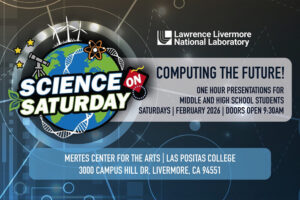
 Lawrence Livermore National Laboratory’s free public lecture series returns February 7–28 at Las Positas College in Livermore, Calif., with four Saturday sessions for middle and high school students. This year’s theme is “Computing the Future.”
The series opens Feb. 7 with “Cosmic Treasure Hunt: Finding Stardust in Meteorites.” That session will dig into how ancient grains preserved in meteorites reveal information about the stars that formed our solar system. Future sessions turn to computing-intensive research.
Of AI and pandemic preparedness
The lecture slated for Feb. 14 on AI and supercomputing in biology will be presented by Dan Faissol, who leads LLNL’s work on the GUIDE (Generative Unconstrained Intelligent Drug Engineering) platform. His team recently used GUIDE to screen over 10 billion potential antibody modifications, identifying candidates that restored 100-fold potency against SARS-CoV-2 variants that had escaped existing therapeutics. The work was published in Science Advances in 2025.
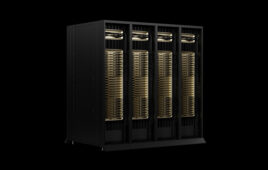
The research reflects LLNL’s broader computing firepower. The lab’s El Capitan supercomputer was verified in November 2024 as the world’s fastest at 1.742 exaFLOPs. That is some 22 times more powerful than its predecessor, Sierra.
Quantum computing’s Nobel connection
The Feb. 28 quantum computing session will be presented by LLNL scientists Sean O’Kelley and Kristi Beck. O’Kelley earned his Ph.D. under 2025 Physics Nobel laureate John Clarke at UC Berkeley. Clarke shared this year’s prize for demonstrating that quantum mechanical effects can occur in macroscopic superconducting circuits.
LLNL’s Quantum Device and Integration Testbed (QuDIT) installed a 21-qubit superconducting chip in 2023 as part of ongoing research into scalable quantum hardware. The timing aligns with renewed federal investment: DOE announced $625 million in November 2025 to fund its five National Quantum Information Science Research Centers for another five years.
GPU atmospheric modeling
The Feb. 21 session covers how graphics processing units, originally developed for video games, are at the heart of the AI wave. GPUs now run atmospheric simulations up to 100 times faster.
Registration opens the Tuesday before each lecture; attendance is capped. Details at LLNL’s Science Education Program website.