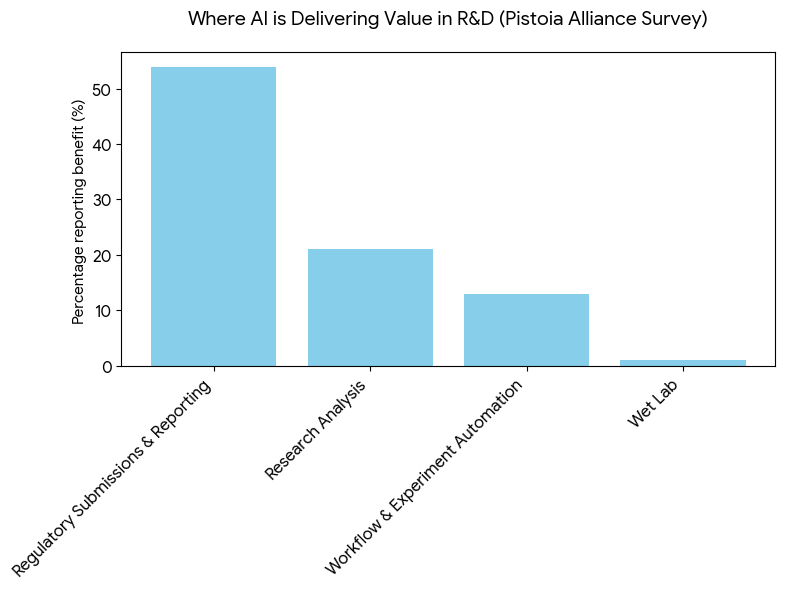
The Pistoia Alliance, a life sciences nonprofit organization, today announced new data showing that only 1% of professionals report AI having value in the wet lab. The data also shows that while 30% of organizations claim to have rolled out enterprise-wide AI, 69% lack metrics to show the impact of AI on reducing costs or timelines.

Credit: Pistoia Alliance
This is widely supported by multiple independent surveys, including a 2026 Deloitte survey, which found that while 22% of life sciences leaders successfully scaled AI, only 9% reported achieving significant returns.
The data was collected at the Pistoia Alliance’s European conference at the Royal Society of Medicine in London, which was attended by leaders from organizations including Roche, AstraZeneca, AbbVie, Pfizer, Bayer, IBM and the FDA.
AI’s uneven impact
“A key focus at this year’s conference was understanding why the gap between AI investment and value persists. The polls show AI success depends on getting both the data and people elements right – 59% say their companies need to prioritize data quality and accessibility, while 22% highlight AI adoption and change management,” said Becky Upton, president of The Pistoia Alliance.
The survey results also showed that the impact of AI is uneven throughout the R&D lifecycle. While 54% of respondents said teams focused on regulatory submissions and reporting are seeing the greatest benefits from AI, 21% said research analysis teams were, and 13% cited value in automating scientific workflows and experiments.
“The real value of AI lies in increasing the speed of the entire R&D pipeline, but today it is often confined to isolated projects,” said Ammara Gafoor, head of Life Sciences Data & AI at Thoughtworks, which sponsored the survey. “Different teams are applying AI to individual use cases, such as target identification or molecule generation. But without a joined-up view of how these efforts work together, AI is stagnating at the level of local gains. To move beyond this plateau, the industry must rethink how humans and AI work together, including how to build reusable agent capabilities and integrate them across the enterprise.”
Still, a cross-industry survey conducted by IDC in April 2025, which included 153 participants in the life sciences industry, showed that 73% of industry participants reported “spectacular” or “significant” improvements in core operational processes from using vendor applications embedded with AI.
Emerging tools may soon start to add value to AI in the wet lab as well. A collaboration between OpenAI and Red Queen Bio showed that GPT-5 enabled a reported 79 times efficiency boost in molecular cloning. Additionally, self-driving laboratories (SDLs) are increasingly able to automate nearly the entire scientific method.