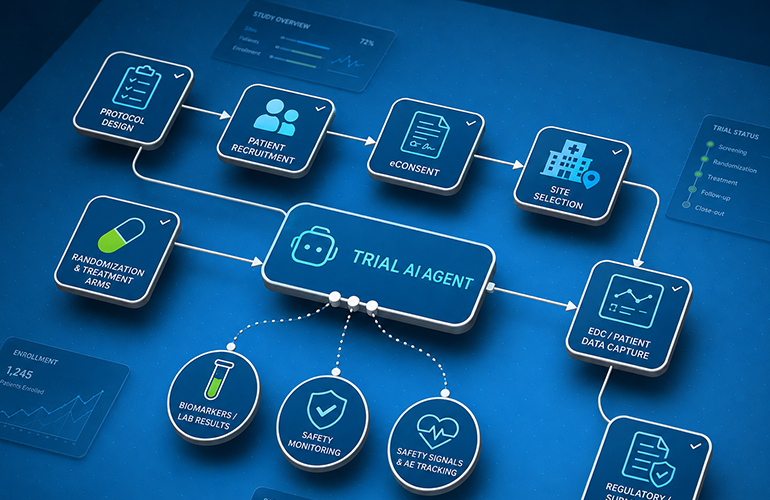
Image based on art from Adobe Stock
In January 2024, Medable, the decentralized clinical-trial company headquartered in Palo Alto, used AI to translate a study protocol directly into a configured eCOA mobile app, complete with questionnaires, workflows and translation into roughly 25 languages. The company said then the feature could halve eCOA deployment timelines, which had typically run 12 to 16 weeks. But CEO Michelle Longmire was deliberate about where the technology stopped. AI, she said, was confined to “rote human tasks” in “low-risk areas” that did not touch the interpretation of data.
In the two years since, AI’s capabilities have expanded rapidly, and the industry’s instinct, visible well beyond clinical trials, has been to agentify an array of functions in coding and, increasingly, enterprise workflows, handing AI increasing swaths of work once gated behind human review. Medable has followed that arc. It now markets itself as a platform for “agentic clinical development.”
Offloading the busywork to free up clinical experts

Andrew Mackinnon
Medable’s newest offering, the Digital Data Flow (DDF) Agent, extends that agentic model to the translation of a static clinical trial protocol into structured, machine-readable data. The agent renders the protocol in CDISC USDM 4.0, a standardized JSON format, so downstream changes such as protocol amendments can propagate across connected documents and systems rather than being re-keyed by hand. Medable frames the release against the FDA’s push toward real-time clinical trials, pitching machine-readable protocols as infrastructure for continuous data review. The task is one of the most manually intensive steps in trial startup. “If we let the agents handle that tactical and administrative burden, we free those incredibly experienced humans to focus on the high-value tasks,” said Andrew Mackinnon, senior vice president and executive general manager, customer value at Medable. “Rather than working on 10 sites across two studies, I can do 100 sites across five studies, because I’ve got the agentic support to leverage my expertise across a broader range and drive value.”
Medable’s offering enters a growing marketplace of agentified workflows for clinical trials. Closest to Medable are the platforms agentifying their own trial-operations stacks. Veeva announced its Falcon agent platform on May 27, focusing on regulated paperwork: trial master file intake and quality control, health-authority correspondence, and safety case triage, with early-adopter availability set for November 2026. Medidata has placed its Dot layer inside the Medidata Platform for protocol feasibility, data management, and risk monitoring, drawing, the company says, on data from 38,000 trials and 12 million patients. Saama spans a similar range across study design, biometrics, and generated clinical documents.
A second tier sits adjacent. Salesforce’s Agentforce Life Sciences, which the company says more than 140 organizations were using as of May, is largely a commercial and medical-engagement product: physician outreach, patient services, recruitment, and site selection.
![A screenshot from the Digital Data Flow Agent marketing site. [Medable]](https://www.rdworldonline.com/wp-content/uploads/2026/06/6a2d5c3cb68826d8a5fd0e3b_traceability.jpg)
A screenshot from the Digital Data Flow Agent marketing site. [Medable]
Overcoming the pilot problem
Stalled AI initiatives are common across industries. McKinsey’s 2025 State of AI survey found that while 88% of organizations used AI in at least one business function, only about a third had begun to scale it enterprise-wide. MIT’s NANDA initiative, somewhat famously, reported in 2025 that only about 5% of integrated AI pilots produced measurable profit-and-loss impact. Cathal McCarthy, chief strategy officer at Kore.ai, has argued that enterprises get “addicted to pilots,” mistaking a run of impressive demos for progress when the learning that matters happens at production scale. Mackinnon has a name for the same pattern from inside clinical research. “In the industry it gets referred to as ‘pilotitis,’ where you find 10 different vendors, do 10 different pilots, and it just generates a mess,” he said. Pilots are fragile by design: “If someone’s piloting something and then leaves the organization, the pilot just withers and dies.” He reached for Indiana Jones to describe where they end up, the warehouse at the close of Raiders of the Lost Ark, “where they take the thing and park it in a warehouse somewhere, and it sits there and no one ever does anything with it.”
Mackinnon’s diagnosis is that pilots rarely die because the underlying technology is to blame on its own accord. What kills them is the collision with enterprise scale in a regulated environment. He points to the same NANDA report from MIT, which found that AI built through outside partnerships reached deployment about twice as often as in-house builds, roughly 67% versus 33%. While there is a degree of correlation vs. causation fuzziness in the figures, there are also many anecdotes of enterprise companies, pharma players among them, who “built something, then went to scale it and hit a brick wall,” Mackinnon said.
From a system-agnostic bet to, eventually, ‘self-driving’ agents
The approach Medable is taking with the agents is to enlist them to take on primarily the “administrative, tactical, burdensome activities that are very consistent across a lot of different clinical trials,” Mackinnon said.
In the longer term, Medable sees room for “much more self-driving agents.” For instance, imagine a future where sponsors might start a study in a day, enroll in a day, and complete in a year. “It’s a very audacious goal, deliberately provocative, meant to challenge everything we do, and it recognizes agents’ ability to deliver on some of that,” Mackinnon said.
Two forces, Mackinnon said, could make that dream a reality. “The first is the recognition of the potential that this can deliver radical transformation. The second is investment,” Mackinnon said. “We’re seeing a lot more executive, top-down mandates [to embed agentic AI across organizations]: this is something we have to get on board with, not something to just experiment and play around with, but something we need to embed into the organization.”