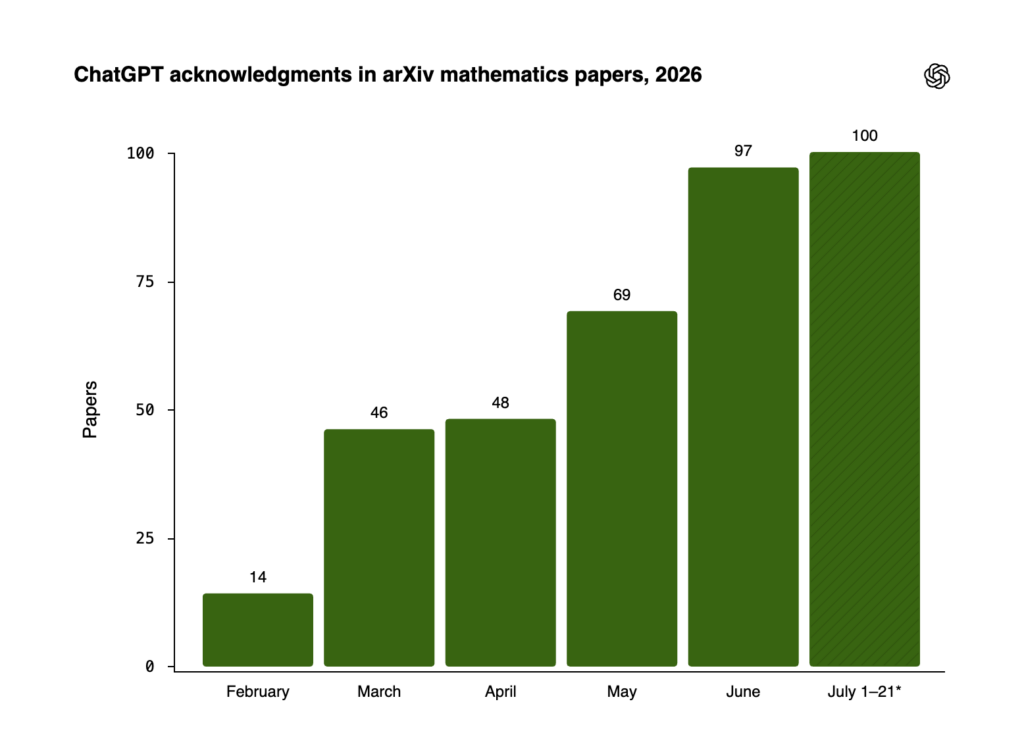
An image showing ChatGPT credits in the preprint server arXiv with July being a partial month. [OpenAI]
The program joins ChatGPT Edu, OpenAI’s institution-level offering for universities, and the Researcher Access Program, which provides API credits for qualifying projects. ChatGPT for Academic Researchers centers on model access, training and hands-on support for scientific work.
The news comes as AI use has become nearly ubiquitous in education, while schools and universities are still defining how the technology can strengthen learning as critics allege the technology, in some cases, can erode critical thinking.
Proponents of the technology note that it is driving advances in scientific research. Google says its Gemini-based Co-Scientist returned, in two days, a top-ranked hypothesis matching the mechanism a team at Imperial College London had spent years establishing. In a separate Nature paper, the nonprofit FutureHouse reported that its Robin agent system proposed ripasudil, a glaucoma drug, as a candidate treatment for dry age-related macular degeneration, with human researchers running the bench experiments.
Some researchers are still in something of exploration mode with genAI. “I feel like AI is erasing the boundaries between subfields of physics,” said Harvard Professor of Physics Xi Yin in an OpenAI video. “So basically, I’m trying to figure out what I can do with the model, not just trying to do better at what I’ve been doing before.”
In the same video, Stirling Churchman, a professor of genetics at Harvard Medical School said she had been using AI to generate code that can analyze data to do early test hypothesis testing. She recounts after giving it a scientific paper, a model, within about 10 minutes, had “histograms basically for every tissue, and it was really striking,” she said. “It’s just really fun to basically make a discovery by using plain language and just talking to the computer.”
OpenAI points to work at Boston Children’s Hospital, where researchers used reasoning models to help diagnose genetic diseases affecting children. Computational astrophysicists have used Codex to develop new approaches to simulating plasma around black holes, accelerating some calculations by up to 1,000 times. Mathematicians have also used OpenAI models to explore longstanding math problems, test conjectures and contribute to new proofs.
OpenAI said the initiative is part of a broader $250 million funding initiative through 2027 to bolster external scientific research and discovery. Included in the funding is NextGenAI, its $50 million project backing research institutions, and its work with the Department of Energy’s Genesis Mission
The enthusiasm around the use of genAI has a shadow side.Science published an editorial in January describing a central concern that AI “could degrade reliability of the scientific literature.” The American Scientist, in an article titled “The Vicious Spiral of AI Slop” warned that “uncurated machine-generated content threatens research integrity and trust in science.” The broader situation ultimately led the preprint site arXiv to clarify that submissions showing clear signs of unchecked model output or fabricated references would draw a one-year ban.
A July 29 preprintposted to arXiv tested the capabilities of AI as research agents. Researchers gave frontier agents six days, thousands of dollars in API and GPU resources, and questions drawn from two unpublished NeurIPS submissions. The authors kept the original findings off the web. The authors then enlisted the agents to handle literature reviews, experimental coding, GPU runs, debugging and paper assembly. In the end, the original researchers scored the resulting papers 2 out of 6 and 1 out of 6, both clear rejections. “We identify five recurring failure modes: poor judgment about the bar for publishable research, uncreative responses to shortcomings in the research design, ineffective backtracking from dead ends, poor resource awareness, and instruction drift,” they wrote in the abstract. The paper itself discloses AI use for LaTeX conversion, copyediting, coding and log analysis, says the team verified the outputs, and assigns full responsibility to the human authors.
The findings support an expert-led model of AI use, with agents expanding the volume of coding, analysis and experimentation while researchers judge the questions, methods and conclusions. AI can also be a force multiplier as Nathaniel Craig, professor at KITP and UC Santa Barbara, said in the aforementioned OpenAI video. Craig noted that the ability to make “leaps of experimental imagination” was traditionally limited by the number of people working on a given problem. “AI can be a huge force multiplier. If any one of those experimentalists now has all of their AI agents, then the space of ideas, the number of leaps of insight they can have, that goes way up,” said Craig, who is also a visiting scientist at OpenAI. “Suddenly we’ll be able to make progress on things in the scale of a year or two years that we thought was the scale of decades. Things that were a lifetime away maybe now only come a decade away.”
Tell Us What You Think!
You must be logged in to post a comment.