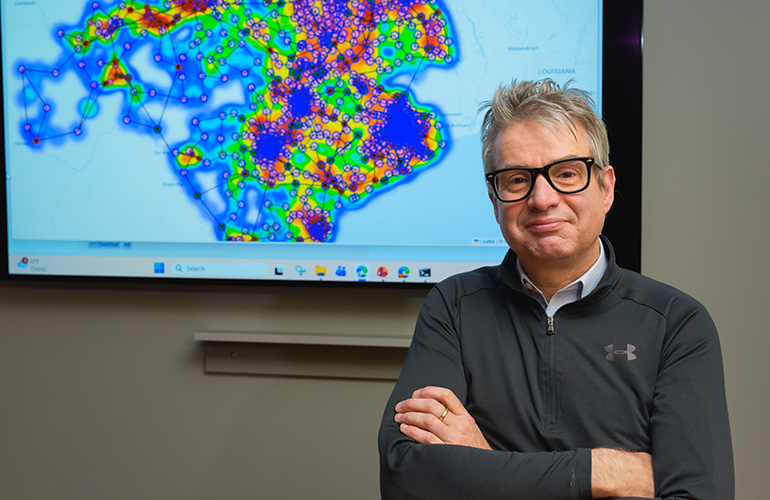
Hendrik Hamann, Brookhaven National Laboratory’s chief AI scientist for Innovation, Science, and Security, demonstrates GridSearch. The software is designed to accelerate the connection of AI data centers, power-generation facilities, and advanced manufacturing plants to the electric grid. Credit: Brookhaven National Laboratory/Tim Kuhn.
Brookhaven National Laboratory says its GridSearch AI system could cut grid simulations from months to minutes as DOE targets 20–100× faster grid decision-making.
Speaking at the recent Genesis Mission Annual Summit, an event dedicated to the U.S. government’s AI-focused initiative that aims to double the productivity and impact of American research and innovation within a decade, Hendrik Hamann, chief AI scientist for innovation, science and security at Brookhaven, noted that the power grid is “arguably the most important critical infrastructure.”
“The electric grid is also one of the largest and most complex systems humanity has ever built,” Hamann said. DOE’s Office of Electricity notes there are 642,000 miles of high-voltage lines and 6.3 million miles of distribution lines and between 60 and 80 million distribution transformers.
Rising load from data centers is one part of broader electricity-demand growth. McKinsey projects that global electricity demand could more than double by 2050, while the Energy Information Administration projects U.S. installed electric generating capacity to climb between 50% and 90% by 2050. In a Brookhaven video, Hamann said the grid might need to grow by as much as an order of magnitude to connect anticipated infrastructure. “To connect all this infrastructure, we need to grow the electric grid by potentially even one order of magnitude, so by 10x,” he said.
To address the growing complexity that AI-driven power demand poses to the grid, Brookhaven is applying AI through GridSearch. The system uses a grid foundation model to prescreen thousands of potential interconnection points and identify locations where large new loads, such as data centers, could connect with lower cost and less disruption.
In late June, Brookhaven announced a partnership with AWS to use the company’s cloud and AI infrastructure to accelerate GridSearch’s development. GridSearch uses a grid foundation model developed through an open-source LF Energy project with major contributions from IBM Research, Hydro-Québec, Brookhaven National Laboratory, Stony Brook University, Argonne National Laboratory, and others.
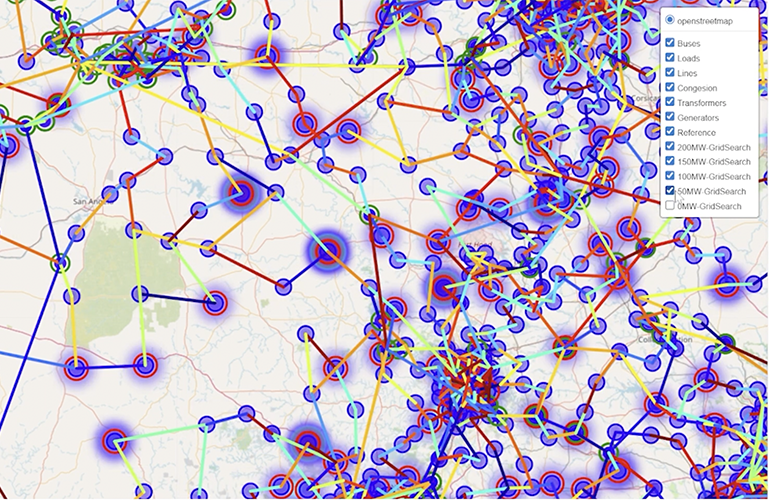
Hendrik Hamann, chief AI scientist at Brookhaven National Laboratory, opened his Genesis Mission Summit keynote by framing the grid as a computational problem. Image from the Genesis Mission Annual Summit.
“Instead of doing it the old way, taking a few scenarios and solving each from the beginning iteratively with complex and somewhat slow physics solvers, we’ve actually built grid foundation models which learn the direct relationship between topology, demand, and energy consumption,” Hamann said. “And because they learn it directly, it’s much faster, and that’s what we need.”
In contrast to language foundation models, which are trained on text, Brookhaven’s models are trained “on the language of the grid,” Hamann said. “That means voltages, power, and frequency across a broad set of conditions. So the model learns how to predict the physics of the grid, enabling us to evaluate billions of scenarios rapidly, not only rapidly, but also accurately and robustly.”
Hamann said the project had already achieved speedups of up to 1,000-fold. “Without AI, for example, data center interconnection simulation studies take months, sometimes years,” he said. “Now, we can do it literally in minutes.”
Hamann closed yesterday’s presentation by saying that GridSearch could flip the script in terms of AI’s impact on the grid. “AI is often considered to be a burden on the grid, but with Genesis, the opposite can actually be true,” he said. “It is actually a huge opportunity to build the most secure, affordable, and reliable grid for the American people.”