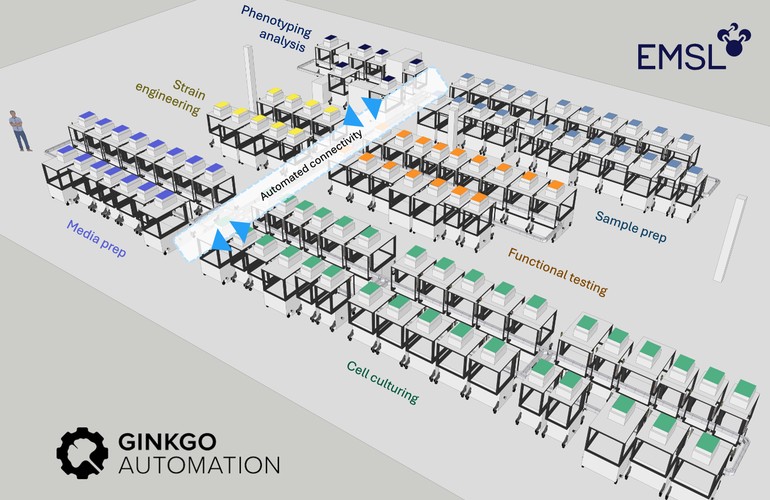
Credit: EMSL communications and Ginkgo Bioworks
Ten months after the Energy Department commissioned a 1,800-square-foot robotic lab for studying microbes, Pacific Northwest National Laboratory (PNNL) has started building a facility 17 times its size. The national lab broke ground Oct. 20 in Richland, Washington, on a 30,800-square-foot autonomous biosciences lab, the Microbial Molecular Phenotyping Capability (M2PC).
Custom software will run M2PC’s more than 100 connected, automated instruments as a single system, according to PNNL. The instruments will grow microbes, prepare samples, measure how microbes grow and behave under precisely controlled conditions and link those observable traits to the molecular machinery inside cells. PNNL plans to use the results to build computer models that predict the behavior of living systems, which could support biotechnology advances in new materials, energy technologies and critical materials recovery. The Environmental Molecular Sciences Laboratory (EMSL), the Department of Energy (DOE) user facility that M2PC will expand, says the lab will cut experimental timeframes “from years to months or even weeks.”
PNNL says M2PC will be one of the world’s largest and most fully autonomous biosciences labs and the first lab of its kind “that will be available to the broader scientific community.” When M2PC opens in 2029, researchers from universities, companies and other national labs can apply to use it at no cost through EMSL’s competitive proposal calls. DOE’s Office of Science approved M2PC in fiscal 2024 and funds it through its Biological and Environmental Research program, according to EMSL.
“M2PC will bring together PNNL’s strengths in microbial science, automation and computing to dramatically accelerate our understanding of what microbes can do and how we put those capabilities to work for the nation,” PNNL Director Deb Gracio said at the groundbreaking.
Ginkgo Bioworks, a Boston company that sells lab automation built on modular robotic carts and runs its own autonomous lab, Nebula, will supply M2PC’s instruments. In December 2025, Ginkgo announced that PNNL had selected it through competitive procurement for a four-year contract worth up to $47 million to co-design, build and integrate the automation using its commercial hardware and software. Ginkgo CEO Jason Kelly told R&D World in April that lab automation has to move from fixed routines, which he compared to a subway, to systems that handle variable experiments, the way a self-driving car handles variable routes. Co-founder Reshma Shetty described Ginkgo’s work with OpenAI on AI-designed experiments in February.
M2PC’s prototype is already running
The robotic lab DOE commissioned in December 2025 is the Anaerobic Microbial Phenotyping Platform (AMP2), which Ginkgo also built and which PNNL calls the prototype for M2PC. AMP2 uses robotics to grow and study microbes that live without oxygen. It began operating in January, and in August it won a 2026 R&D 100 Award, with Ginkgo as co-developer. When PNNL announced the prototype in December 2025, it said the lab would be available to scientists around the nation working with DOE.
The Orchestrated Platform for Autonomous Laboratories (OPAL), a four-lab collaboration led in part by PNNL, aims to link autonomous labs that combine AI, robotics and automated equipment. OPAL is part of the Genesis Mission, DOE’s initiative to use AI to accelerate scientific research. At PNNL, OPAL researchers use AMP2 to map microbial genes to their functions. In AMP2’s first two months of operation, that OPAL work identified biological pathways that could improve critical mineral recovery under preferred laboratory growth conditions, according to a PNNL story. PNNL researchers have also built AutoLabs, a self-correcting AI interface for a high-throughput liquid handler.
EMSL plans for AMP2 to feed AI-ready data into public datasets on Science Central, EMSL’s online platform for user projects and data, according to EMSL’s AMP2 page.

Tell Us What You Think!
You must be logged in to post a comment.