 Ginkgo Bioworks started in a Cambridge apartment in 2008. Five MIT scientists: Shetty, Jason Kelly, Barry Canton, Austin Che and their adviser Tom Knight, set out to make biology easier to engineer. Tom Knight, originally trained in computer science and engineering, shifted into biology before co-founding Ginkgo Bioworks with four MIT colleagues. The team’s founding premise was that software, automation, and biological design could be combined to make biology easier to engineer in ways traditional bench work alone could not match.
That premise took Ginkgo from engineered yeast strains producing fragrances to a $17.5 billion SPAC valuation when it went public in 2021 under the ticker DNA, the same symbol Genentech once used. Along the way, Ginkgo became the first biotech company in Y Combinator, acquired competitors including Zymergen, and built what it called a “foundry” for programming organisms at industrial scale. It was one of the companies that defined “techbio:” the bet that biology could be engineered with the same platform logic as software.
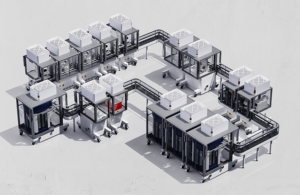
The pandemic briefly recast Ginkgo as a testing and surveillance operator. It launched Concentric, and biosecurity became a major revenue stream before shrinking as school testing wound down. Coming out of that cycle, Ginkgo has leaned harder into productizing the infrastructure behind its original foundry idea. Though it has always focused on automation, its focus has expanded in recent years. The firm has turned its internal stack into a standalone product line, selling its modular Reconfigurable Automation Carts (RACs) and supporting software to outside labs.
The GPT-5 preprint, published February 5 on bioRxiv, landed in that context. Ginkgo’s stock jumped on the announcement. The paper is both a scientific result and a commercial proof of concept: the Reconfigurable Automation Carts and cloud lab infrastructure at the center of the experiment are things Ginkgo sells.
R&D World: Your background spans computer science and biological engineering. How did that shape this project?
Shetty: I did my undergrad in computer science at the University of Utah, and I was lucky enough during that time to also join a biology research lab. I combined those two in my PhD in Biological Engineering. Throughout my career, I’ve always been interested in bringing together different types of tools: software, automation, and biological improvements and inventions. We call it software, hardware, and wetware. In some sense, this is a natural evolution on a journey I’ve been on for many years.
The Ginkgo-OpenAI experiment ran for six months on Ginkgo’s cloud lab in Boston. GPT-5 designed the experiments; Ginkgo’s robotic systems executed them. The human role was narrower than in traditional lab work but far from zero. Ginkgo staff prepared reagents, loaded consumables, fixed stock concentrations when early plates showed high variability, improved the DNA template and cell lysate partway through, and handed GPT-5 the published state of the art it was trying to beat. The result: superfolder green fluorescent protein produced at $422 per gram, versus $698 per gram in the prior benchmark.
R&D World: You describe this as a team effort. What does that team actually look like when it includes AI?
Shetty: You should think of it as a team, except instead of your team being a team of humans, it’s now a mixture of humans and AI agents. Humans might be good at setting scientific direction and doing some of the physical real-world things like reagent quality. The LLM itself is really good at synthesizing information from prior datasets, from the internet, from relevant literature.
It’s just like you would have a human team where each person has a specialization. The team is just now a mix of humans and agents.
R&D World: Where does that go? Do you envision specialized agents for different parts of the research workflow?
Shetty: Right. You can imagine agents that are really good at searching the scientific literature, agents that are really good at analyzing data, agents that are good at writing protocols, agents that are good at verifying that protocols work, agents that help humans prepare reagents. You could have a specialized set of different tools, and then maybe even an agent on top of that that helps synthesize the inputs from all the other agents.
It gets complicated fast, but it’s in many ways not dissimilar from how human teams work. As you try to go after bigger and bigger objectives, you tend to have more people, and then you need to organize the efforts of those people. There’s no particular reason why a team of computer agents and human scientists couldn’t organize themselves to go after bigger and bigger scientific objectives.
Ginkgo has long framed its business around a transportation analogy. When Shetty describes the current state of lab automation, the metaphor doubles as a pitch for what Ginkgo is selling.
R&D World: Your CEO Jason Kelly uses a transportation analogy to describe lab automation. Can you walk through it?
Shetty: If you look at lab automation in general, what you see in most labs is walk-up automation. A scientist has their plate of samples, they walk up to a liquid handling robot, put their plate on it, it mixes liquids for them, they physically take it off, take it to an incubator, then to an analytical instrument.
The next level is integrated automation: a central robotic arm that moves samples from instrument to instrument. If you’ve been to SLAS, you’d have seen these systems. But people invest in integrated automation for very particular workflows they want to run over and over again. Jason likes to say integrated automation is like a subway. It’s automated, it’s a great way to move large numbers of people along a fixed route, on a fixed schedule. But most ground transportation is cars. Ninety-nine percent of miles traveled are in cars because people love flexibility. Subways are relegated to a few niche use cases.
We have the same challenge in the lab. Integrated work cells are good for fixed workflows. But most science is actually done at the lab bench. The lab bench is science’s equivalent of the car: very flexible, you can change what experiment you do every day.
Where I think we realize the full potential of AI-driven science is autonomous labs. In transportation, we now have Waymos. The human gives directions through the app, but the driving is done by a computer. RACs are the hardware layer that enables that. Because they’re modular, because you can mix and match them, because you can encode protocols in software, you can write any workflow to run on that system.
The 40% cost reduction, however, came with a caveat. The optimization targeted a single protein, superfolder green fluorescent protein, and when the team tested the winning reaction composition against a panel of twelve other proteins, only half produced enough protein to be visible by SDS-PAGE.
R&D World: Is the 40% cost reduction universal, or specific to what you optimized for?
Shetty: My assumption is that you get what you optimize for. Biologists have a saying: you get what you screen for. I think the same is true for AI-driven science.
We gave the model a particular objective: optimize the cost of cell-free protein synthesis for a particular protein, sfGFP. If I asked GPT-5 to instead optimize production of a panel of proteins, or optimize a protein with disulfide bonds, it would come up with a different answer. If we want to broaden the application, we would need to do additional rounds of optimization.
R&D World: The biggest performance jump came in Step 3. What factors did GPT-5 drive here?
Shetty: We gave GPT-5 access to the internet, a computer, data analysis packages, and Mike Jewett’s preprint. Everything a human scientist would have access to. On the human side, we also improved some reagent quality on both the DNA side and the lysate side. That’s when we were able to actually achieve the 40% improvement.
R&D World: If this works at scale, do human scientists still need to pipette?
Shetty: Right now, I would say 99% of science is done at the bench with individuals pipetting liquids around, and a very small fraction is done on robots, let alone on autonomous labs. That percentage feels off to me. More science can and should be done using autonomous labs, using AI agents to help design and analyze experiments.
Do I think no human should ever have to pipette again? No. There’s going to be a place for some bench science: things that don’t make sense to run on an autonomous lab for whatever reason. But right now, we’re so far skewed toward the bench that there might be opportunities we’re missing by not unlocking the potential of these tools.
Related: OpenAI’s GPT-5 autonomously ran 36,000 protein synthesis experiments in Ginkgo Bioworks’ cloud lab | ARPA-H funds $29M Ginkgo-led project to reshore pharma supply chains using wheat germ tech