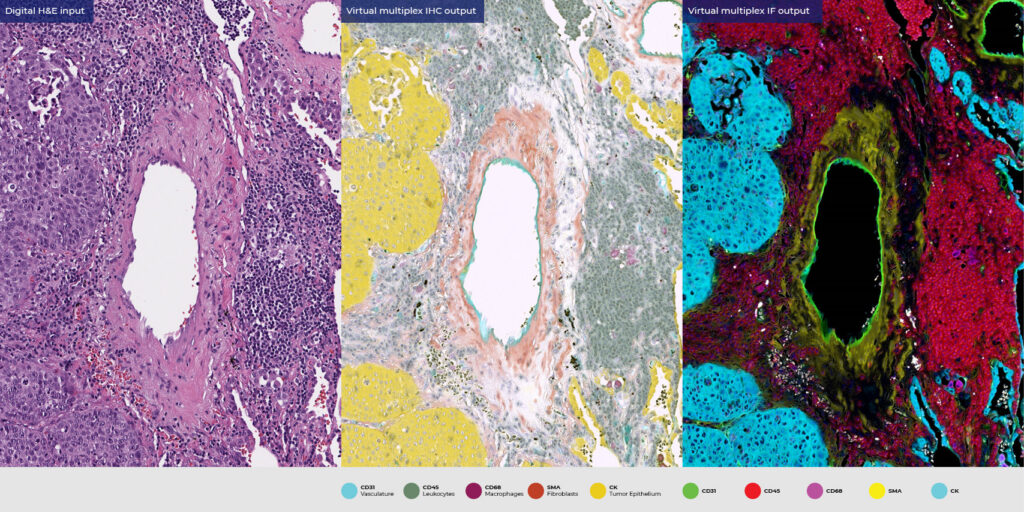
ViewsML generates virtual multiplex stains from a digital H&E image (left), predicting biomarkers per cell to map tumor epithelium, vasculature and immune and stromal compartments, shown as virtual IHC (center) and immunofluorescence (right). Image courtesy of ViewsML.
ViewsML, the Vancouver-based company developing what it calls the world’s first virtual biomarker library, closed an oversubscribed $4.9 million seed round earlier this year. Wittington Ventures, the Toronto venture arm of the Weston family holding company, led the round. New investors Mayo Clinic and Continuum Health Ventures participated alongside repeat backers including Debiopharm.
In an interview, CEO Kenneth To said the company plans to use the capital to expand its team of roughly a dozen employees while accelerating commercialization and clinical validation work. One of the round’s more notable signals was Mayo Clinic’s participation as a new investor. Mayo is new to ViewsML’s cap table, but the two organizations were already working together: Mayo Clinic Digital Pathology has been assembling a broader ecosystem that brings together clinical expertise, data, infrastructure, and outside AI developers, and ViewsML is among the companies in it. That collaboration sits on the clinical diagnostic side and is separate from the equity stake Mayo took in this round. To said Mayo had been tracking digital pathology for several years and grew more interested as virtual staining emerged as a distinct category, and he characterized the clinic’s read on ViewsML directly: “As they tracked us, it started becoming clear that we were becoming the category leader,” he said. “Over the last year we’ve really proved that out, and I think that’s where they got really excited.”
The broader digital pathology field has shifted markedly in recent years as artificial intelligence and machine learning have begun extracting meaningful information from routine H&E images. To argues that simply digitizing slides was never enough on its own.
Digital as necessary but not sufficient
 “Slide scanners have been around for quite a while, and the ability to go digital has been there for quite some time,” he said. “But going digital for the sake of going digital doesn’t really offer much value. This is where the intersection of AI and ML comes into place: once you go digital, you can unlock a lot of information and insights. I think that’s really the convergence you’re seeing.”
Several companies are now applying AI to speed up or augment pathology workflows. PathAI, for instance, has built partnerships with biopharmas to analyze tissue samples at scale, while Paige has obtained FDA clearances for AI applications in cancer diagnostics.
Growing adoption of precision medicine is also stoking interest in digital pathology. “The importance of biomarkers has really emerged,” To said. “And you’re now starting to see that the bottleneck around precision medicine is really biomarker insights, or at least a significant part of that bottleneck is biomarker-based insights.”
ViewsML’s strategy is to help biopharma companies generate more biomarker insights from existing tissue samples. “We can help enable better patient characterization, faster patient selection, more efficient clinical trial execution,” To said. “And we’re doing that by using AI to generate these biomarker virtual stains, all from this routine pathology image called the H&E slide.”
That advantage comes from converting a traditionally wet-lab process into software. “Normally you’d have to take a biopsy, send it to the wet lab, do the biomarker staining called immunohistochemistry, and wait days to weeks for results,” To said. ViewsML instead delivers virtual stains directly from the digital H&E image.
To contrasts ViewsML with traditional pathology AI tools that, as he describes them, deliver case-level biomarker status, positive or negative. ViewsML instead generates per-cell predictions, which enables spatial mapping of biomarker expression inside the tumor microenvironment versus the surrounding tissue. This capability is particularly relevant for immuno-oncology, antibody-drug conjugates, and bispecifics, where understanding heterogeneity within the tumor can inform therapeutic strategy.
An additional layer of differentiation comes from virtual multiplexing. By virtualizing multiple biomarkers and layering them computationally, the platform can deliver greater spatial biology insights than would be practical with physical multiplexing.
“By showcasing our virtual multiplexing platform, by being able to virtualize multiple biomarkers and then layer them one on top of another through our virtual multiplexing technology, it’s allowing them to get even greater insights from a spatial biology perspective,” To said.
Traditional biomarker profiling typically relies on immunohistochemistry (IHC) performed in the wet lab, followed by molecular testing such as next-generation sequencing. ViewsML instead converts the IHC step into software that generates virtual biomarker stains directly from routine H&E images.
“We are taking a traditionally wet lab procedure and we’re turning it into software,” To said. “By turning it into software, we can provide these virtual stains directly from this digital H&E image, and that provides immediate predictive outcomes at a per-cell level.”
Stretching scarce tissue and time
One practical advantage of this approach is tissue conservation. In conventional workflows, physical IHC staining consumes biopsy material that could otherwise be used for downstream molecular analyses. By predicting protein localization virtually, ViewsML leaves more of the sample available for NGS or other multi-omic testing.
As To put it, the goal is “being able to do the virtual staining, predicting where those proteins are, to be able to conserve that tissue so that you have sufficient tissue to do the downstream molecular testing.”
To rejects the binary framing that often surrounds AI in pathology. Rather than positioning virtual staining as a replacement for physical immunohistochemistry, he describes it as a strategy that can help stretch limited biopsy material further. “We can help triage, we can help stratify, and create efficiencies, so that when you want to then do confirmatory testing, you’re doing it in a much more efficient manner. And you’re also being a better steward of the physical tissue from the patient.”
For the biopharma customers, the argument ultimately comes back to cost. “We know how expensive it is to run clinical trials,” To said. “If you’re able to save even a few days in identifying a patient to enroll in that clinical trial, that’s obviously of significant value to that pharma.”