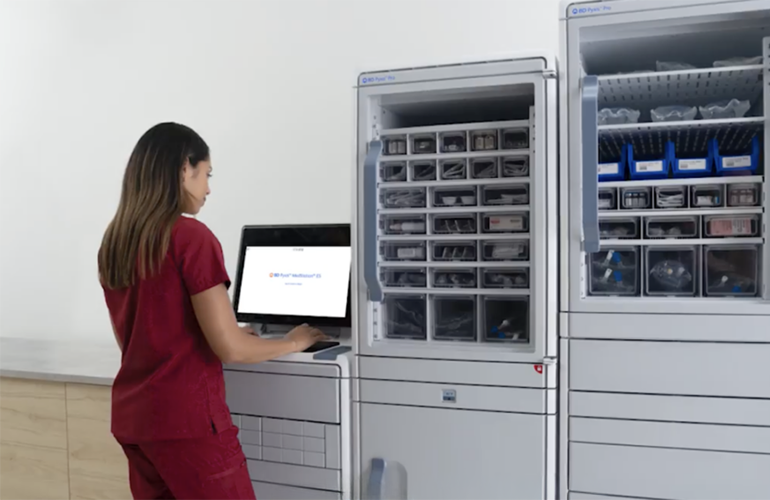
 When Becton, Dickinson and Company launched its Incada Connected Care Platform in October 2025 with the next-generation Pyxis Pro dispensing system, it framed the move as a way to turn data from nearly 3 million smart connected BD devices into actionable insights on medication inventory, waste and clinician workflows.
Omar Ahmed, who joined BD as senior vice president of R&D for the Connected Care segment in December 2025, sees Incada as the foundation for a broader AI-enabled strategy. “What that means for Incada is we have to build on that foundation that’s already there and bring it up to the next level,” Ahmed said.
Current inventory visibility

Omar Ahmed
The near-term focus is on “taking the real-time data streams and signals off the devices we have within the BD portfolio and creating real-time actionable scores that healthcare professionals can take advantage of,” Ahmed said.
Those streams span pharmacy automation, medication dispensing, infusion pumps, medication cabinets and BD’s Advanced Patient Monitoring portfolio. Incada is intended to bring the data together in one platform rather than leaving hospitals to interpret it device by device.
Other healthcare companies are also applying AI to routine workflows. Omnicell, for instance, has backed AI-powered inventory optimization for medication dispensing, while Philips and GE HealthCare apply AI to insights from continuous patient monitoring. BD’s effort spans both medication management and monitoring data.
Mitigating medication waste with AI
Medication waste is one of the biggest challenges BD sees across its hospital customers and “probably one of the largest financial burdens on a hospital system today,” Ahmed said. But reducing waste is not simply a matter of keeping less medication on hand.
“Some of the challenges we’re solving for include medication expiration and waste,” Ahmed said. “However, if you try to overcompensate for waste, you can lead to stockouts, where clinicians go to a dispensing cabinet and can’t find the medication they need. There is a balancing act in managing inventory and par levels within a hospital.”
BD therefore tracks expiration, stockouts and the number of trips a clinician makes to a cabinet. “What we want to do is minimize the number of trips while still maintaining par levels and preventing medication waste,” Ahmed said.
Hospitals operating under margin and staffing pressure need to reduce process bottlenecks and make better use of clinicians’ time. Ahmed said BD evaluates workflow projects against two goals: a measurable financial return from greater efficiency and improved clinical outcomes.
Predictive signals
Demand forecasting over time-series data has long been used in applications such as energy load planning and retail supply chains. Fresh-goods supply chains offer one comparison because short shelf life turns every over-order into a write-off. A linked vendor case study of Danone’s 2011 Disc’Over project reported that the company used a machine learning demand system for fresh-product lines with volatile, promotion-heavy sales, reducing forecast error by about 20% and product obsolescence by about 30%.
Hospital medication usage data has some similarities with a stream of consumption data carrying weekly rhythms, seasonal swings and admission-driven spikes. “There are multiple ways you look at this,” Ahmed said. “There’s the institutional data. Based off a historical trend, what is my usage going to be?” There are other avenues as well, such as data relating to the types of patients admitted across a hospital system, which can help predict usage over the next few days or weeks. The data options for such predictions are far-ranging. “You also have seasonal data and environmental data, and then you have data that can actually come in from other hospital systems that can serve as leading indicators for these things,” Ahmed said. “You build an algorithm that takes into account all of these different avenues, building that AI model that takes that into account, and then, to your point, it predicts what’s actually going to happen.” Ultimately, hospitals can become increasingly accurate at predicting, say, what type of medication to stock up on, or the reverse, the ones not to stock up on.
Guardrails first
Long before hallucinations made AI a headline risk, statisticians were wrestling with fitting models to data. A model trained too tightly on past demand learns the noise in last year’s numbers and stumbles the moment conditions shift. In other words, it overfits. A model built too simply smooths away the spikes it was meant to catch. It underfits. Both are versions of the same older caution: a model is a simplification, never the reality it stands in for. Or, in a line often attributed to statistician George Box, who helped lay the groundwork for modern time-series forecasting, all models are wrong, but some are useful.
“Our approach is always to design with risk in mind,” Ahmed said. BD approaches problems by looking at what could potentially go wrong and ensuring mitigations are in place. “You heard about this problem with AI models hallucinating or making things up.”
Such problems call for firm guardrails. NHS England, for instance, first issued guidance in April 2025 advising organizations to ensure that ambient scribing products deemed to be medical devices are registered with the Medicines and Healthcare products Regulatory Agency (MHRA) and regulated in proportion to their risk classification. Meanwhile, a May 2026 report from Ontario’s auditor general found at least one type of inaccuracy in notes from multiple approved AI scribe systems tested with simulated recordings.
BD Incada has a number of safeguards built in to reduce risk, supporting a natural language query in which a large language model translates user questions into structured queries “using a governed semantic layer that maps business terms to data,” as Ahmed noted in an earlier interview. “The system then validates those queries through schema checks, access controls, and rule-based or statistical guardrails before execution.” Ahmed also noted that BD Incada uses additional training and safety guardrails to maintain accuracy of plain-language answers delivered to users.
“We build guardrails defining what is okay and what is not okay, and the model operates within those bounds,” he said. “There are general guardrails for the specific population, for instance, and we ensure everything stays within those bounds before we launch. It is highly specific to the use case, and that approach serves as a template and framework whenever we launch our AI models.”