Scientific data isn’t exactly scarce. But considerable obstacles stand in the way of tapping it. A 2023 iScience article concluded that, in academia alone, there was an estimated $6.2 billion in unused laboratory resources, including unpublished data and unused research samples. The sum represents an estimated 7% of the annual U.S. academic R&D budget.
But the problem isn’t confined to academia. Some biopharma companies, for instance, have decades’ worth of data, encompassing clinical trials, research findings, and patient records, but it is frequently disorganized and thus of little use without stringent validation.
Ginkgo co-founder Reshma Shetty said in an interview with R&D World.
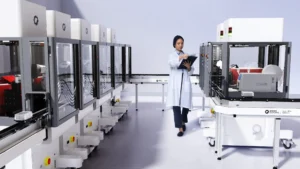
But what if machines could help automate the process of both collecting and analyzing experimental data? The techbio Ginkgo Bioworks has worked on lab automation for years, and as of mid-2024, began offering its Reconfigurable Automation Carts (RACs) commercially after using them internally for nearly a decade. The system represents a shift in laboratory automation. That is, it can create a closed-loop between physical experiments and AI-driven analysis.
In an impromptu interview at NVIDIA’s GTC, I asked William Serber, General Manager of Ginkgo’s automation business unit, for an overview of what the company was up to with laboratory automation. Ginkgo had taken standard laboratory instruments commonly used in labs and incorporated software and sensors to create, in essence, “machines that run biology experiments with minimal human input,” as the company put it in an email.
Lab machines that can click together
The modular, LEGO-like system can be customized and extended. A new RAC unit can be added to a workflow in “about ten minutes,” Serber said. No specialized tools or elaborate construction are required.
This building-block approach takes aim at one of the biggest frustrations in lab automation: scalability. With Ginkgo’s decentralized design, Serber said that facilities can start with just a few units for smaller workflows and then quickly expand or reconfigure as project demands evolve.
[Image courtesy of Ginkgo Bioworks]
Bringing order to experimental data
What does this have to do with the data problems described at the outset of this article? Well, machines have the potential to be superhuman recordkeepers. In Ginkgo’s case, each RAC system directly addresses the challenge of unused laboratory resources through its comprehensive data capture capabilities. The robots will keep all the data. Every action that happens in a RAC is recorded and logged. It can capture details that “no human scientist” would, Serber said. In essence, this automatic documentation eliminates one of the primary causes of scientific waste: incomplete or disorganized record-keeping.
The system’s web-based software doesn’t just collect data—it structures it from the beginning in a format immediately ready for analysis. The RAC platform can ensure that new experimental data is born structured, contextualized, and ready for use. It also can tap NVIDIA’s GPU-powered accelerated computing to parse complex biological workflows, and assist in designing, testing, and analyzing biological systems.
When asked where the RAC system is seeing traction, Serber notes that it is finding use across sectors: in diagnostics companies, large chemicals companies, small molecule drug discovery companies, national labs, and academic labs.
Ginkgo is bullish on the system doing more at automating some experimental procedures and logging them. The company imagines a future where human and AI scientists collaborate seamlessly — in a manner similar to how AI is augmenting software development today.
Serber wonders aloud about the power of combining human intelligence with AI to design experiments, search literature, and guide the scientific process. But he stresses that AI alone can’t (and perhaps shouldn’t) replace every aspect of human intuition—especially in shaping a good hypothesis.
Related: Full Q&A: Reshma Shetty on autonomous labs and AI-designed experiments | Inside Ginkgo’s modular RAC platform | ARPA-H’s $29M cell-free protein synthesis project with Ginkgo