A soft contact lens can now measure serotonin, a neurotransmitter involved in mood regulation and stress, in tears. Researchers at the Terasaki Institute for Biomedical Innovation (TIBI) in Los Angeles described the reusable lens Sept. 16 in Science Translational Medicine.
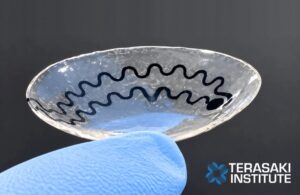
A soft, reusable contact lens from the Terasaki Institute for Biomedical Innovation carries a printed, stretchable sensor that measures serotonin in tears. [Image courtesy of Terasaki Institute]
The serotonin lens is at least the third Zhu has worked on at TIBI, after a 2022 lens aimed at cancer screening and an April lens that monitors and treats glaucoma. Separately, Jang-Ung Park’s group in South Korea has built a wireless lens that measures the stress hormone cortisol and a lens that stimulates the retina, which reduced depression-like symptoms in mice.
Serotonin, measured in tears
Researchers have reported serotonin in human tears since at least 1994, and recent studies have tied tear cortisol to anxiety scores and to stress induced in the lab.
Zhu’s soft hydrogel lens carries a printable, stretchable sensor based on ferrocene, an iron-containing compound that reacts with serotonin to produce a small electrical signal. In artificial tears, it detected serotonin at concentrations as low as 72 picomolar, about 200 times lower than the typical concentration in human tears, and kept accurate readings across up to 400 uses, TIBI said in a press release.
“Tears carry more information about our bodies than most people realize,” first author Minwoo Kim, a TIBI postdoctoral researcher, said in the release.
In the same study, in a mouse model of chronic stress, tear serotonin dropped while cortisol rose in both blood and tears. The researchers also showed the lens was safe and biocompatible in a pig eye model.
The team also collected tears from 10 volunteers during a standardized stress test, the release said, and analyzed them later. Serotonin fell during the stressful task and returned toward baseline afterward. None of the volunteers wore the lens, which is still connected to laboratory equipment. The team plans to add wireless components.
Larger and more diverse human studies are still needed, along with work on long-term sensor stability, calibration in the changing tear environment, comfort, reproducible manufacturing and extended on-eye safety, the release notes.
The cortisol lens that came first
The TIBI lens is not the first contact lens built to read stress chemistry. In 2020, Park’s team at the Institute for Basic Science (IBS) Center for Nanomedicine in South Korea published a lens in Science Advances that measured cortisol in tears with a graphene sensor. Transparent antennas let a smartphone operate the lens wirelessly, and the team tested it in rabbits and a human pilot experiment. The sensor detected cortisol at concentrations as low as 10 picograms per milliliter, low enough to measure the hormone in human tears, and the rabbit and human tests confirmed the lens was biocompatible and reliable, the researchers reported.
From sensing to stimulating
Park’s group at Yonsei University has since built a lens that tries to change mood chemistry rather than read it. In a May study in Cell Reports Physical Science, the team described a soft lens whose electrodes send two electrical signals that intersect at the retina, stimulating eye-to-brain pathways to brain regions linked to depression.
Mice with depression-like symptoms that received 30 minutes of stimulation a day for three weeks showed behavioral improvements comparable to mice given fluoxetine, sold as Prozac, according to a Cell Press release. They also had 47% more serotonin and 48% less blood corticosterone, a stress hormone, than untreated mice. The researchers call the work preclinical, and the lens is not yet wireless.
The tear-blood problem
The eye itself could complicate readings. A 2015 University of Miami study of 62 patients at a Veterans Administration eye clinic found significantly higher tear serotonin in people with both dry-eye symptoms and low tear production than in people with normal tear production or no symptoms. Zhu told IEEE Spectrum that researchers still need to learn how tear serotonin varies with the condition of the eye’s surface, as well as across individuals, times of day and diseases.
What comes next
All of these lenses remain in preclinical or early pilot testing.
Next, TIBI will apply the approach to post-traumatic stress disorder (PTSD) under an NIH grant worth about $6.9 million. Zhu leads the project with Nanthia Suthana of Duke University and Ximin He of UCLA. The team plans to test a multimodal lens platform in people who already have implanted brain-recording devices, linking lens readings to activity in the amygdala and hippocampus, the announcement said.
Serotonin is a proof of concept, Zhu said in the release. “The broader goal is to build wearable ocular systems capable of monitoring multiple biomarkers and physiological signals over time.”


Tell Us What You Think!
You must be logged in to post a comment.