Research & Development World

  • R&D World Home
  • Topics
    • Aerospace
    • Automotive
    • Biotech
    • Careers
    • Chemistry
    • Environment
    • Energy
    • Life Science
    • Material Science
    • R&D Management
    • Physics
  • Technology
    • 3D Printing
    • A.I./Robotics
    • Software
    • Battery Technology
    • Controlled Environments
      • Cleanrooms
      • Graphene
      • Lasers
      • Regulations/Standards
      • Sensors
    • Imaging
    • Nanotechnology
    • Scientific Computing
      • Big Data
      • HPC/Supercomputing
      • Informatics
      • Security
    • Semiconductors
  • R&D Market Pulse
  • R&D 100
    • 2025 R&D 100 Award Winners
    • 2025 Professional Award Winners
    • 2025 Special Recognition Winners
    • R&D 100 Awards Event
    • R&D 100 Submissions
    • Winner Archive
  • Resources
    • Research Reports
    • Digital Issues
    • Educational Assets
    • Subscribe
    • Video
    • Webinars
    • Content submission guidelines for R&D World
  • Global Funding Forecast
  • Top Labs
  • Advertise
  • SUBSCRIBE

This contact lens measures eye pressure and automatically dispenses medicine

By Julia Rock-Torcivia | April 9, 2026

Glaucoma is a leading cause of irreversible blindness, primarily driven by elevated intraocular pressure (IOP) inside the eye. Current treatments include eye drops and clinic visits to check eye pressure, meaning that doctors often miss pressure spikes between visits. 
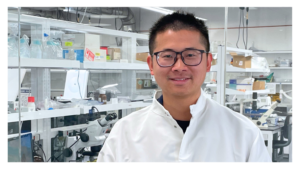
Terasaki Principal Investigator Dr. Yangzhi Zhu. Credit: Tarasaki Institute

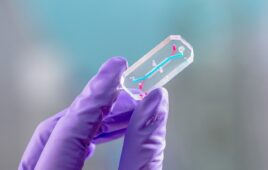
A research team from the Teraski Institute for Biomedical Innovation (TIBI) has developed a smart contact lens made of soft, flexible polymers that monitors eye pressure and delivers medication as needed. The lens does not contain any metal sensors, batteries or hard electronic circuits, allowing it to remain highly transparent and comfortable enough for prolonged wear. The work is published in Science Translational Medicine. 

“Our design fundamentally shifts the paradigm from reactive to proactive ocular care by embedding intelligence directly at the disease interface,” said Principal Investigator Yangzhi Zhu. 

The lens is a theranostic device, meaning that it combines diagnostics and therapeutics in a single, closed-loop system. It’s built with a multilayered structure containing tiny pouches of diagnostic liquid and therapeutic drugs. 

When eye pressure rises, the cornea bulges and deforms slightly, compressing the diagnostic pouch and pushing liquid through a serpentine microchannel. The patient can take a photo of their eye and upload it to an AI application that reads how far the liquid has traveled in the microchannel and translates it into an intraocular pressure reading. 

If the pressure exceeds a dangerous threshold, the corneal bulging mechanically compresses the therapeutic drug pouches, releasing pressure-lowering drugs such as timolol or brimonidine directly into the eye. 

The drug reservoirs in the lens use a silk-based spone strucutre which allows the lens to hold a higher volume of medication than a simple hollow chamber and provides structural support. The support prevents the microchannels from collapsing under the eyelid’s pressure. 

The reservoirs were engineered with different mechanical thresholds. For example, a mild pressure spike might release timolol, while a more severe or sustained spike might compress a second reservoir to release brimonidine. 

The researchers tested the technology on enucleated bovine eyes and live rabbit eyes. The preclinical trials demonstrated that the lens could stably and accurately track intraocular pressure in real-time and autonomously release precise amounts of medication when the pressure threshold was crossed.

The bovine eyes were used to test the mechanical accuracy of the sensor. Cow eyes are large and have similar elastic properties to human eyes, allowing the scientists to control the internal pressure and verify that the microchannels responded linearly to pressure changes.  

The live rabbit eyes were used to test biocompatibility and real-world performance. This proved the lens could accurately track IOP in a living system with factors like blinking, tear film interference and eye movement. This trial demonstrated that the lens release the medication autonomously when the rabbits’ eye pressure reached a preset threshold. 

Related Articles Read More >

We are still likely years away from a hantavirus vaccine
Artemis II experiment uses organ chips to prepare for long-duration missions
New brain-computer interface allows monkeys to navigate 3D virtual reality
Researchers develop immune-capable cervix-on-a-chip to advance STI research
rd newsletter
EXPAND YOUR KNOWLEDGE AND STAY CONNECTED
Get the latest info on technologies, trends, and strategies in Research & Development.

R&D World Digital Issues

Fall 2025 issue

Browse the most current issue of R&D World and back issues in an easy to use high quality format. Clip, share and download with the leading R&D magazine today.

R&D 100 Awards
Research & Development World
  • Subscribe to R&D World Magazine
  • Sign up for R&D World’s newsletter
  • Contact Us
  • About Us
  • Drug Discovery & Development
  • Pharmaceutical Processing
  • Global Funding Forecast

Copyright © 2026 WTWH Media LLC. All Rights Reserved. The material on this site may not be reproduced, distributed, transmitted, cached or otherwise used, except with the prior written permission of WTWH Media
Privacy Policy | Advertising | About Us

Search R&D World

  • R&D World Home
  • Topics
    • Aerospace
    • Automotive
    • Biotech
    • Careers
    • Chemistry
    • Environment
    • Energy
    • Life Science
    • Material Science
    • R&D Management
    • Physics
  • Technology
    • 3D Printing
    • A.I./Robotics
    • Software
    • Battery Technology
    • Controlled Environments
      • Cleanrooms
      • Graphene
      • Lasers
      • Regulations/Standards
      • Sensors
    • Imaging
    • Nanotechnology
    • Scientific Computing
      • Big Data
      • HPC/Supercomputing
      • Informatics
      • Security
    • Semiconductors
  • R&D Market Pulse
  • R&D 100
    • 2025 R&D 100 Award Winners
    • 2025 Professional Award Winners
    • 2025 Special Recognition Winners
    • R&D 100 Awards Event
    • R&D 100 Submissions
    • Winner Archive
  • Resources
    • Research Reports
    • Digital Issues
    • Educational Assets
    • Subscribe
    • Video
    • Webinars
    • Content submission guidelines for R&D World
  • Global Funding Forecast
  • Top Labs
  • Advertise
  • SUBSCRIBE