While the Artemis II mission was primarily a test flight for future lunar missions, a small experiment aboard the spacecraft is investigating space’s effects on the human body. The A Virtual Astronaut Tissue Analog Response (AVATAR) experiment used organ-on-a-chip devices to study the effects of deep space radiation and microgravity on human health.
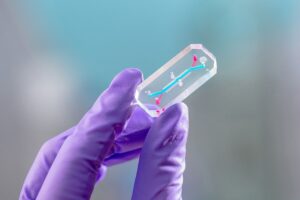
An AVATAR Organ chip. Credit: NASA
The experiment aims to identify potential risks to human health before long-duration Moon and Mars missions and advance the use of biomedical technologies in research to contribute to healthcare improvements, such as cancer treatments.
The experiment involves organ chips containing bone marrow tissue derived from cells from the Artemis II astronauts that were housed in a self-contained life support system aboard the Orion spacecraft. Now that the mission has returned to Earth, the samples will be analyzed and compared to data gathered during a simultaneous ground control study.
Using organ chips to study individual responses to space
Organ chips, also referred to as tissue chips or microphysiological systems, are roughly the size of a USB thumb drive and are used to help understand how an individual might respond to a variety of stressors, such as radiation or medical treatments, including pharmaceuticals. Essentially, these small devices serve as “avatars” for human organs.
“For NASA, organ chips could provide vital data for protecting astronaut health on deep space missions,” said Lisa Carnell, director of NASA’s Biological and Physical Sciences Division.
The chips could help determine individualized responses to deep-space stressors and personalize medical kits for future astronauts. The experiment will also investigate how radiation affects the bone marrow samples to provide insights into how radiation therapy and other DNA-damaging agents, such as chemotherapeutic drugs, impair blood cell formation.
Studies have shown that microgravity affects the development of bone marrow cells. Although the International Space Station operates in low Earth orbit, which is shielded from most cosmic and solar radiation by the Earth’s magnetosphere, astronauts often experience a loss of bone density. Given that the Artemis II crew will be flying beyond this protective layer, AVATAR researchers also seek to understand how the combined stressors of deep space radiation and microgravity affect the developing cells.
Now that the organ chips have returned to Earth, researchers will examine how spaceflight affected the chips by performing single-cell RNA sequencing to measure how thousands of genes may have changed within individual cells. This could provide information about how each astronaut responded to the conditions of space.
Automated hardware and system design for deep space research
The chips were mounted on the port Environmental Control and Life Support System (ECLSS) wall inside the Orion Crew Module. Space Tango constructed the automated systems and hardware that allowed for sample maintenance and data collection. The payload unit included an aluminum outer structure to protect the samples from launch and return loads.
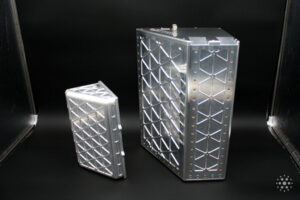
The bay that stored the chips aboard the Orion spacecraft. Credit: Space Tango
Within the structure is a specialized science bay based on Space Tango’s space systems. The bay components were designed and selected for biological and chemical compatibility and sterility to prevent adverse effects. A pressure-driven microfluidics system delivered nutrients and removed waste at an ultra-slow, precisely controlled flow. With continuous environmental control at 37 degrees Celsius (98.6 degrees Fahrenheit), the chips remain as close as possible to natural human body conditions.
The system was powered by an internal bank of lithium-ion batteries designed to support the experiment for 14 days of operation. Capacity margins allowed for three consecutive launch attempts. After activation on the ground, the payload operated autonomously and independently from Artemis II operations. Astronauts interacted with the payload once daily by pressing a button to confirm system health and status.
AVATAR was the first program to utilize organ chips beyond low-Earth orbit. Space Tango also participated in the ISS National Laboratory and National Center for Advancing Translational Sciences (NCATS) Tissue Chips in Space Initiative that flew multiple chip systems to the ISS from 2018 to 2023. Those earlier studies revealed how microgravity accelerates changes in immunity, bone loss and tissue degeneration. AVATAR expands on program findings into a new orbital domain where radiation levels and gravitational dynamics differ dramatically.
AVATAR is led by NASA, in collaboration with other U.S. government agencies, including the Biomedical Advanced Research and Development Authority (BARDA) and the National Center for Advancing Translational Sciences (NCATS), which is part of the National Institutes of Health. Commercial partner Space Tango developed the innovative hardware to enable the automated experiment aboard Orion using Emulate organ chips, with Emulate and the Wyss Institute scientists leading the research.