Researchers have developed an intracortical brain-computer interface (BCI) that could someday help paralyzed patients control devices such as wheelchairs and prostheses. They tested the technology in macaque monkeys and published the results in Science Advances.
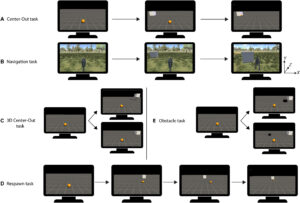
Monkeys completed a series of tasks in a 3D virtual reality. Credit: Saussus et al., Science Advances 2026
The BCI system drew on neural signals from three regions of the macaque brain: the primary motor cortex and the dorsal and ventral premotor cortices, enabling more precise and flexible decoding of real-time 3D movements, marking an improvement over previous BCI systems.
The study used a complex 3D virtual reality environment with stereoscopic vision, featuring simulations of increasing complexity and unpredictability that mimicked real-life scenarios. The monkeys sat in a chair with their heads fixed and arms restrained, viewing a high-refresh-rate 3D screen. They wore shutter glasses synchronized with the display for stereoscopic vision, while infrared eye-tracking monitored their gaze at 500 Hz.
Beyond the primary motor cortex
The researchers implanted three rhesus macaque monkeys with Utah arrays, grids of tiny electrodes, in three distinct motor brain regions: the primary motor cortex (M1), the dorsal premotor cortex (PMd) and the ventral premotor cortex (PMv). Most prior BCIs have relied on the primary motor cortex alone. This decreases the quality of data as many regions beyond the primary motor cortex contribute unique motor outputs with movement-related information that is absent or difficult to resolve from M1 activity alone.
The researchers attempted to solve this problem by recording from two additional brain regions. The study found that PMv and PMd consistently outperformed M1 across tasks and monkeys. The combination of PMv and PMd often matched or even exceeded the “All” condition (balanced input from all three areas), suggesting a synergistic premotor contribution and underscoring M1’s limited independent contribution when premotor signals are available.
A companion study confirmed that PMv activity alone can support online cursor control at performance levels comparable to M1 or PMd. Input from this area may make it easier for patients to control a BCI because its cortical activity reflects high-level motor planning commands rather than the low-level execution signals in M1.
Additionally, in cases where the M1 is damaged, after a stroke, or in patients with ALS, it is important to be able to use activity from other cortical areas for BCI control.
Training through observation
In all tasks, the decoder was trained using data obtained during passive observation of movements in the VR environment. The monkey watches a movement on screen and the brain’s neural response to the observation was used to calibrate the decoder. This is crucial for paralyzed patients who can’t perform movements to train the system.
The BCI translated neural activity from the three motor cortical areas into real-time 3D velocities. The monkeys’ brain signals were continuously decoded into directional movement commands for a sphere or avatar in the VR environment.
The system operates in a closed-loop without retraining the decoder during online use, relying on the user’s own neural plasticity and the decoder’s robust generalization. The monkeys’ brains adapted to control the system, rather than the system constantly recalibrating to the brain.
The researchers designed five tasks to validate the system’s effectiveness, progressively testing whether the BCI could handle dynamic, unpredictable scenarios like obstacle avoidance.
The setup used a dynamic camera tracking system in a realistic, immersive 3D VR environment, allowing continuous navigation and obstacle avoidance that mimicked real-world scenarios. The stereoscopic 3D display gave the monkeys genuine depth perception, an important improvement beyond 2D screens used in previous studies.
The BCI was specifically designed to be suitable for paralyzed patients. It requires only a brief passive fixation with no overt movements and operates in closed-loop without decoder retraining. The combination of passive calibration and self-adapting control marks a step towards BCIs in the real-world.