Research & Development World

  • R&D World Home
  • Topics
    • Aerospace
    • Automotive
    • Biotech
    • Careers
    • Chemistry
    • Environment
    • Energy
    • Life Science
    • Material Science
    • R&D Management
    • Physics
  • Technology
    • 3D Printing
    • A.I./Robotics
    • Software
    • Battery Technology
    • Controlled Environments
      • Cleanrooms
      • Graphene
      • Lasers
      • Regulations/Standards
      • Sensors
    • Imaging
    • Nanotechnology
    • Scientific Computing
      • Big Data
      • HPC/Supercomputing
      • Informatics
      • Security
    • Semiconductors
  • R&D Market Pulse
  • R&D 100
    • 2025 R&D 100 Award Winners
    • 2025 Professional Award Winners
    • 2025 Special Recognition Winners
    • R&D 100 Awards Event
    • R&D 100 Submissions
    • Winner Archive
  • Resources
    • Research Reports
    • Digital Issues
    • Educational Assets
    • Subscribe
    • Video
    • Webinars
    • PharmSci360
    • Content submission guidelines for R&D World
  • Global Funding Forecast
  • Top Labs
  • Advertise
  • SUBSCRIBE

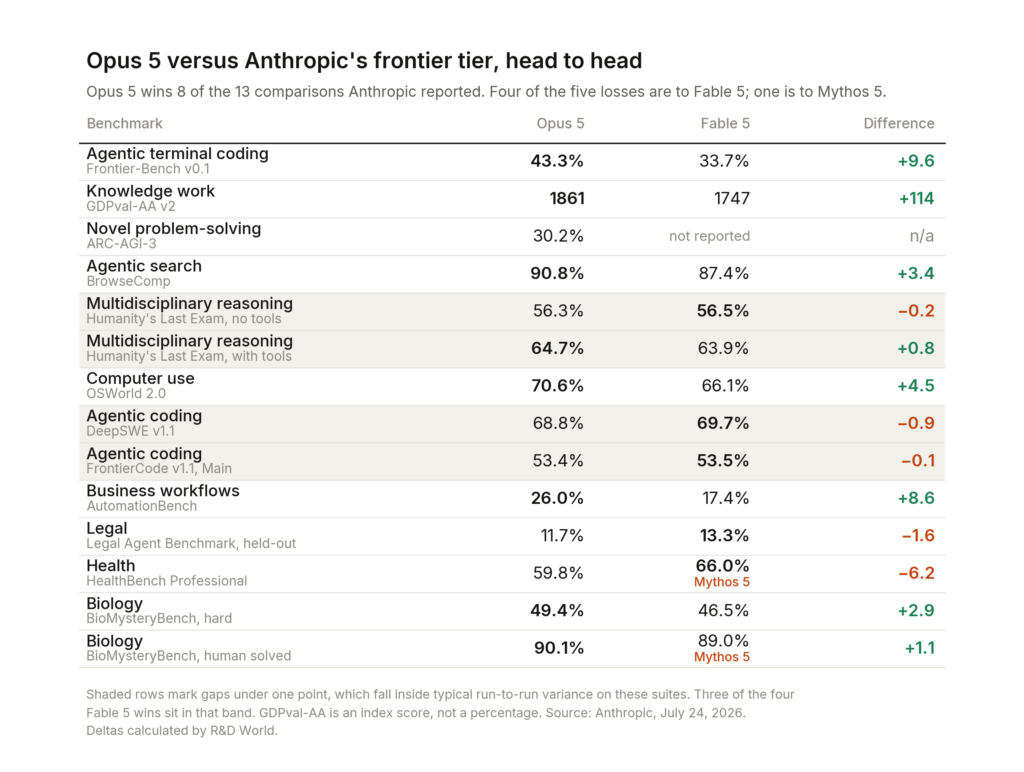
Claude Opus 5 outscores Fable 5 on 8 of 13 benchmarks at half the token price

By Brian Buntz | July 24, 2026

Anthropic’s Claude Fable 5 is arguably the most influential LLM to launch in recent memory, marking the biggest leap in capabilities since Opus 4.5 debuted in November 2025. The publicly available counterpart to Claude Mythos Preview, which had a sizable jump in capabilities, most notably, in cybersecurity, Claude Fable featured stronger agentic performance and markedly better performance in coding tasks.

But Fable had a difficult forty-five days. After initially launching on June 9, it went dark internationally three days later under Commerce Department export controls. The model returned July 1, and by July 22 was the subject of a White House accusation that a Chinese lab had covertly distilled it. Not everyone says it is that simple. Braden Hancock of the Laude Institute, for instance, told TechCrunch that a model this strong could not come from straight distillation with Fable only public since July 1.

In any case, on Friday, Anthropic released a model that beats Fable on most of the company’s own benchmarks for half the price.

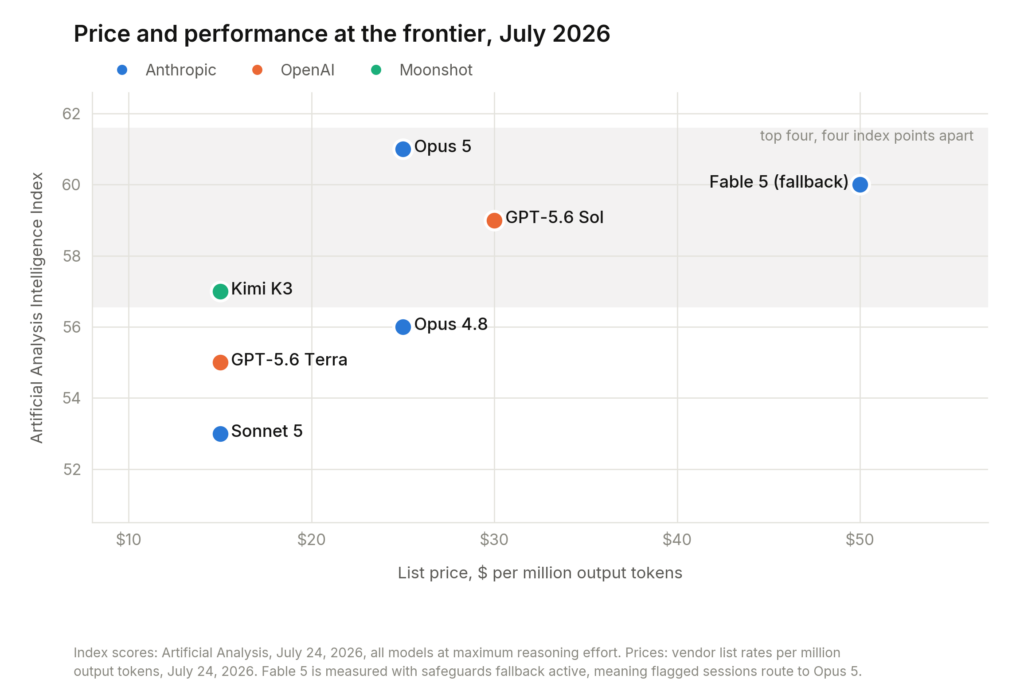
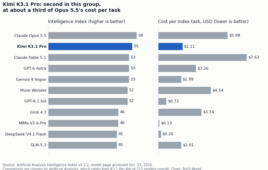
In terms of pricing, Opus 5 lands at $5 per million input tokens and $25 per million output tokens. That is identical to Opus 4.8 and half what Anthropic charges for Fable 5. GPT-5.6 Sol is in the same ballpark at $5 and $30. Kimi K3, the most expensive open-weight model (weights to drop on July 27), undercuts both at $3 and $15, with cache hits billed at $0.30.

In a private head-to-head testing on a narrow language-engineering task, GPT-5.6 Sol at medium effort matched or beat Claude Opus 5 at every effort tier we tested. (Caveat: This test didn’t test Opus 5’s top two effort tiers: xhigh and max.) The task involved mapping audio files to corresponding text. Sol mapped the recordings to the correct printed section 100% of the time on both units. Opus 5 managed 100% on one and 88.4% on the other, where a single misplaced section boundary swept 14 consecutive recordings into the neighboring drill. Transcription accuracy favored Sol as well, 96.1% to 90.7% on the harder unit. The prompt was authored and iterated against GPT-5.6, then replayed to Opus 5 verbatim.

Opus 5 bills less per output token than Sol under batch pricing, $12.50 per million against $15, yet cost 21% more per unit at its cheapest setting and 80% more at high effort, because it generated 1.5 to 2.5 times as many output tokens. Adaptive thinking is on by default in Opus 5. Per-token price turned out to be a poor predictor of per-task cost.

Anthropic’s own migration guide in the Opus 5 system card warns that max effort can produce diminishing returns and overthinking on simpler tasks. On FrontierCode, scores fell above high effort because the model made unnecessary refactors and other out-of-scope edits. A brief instruction to stay within the requested scope recovered performance on most tasks. External pilot users likewise reported cases where higher effort made the model perform worse.

More thinking sometimes also means more opportunities for hallucinations. On the closed-book AA-Omniscience benchmark, Opus 5 was 11% more accurate than Opus 4.8, while its hallucination rate was 6% higher.

Tell Us What You Think! Cancel reply

You must be logged in to post a comment.

Related Articles Read More >

As U.S. power demand surges, Brookhaven taps AWS in aim to drive 20-100x faster power grid decision-making with GridSearch AI
Purple Glowing Spiral Fractal Background Image, Illustration - Vortex repeating spiral patterns, Symmetrical repeating geometric patterns. Abstract design, black background
Recursion says its Norstella-backed real-time simulation can expand trial eligibility by up to 40%
How EcoBOT’s automated plant lab knows where it’s guessing 
China’s Kimi K3 comes close to Fable benchmarks at one-third the token price
rd newsletter
EXPAND YOUR KNOWLEDGE AND STAY CONNECTED
Get the latest info on technologies, trends, and strategies in Research & Development.

R&D World Digital Issues

Fall 2025 issue

Browse the most current issue of R&D World and back issues in an easy to use high quality format. Clip, share and download with the leading R&D magazine today.

R&D 100 Awards
Research & Development World
  • Subscribe to R&D World Magazine
  • Sign up for R&D World’s newsletter
  • Contact Us
  • About Us
  • Drug Discovery & Development
  • Pharmaceutical Processing
  • Global Funding Forecast

Copyright © 2026 Arrowfly LLC. All Rights Reserved. The material on this site may not be reproduced, distributed, transmitted, cached or otherwise used, except with the prior written permission of Arrowfly
Privacy Policy | Advertising | About Us

Search R&D World

  • R&D World Home
  • Topics
    • Aerospace
    • Automotive
    • Biotech
    • Careers
    • Chemistry
    • Environment
    • Energy
    • Life Science
    • Material Science
    • R&D Management
    • Physics
  • Technology
    • 3D Printing
    • A.I./Robotics
    • Software
    • Battery Technology
    • Controlled Environments
      • Cleanrooms
      • Graphene
      • Lasers
      • Regulations/Standards
      • Sensors
    • Imaging
    • Nanotechnology
    • Scientific Computing
      • Big Data
      • HPC/Supercomputing
      • Informatics
      • Security
    • Semiconductors
  • R&D Market Pulse
  • R&D 100
    • 2025 R&D 100 Award Winners
    • 2025 Professional Award Winners
    • 2025 Special Recognition Winners
    • R&D 100 Awards Event
    • R&D 100 Submissions
    • Winner Archive
  • Resources
    • Research Reports
    • Digital Issues
    • Educational Assets
    • Subscribe
    • Video
    • Webinars
    • PharmSci360
    • Content submission guidelines for R&D World
  • Global Funding Forecast
  • Top Labs
  • Advertise
  • SUBSCRIBE